A method to calibrate the geometries of hydrophone arrays using the sound emitted from nearby ships, is presented. The calibration problem is formulated as a simultaneous localization and mapping (SLAM) estimation problem, where the locations and geometries of the arrays are viewed as unknown map states and the position of the source is viewed as the unknown dynamic state. Two models for the geometry of the arrays are presented. The first model does not impose any constraint on array geometry, whereas the second model takes into account the known maximum distance between the hydrophones. The performance of the proposed calibration method is evaluated using data from two PASS-2447 Omnitech Electronics Inc. 56-element hydrophone arrays. Tests with three data sets show that array geometries in the north-east plane can be consistently estimated. Only the second model provides consistent results in the depth direction. The calibration of the array geometries is shown to increase source localization accuracy significantly.
In this paper, we propose a new approach for target tracking using bearings-only estimates. Our focus is on the case where the estimates are produced by groups of individual sensors, e.g., sensor buoys or nodes. We estimate the position and velocity of the target by modelling the bearing estimates as a mixture of a uniform distribution and a von Mises distribution. To solve the tracking problem, we use a) an algorithm based on a centralized particle filter (CPF) meaning that each bearing measurement gets communicated to a central computer at which the tracking is performed; b) each group of sensors performs its own bearing tracking with a local particle filter and communicates that result to a central computer at which an extended Kalman filter (EKF) is used to track the target's position and velocity. This method will be refereed to as the Local Partical Filter with a centralized extended Kalman Filter (LPF-EKF). The methods are evaluated using simulated data and we note that both methods are able to track the target even in the case of a high number of uniformly distributed bearings. Moreover, CPF gives a slightly higher probability of being able to track the target as compared to LPF-EKF.
Nuclear Quadrupole Resonance (NQR) is a method of detection and unique characterization of compounds containing quadrupolar nuclei, commonly found in many forms of explosives, narcotics, and medicines. Typically, multi-pulse sequences are used to acquire the NQR signal, allowing the resulting signal to be well modeled as a sum of exponentially damped sinusoidal echoes. In this paper, we improve upon the earlier used NQR signal model, introducing an observed amplitude modulation of the spectral lines as a function of the sample temperature. This dependency noticeably affects the achievable identification performance in the typical case when the substance temperature is not perfectly known. We further extend the recently presented Cramér-Rao lower bound to the more detailed model, allowing one to determine suitable experimental conditions to optimize the detection and identifiability of the resulting signal. The theoretical results are carefully motivated using extensive NQR measurements.
The examination of blood flow inside the body may yield important information about vascular anomalies, such as possible indications of, for example, stenosis. Current medical ultrasound systems suffer from only allowing for measuring the blood flow velocity along the direction of irradiation, posing natural difficulties due to the complex behaviour of blood flow, and due to the natural orientation of most blood vessels. Recently, a transversal modulation scheme was introduced to induce also an oscillation along the transversal direction, thereby allowing for the measurement of also the transversal blood flow. In this paper, we propose a novel data-adaptive blood flow estimator exploiting this modulation scheme. Using realistic Field II simulations, the proposed estimator is shown to achieve a notable performance improvement as compared to current state-of-the-art techniques.
Nuclear quadrupole resonance (NQR) is a solid-state radio frequency spectroscopic technique that can be used to detect the presence of quadrupolar nuclei, that are prevalent in many narcotics, drugs, and explosive materials. Similar to other modern spectroscopic techniques, such as nuclear magnetic resonance, and Raman spectroscopy, NQR also relies heavily on statistical signal processing systems for decision making and information extraction. This chapter provides an overview of the current state-of-the-art algorithms for detection, estimation, and classification of NQR signals. More specifically, the problem of NQR-based detection of illicit materials is considered in detail. Several single- and multi-sensor algorithms are reviewed that possess many features of practical importance, including (a) robustness to uncertainties in the assumed spectral amplitudes, (b) exploitation of the polymorphous nature of relevant compounds to improve detection, (c) ability to quantify mixtures, and (d) efficient estimation and cancellation of background noise and radio frequency interference.
PurposeThe balanced steady‐state free precession (bSSFP) pulse sequence has shown to be of great interest due to its high signal‐to‐noise ratio efficiency. However, bSSFP images often suffer from banding artifacts due to off‐resonance effects, which we aim to minimize in this article.MethodsWe present a general and fast two‐step algorithm for 1) estimating the unknowns in the bSSFP signal model from multiple phase‐cycled acquisitions, and 2) reconstructing band‐free images. The first step, linearization for off‐resonance estimation (LORE), solves the nonlinear problem approximately by a robust linear approach. The second step applies a Gauss‐Newton algorithm, initialized by LORE, to minimize the nonlinear least squares criterion. We name the full algorithm LORE‐GN.ResultsWe derive the Cramér‐Rao bound, a theoretical lower bound of the variance for any unbiased estimator, and show that LORE‐GN is statistically efficient. Furthermore, we show that simultaneous estimation of T1 and T2 from phase‐cycled bSSFP is difficult, since the Cramér‐Rao bound is high at common signal‐to‐noise ratio. Using simulated, phantom, and in vivo data, we illustrate the band‐reduction capabilities of LORE‐GN compared to other techniques, such as sum‐of‐squares.ConclusionUsing LORE‐GN we can successfully minimize banding artifacts in bSSFP. Magn Reson Med 72:880–892, 2014. © 2013 Wiley Periodicals, Inc.
High-resolution spectral Doppler is an important and powerful noninvasive tool for estimation of velocities in blood vessels using medical ultrasound scanners. Such estimates are typically formed using an averaged periodogram technique, resulting in well-known limitations in the resulting spectral resolution. Recently, we have proposed techniques to instead form high-resolution data-adaptive estimates exploiting measurements along both depth and emission. The resulting estimates gives noticeably superior velocity estimates as compared to the standard technique, but suffers from a high computational complexity, making it interesting to formulate computationally efficient implementations of the estimators. In this work, by exploiting the rich structure of the iterative adaptive approach (IAA) based estimator, we examine how these estimates can be efficiently implemented in a time-recursive manner using both exact and approximate formulations of the method. The resulting algorithms are shown to reduce the necessary computational load with several orders of magnitude without noticeable loss of performance.
Spectral Doppler ultrasound imaging typically consists of a spectrogram, showing the velocity distribution of the blood, and a brightness (B-) mode image allowing the operator to navigate. It is desirable to have both high spectral and velocity resolution, so that details in the blood flow can be traced, as well as a high B-mode frame rate to allow for tracking of movements and to adjust the position of the transducer. The blood flow signal is often sampled 1) using alternating transmissions for blood flow estimation and for B-mode imaging, or, 2) by acquiring a full Doppler spectrum and then parts of the B-mode image. The former has the disadvantage that it halves the sampling rate, making it likely that aliasing will occur when imaging fast moving blood or deeply positioned vessels; the latter that gaps appears in the spectrogram, and that if the frame rate of the B-mode images is slow, it will be difficult to track movements. Adaptive methods have been implemented to circumvent such problems, but even so, to get an acceptable frame rate of the B-mode images, the number of transmissions for Doppler estimation will be limited, restricting the spectral resolution. Alternatively, one may use an irregularly spaced emission pattern, but existing work on the topic is limited and generally suffers from poor resolution and spurious velocity components resulting from the irregular sampling pattern. In this paper, we examine the BIAA algorithm, showing that this approach allows for an accurate velocity estimate even from irregularly sampled measurements. Using an irregular emission pattern, with half the emissions used to form the B-mode image, the remaining emissions are found to yield accurate velocity estimates without reducing the maximally measurable velocity and without the spurious velocity components. Moreover, we show that the approach will allow for the same maximal velocity without aliasing as if all emissions would have been used for the velocity estimation.
The pulse spin-locking sequence is a common excitation sequence for magnetic resonance and nuclear quadrupole resonance signals, with the resulting measurement data being well modeled as a train of exponentially damped sinusoidals. In this paper, we derive an ESPRIT-based estimator for such signals, together with the corresponding Cramér-Rao lower bound. The proposed estimator is computationally efficient and only requires prior knowledge of the number of spectral lines, which is in general available in the considered applications. Numerical simulations indicate that the proposed method is close to statistically efficient, and that it offers an attractive approach for initialization of existing statistically efficient gradient or search based techniques.
In magnetic resonance imaging (MRI), the balanced steady-state free precession (bSSFP) pulse sequence has shown to be of great interest, due to its relatively high signal-to-noise ratio in a short scan time. However, images acquired with this pulse sequence suffer from banding artifacts due to off-resonance effects. These artifacts typically appear as black bands covering parts of the image and they severely degrade the image quality. In this paper, we present a fast two-step algorithm for estimating the unknowns in the signal model and removing the banding artifacts. The first step consists of rewriting the model in such a way that it becomes linear in the unknowns (this step is named Linearization for Off-Resonance Estimation, or LORE). In the second step, we use a Gauss-Newton iterative optimization with the parameters obtained by LORE as initial guesses. We name the full algorithm LORE-GN. Using both simulated and in vivo data, we show the performance gain associated with using LOREGN as compared to general methods commonly employed in similar cases.
Spectroscopic techniques allow for studies of materials and organisms on the atomic and molecular level. Examples of such techniques are nuclear magnetic resonance (NMR) spectroscopy—one of the pri ...
This paper proposes a novel iterative data-adaptive spectral estimation technique for blood velocity estimation using medical ultrasound scanners. The technique makes no assumption on the sampling pattern of the slow-time or the fast-time samples, allowing for duplex mode transmissions where B-mode images are interleaved with the Doppler emissions. Furthermore, the technique is shown, using both simplified and more realistic Field II simulations, to outperform current state-of-the-art techniques, allowing for accurate estimation of the blood velocity spectrum using only 30% of the transmissions, thereby allowing for the examination of two separate vessel regions while retaining an adequate updating rate of the B-mode images. In addition, the proposed method also allows for more flexible transmission patterns, as well as exhibits fewer spectral artifacts as compared to earlier techniques.
In this article, a robust methodology for in vivo T 1 mapping is presented. The approach combines a gold standard scanning procedure with a novel fitting procedure. Fitting complex data to a five‐parameter model ensures accuracy and precision of the T 1 estimation. A reduced‐dimension nonlinear least squares method is proposed. This method turns the complicated multi‐parameter minimization into a straightforward one‐dimensional search. As the range of possible T 1 values is known, a global grid search can be used, ensuring that a global optimal solution is found. When only magnitude data are available, the algorithm is adapted to concurrently restore polarity. The performance of the new algorithm is demonstrated in simulations and phantom experiments. The new algorithm is as accurate and precise as the conventionally used Levenberg‐Marquardt algorithm but much faster. This gain in speed makes the use of the five‐parameter model viable. In addition, the new algorithm does not require initialization of the search parameters. Finally, the methodology is applied in vivo to conventional brain imaging and to skin imaging. T 1 values are estimated for white matter and gray matter at 1.5 T and for dermis, hypodermis, and muscle at 1.5 T, 3 T, and 7 T. Magn Reson Med, 2010. © 2010 Wiley‐Liss, Inc.
Nuclear quadrupole resonance (NQR) is a radio frequency spectroscopic technique that can be used to detect solid-state compounds containing quadrupolar nuclei, a requirement fulfilled by most high explosives (and narcotics). In this paper, we present an overview of recent research in the detection of explosives using this technique. We also present mathematical models for the data for different acquisition techniques and discuss different state of the art detection algorithms. Finally, we evaluate various algorithms on measured and simulated NQR data.
In this work, we present a novel method for non-invasive identification of liquids, for instance to allow for the detection of liquid explosives at airports or border controls. The approach is based on a nuclear magnetic resonance technique with an inhomogeneous magnetic field, forming estimates of the liquid's spin-spin relaxation time, T2, and diffusion constant, D, thereby allowing for a unique classification of the liquid. The proposed detectors are evaluated using both simulated and measured data sets.
The problem of estimating a spectral representation of damped sinusoidal signals from a gapped data set is of considerable interest in several applications. In this paper, we propose a new iterative adaptive approach, named dIAA, that provides such an estimate also in the case of irregularly sampled data, a common scenario in, for instance, spectroscopical data measurements. Numerical examples illustrate the benefits of the proposed estimator as compared to typically used methods.
L'invention concerne un procede d'essai d'un echantillon, qui comprend les etapes consistant a: appliquer une excitation sur l'echantillon; detecter un signal de reponse provenant de l'echantillon; traiter une premiere partie et une seconde partie du signal de reponse; et determiner, a partir de la seconde partie du signal de reponse, des donnees servant a renforcer la premiere partie du signal de reponse.
 Andreas Jakobsson合作论文数Centre for Mathematical Sciences, Lund University;VoiceDiagnostic Sweden AB;Medotemic AB14
 Petre Stoica合作论文数Information Technology Department, Division of Systems and Control, Uppsala University13
 Barral Joëlle K合作论文数Department of Electrical Engineering, Stanford University8
 Dwight Nishimura合作论文数Department of Electrical Engineering, School of Engineering, Stanford University7Björk Marcus合作论文数Department of Information Technology, Uppsala University5
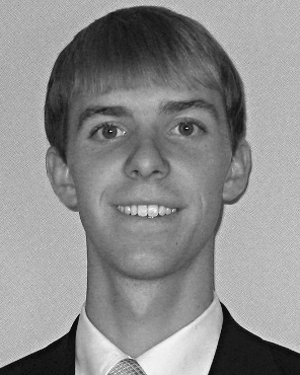 Ingle R Reeve合作论文数Magnetic Resonance Systems Research Laboratory, Stanford University4
 Nikola Stikov合作论文数Montreal Neurological Institute, McGill University3Samuel D Somasundaram合作论文数2
 Kaspar Althoefer合作论文数School of Electronic Engineering and Computer Science, Queen Mary University of London2
 Jian Li (李荐)合作论文数Spectral Analysis Laboratory, Department of Electrical & Computer Engineering, University of Florida2
 Naveed R. Butt合作论文数Department of Electrical Engineering, Karlstad University2
 Jørgen Arendt Jensen合作论文数Center for Fast Ultrasound Imaging, Department of Health Technology, Technical University of Denmark2
 Jun Ling合作论文数Careray Digital Medical Technology Co., Ltd.2
 Prabhu Babu合作论文数Centre for Applied Research in Electronics, Indian Institute of Technology, Delhi2J. A. S. Smith合作论文数1peter stoica合作论文数1Maryam Etezadi-Amoli合作论文数1John A S Smith合作论文数1
 Magnus Lundberg Nordenvaad合作论文数1
 Barras Jamie合作论文数1Pirnia, E.合作论文数Dept. of Math. Stat., Lund Univ.;c;Dept. of Math. Stat., Lund Univ.1Kyriakidou, G.合作论文数1
 Niclas Sandgren合作论文数1
 Isaac Skog合作论文数ACCESS Linnaeus Center, Royal Institute of Technology1
 Iain Poplett合作论文数1
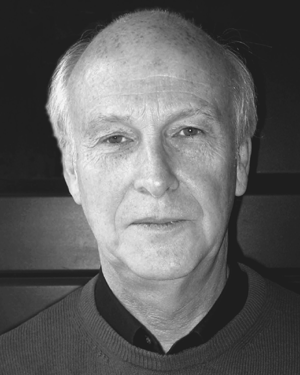 Michael D. Rowe合作论文数1
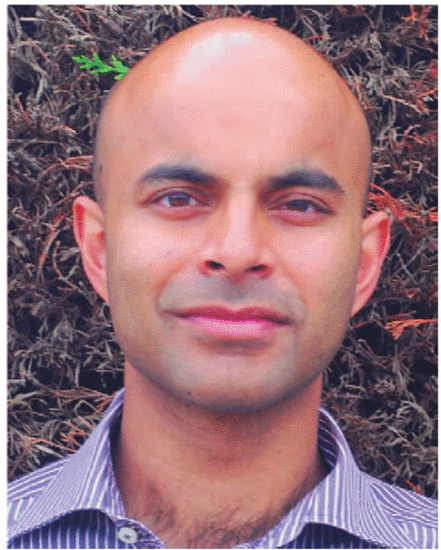 Samuel Dilshan Somasundaram合作论文数1
 Magnus Jansson合作论文数Division of Information Science and Engineering, Department of Intelligent Systems, School of Electrical Engineering and Computer Science, KTH Royal Institute of Technology1
 Petter Wirfält合作论文数1A Gregorovic合作论文数1
 G.-O. Glentis合作论文数1
 Fredrik Gran合作论文数1




