Lyapunov stability-based neural network (NN) controllers have been widely applied to nonlinear systems, yet challenges such as high computational cost and reliance on signal estimators persist. This paper introduces a novel estimator-free neuro-adaptive control approach using a Lyapunov Stable Machine Learning Recurrent Neural Network (LSMRN). The key contributions are twofold: reducing computational complexity by replacing the traditional neural network estimator (NNE) and controller (NNC) with a single recurrent neural network, and significantly improving tracking performance. The LSMRN relies solely on input/output data, eliminating the need for explicit system models and control signal estimators in the closed loop. Lyapunov stability analysis ensures closed-loop stability and error convergence. Simulations on the Lorenz Chaotic and 3D Chaotic Satellite systems demonstrate the controller’s superior tracking accuracy with reduced control effort, highlighting its robustness and efficiency compared to conventional methods.
This paper proposes an iterative algorithm to reconstruct missing samples from non-stationary signals. The proposed algorithm is based on the well-known amplitude-modulation frequency-modulation model for non-stationary signals. The method initially estimates the instantaneous frequencies of the observed multi-component signal. The estimated IFs are then used to de-chirp the corresponding components to convert them into stationary components. Following this, a relatively recent nonparametric iterative missing data recovery procedure is employed to reconstruct the time-varying amplitudes of the signal components. The complete signal is constructed by adding all the estimated components, which is used as an input signal to re-estimate the IFs and time-varying amplitudes in an iterative procedure. Studies based on simulated and real data sets show that the proposed approach provides better estimates as compared to the state of the art.
Estimation of time-varying fundamental frequency is an important problem in many real-life applications, e.g. analysis of electroencephalogram (EEG) seizure signals. Instantaneous fundamental frequency (IF) of such signals is usually estimated by first windowing a signal and then applying methods such as non-linear least square. However, this approach is based on an assumption that a given signal is stationary within an observation time and that the model order (number of harmonics) is known. We propose a novel instantaneous fundamental frequency estimator that uses fractional Fourier windows to stationarize a signal within an observation window followed by MAP criteria for estimating model order and non-linear least squares method for fundamental frequency estimation. Application to simulated and real data indicates that the use of fractional Fourier windows improves the estimation accuracy as compared to both commonly used fundamental frequency estimators and state of art instantaneous frequency estimator. The proposed method provides good IF estimates without requiring any prior knowledge of the model order and is more computationally efficient compared to recent semi-parametric methods. For the case of quadratic chirp, we also derive a parametric CRLB to show that the proposed approach, while being biased, achieves better mean-squared error (MSE) than any unbiased parametric estimator.
We consider a downlink resource allocation problem that maximizes the downlink rate, where several users can be allocated to the same resource by employing a larger modulation alphabet. Moreover, each user is constrained to receive across one resource only. The latter constraint is especially suitable for computational and power constrained users. These requirements give rise to a different resource allocation problem compared to previous studies. The throughput of a user is not measured by conventional logarithm formulae for throughput (which implicitly assume Gaussian alphabets). Instead, we let UEs calculate effective signal- to-noise-ratios for each resource and modulation alphabet, which corresponds to the achievable data rate on a resource with the specific modulation. These values are reported to the transmitter, which then uses them to find the optimal allocation. The underlying optimization problem is discrete, and it is made linear through our formulation of the problem. We solve the problem exactly, and formulate a simple heuristic allocation procedure that is close to the optimal allocation in simulated scenarios.
We study the case where a narrowband (NB) signal, intended possibly for an Internet of Things (IoT) application, is concurrently transmitted with a legacy wideband (WB) Wi-Fi signal by means of overlay - meaning that the two signals are not orthogonal to each other. Concurrent operation is particularly seen as a means to achieve high spectral efficiency in the future IoT society. Although, under certain conditions, concurrent transmission may be possible without any modifications to the legacy Wi-Fi transceiver, we show that minimal adjustments to the Wi-Fi receiver can in fact lead to significant gains for the concurrent WB transmissions. Furthermore, if also the WB transmitter is aware of the scheduled overlay, small modifications to it can help improve the performance of the NB transmissions. Both these aspects are studied here in detail under various assumptions for the WB and NB transceivers.
Recent work has highlighted the potential benefits of exploiting ellipsoidal uncertainty-set-based robust Capon beamformer (RCB) techniques in passive sonar. Regrettably, the computational complexity required to form RCB weights is cubic in the number of adaptive degrees of freedom, which is often prohibitive in practice. For this reason, several low-complexity techniques for computing RCB weights, or equivalent worst case robust adaptive beamformer weights, have recently been developed. These techniques, whose complexities are only quadratic in the number of adaptive degrees of freedom, use gradient-based, reduced-dimension Krylov-subspace or Kalman-filtering methods. In this work, we review these techniques for passive sonar, analyzing their complexities and evaluating them initially on simulated data. The best performing methods are then evaluated on two in-water recorded passive sonar data sets. One set, containing a strong controlled acoustic source, demonstrates the ability of the algorithms to protect against signal cancellation when pointing at the source, and their ability to reject the source when pointing away from it. The other data set, recorded during a period when the boat was accelerating, demonstrates the ability of the algorithms to operate in the presence of speed-induced noises.
Using antenna arrays for direction of arrival (DoA) estimation and source localization is a well-researched topic. In this paper, we analyze virtual antenna arrays for DoA estimation where the antenna array geometry is acquired using data from a low-cost inertial measurement unit (IMU). Performance evaluation of an unaided inertial navigation system with respect to individual IMU sensor noise parameters is provided using a state space based extended Kalman filter. Secondly, using Monte Carlo simulations, DoA estimation performance of random 3-D antenna arrays is evaluated by computing Cramér-Rao lower bound values for a single plane wave source located in the far field of the array. Results in the paper suggest that larger antenna arrays can provide significant gain in DoA estimation accuracy, but, noise in the rate gyroscope measurements proves to be a limiting factor when making virtual antenna arrays for DoA estimation and source localization using single antenna devices.
A single antenna based virtual antenna array at the receiver can be used to find direction of different incoming radio signals impinging at the receiver. In this paper, we investigate the performance of random 3D virtual antenna arrays for DoA estimation. We have computed a Cramér-Rao Lower Bound (CRLB) for DoA estimation if the true antenna positions are not known, but these are estimated with an uncertainty. Position displacement is estimated with an extended Kalman filter (EKF) by using simulated data samples of acceleration and rotation rate which are corrupted by stochastic errors, such as, white Gaussian noise and bias drift. Furthermore, the effect of position estimation error on the DoA estimation performance is evaluated using the CRLB. The results show that the number of useful elements in the antenna array is limited, because the standard deviation of the position estimation error grows over time.
We develop a general robust fundamental frequency estimator that allows for non-parametric inharmonicities in the observed signal. To this end, we incorporate the recently developed multi-dimensional covariance fitting approach by allowing the Fourier vector corresponding to each perturbed harmonic to lie within a small uncertainty hypersphere centered around its strictly harmonic counterpart. Within these hyperspheres, we find the best perturbed vectors fitting the covariance of the observed data. The proposed approach provides the estimate of the fundamental frequency in two steps, and, unlike other recentmethods, involves only a single 1-D search over a range of candidate fundamental frequencies. The proposed algorithm is numerically shown to outperform the current competitors under a variety of practical conditions, including various degrees of inharmonicity and different levels of noise.
In this work, we introduce a computationally efficient Kalman-filter based implementation of the robust widely linear (WL) minimum variance distortionless response (MVDR) beamformer. The beamformer is able to achieve the same performance as the recently derived robust WL MVDR beamformer, but avoids the computationally burdensome solution based on a second order cone programming (SOCP), and exploiting the recent Kalman-based regular robust MVDR beamformer, extends this to also allow for non-circular sources and interferences. Numerical simulations illustrate the achieved performance.
This work presents a relaxation-based multi-pitch estimation technique for harmonic signals suffering from inharmonicity. Different from most earlier works, the proposed method does not require a priori knowledge of the number of sources present, nor of their respective number of harmonics, or the inharmonicity structure of the expected deviations. Using a recent group-sparse multi-pitch estimation method to form initial coarse pitch estimates, the number of sources and their harmonics are estimated using a BIC-based formulation, whereafter an iterative, relaxation-based, technique is formed to separately estimate the inharmonicity of each source using a recently proposed robust single-pitch estimation technique. The proposed algorithm is evaluated and compared to other existing methods using both simulated and real audio signals, clearly illustrating the improved performance.
Nuclear quadrupole resonance (NQR) is a solid-state radio frequency spectroscopic technique that can be used to detect the presence of quadrupolar nuclei, that are prevalent in many narcotics, drugs, and explosive materials. Similar to other modern spectroscopic techniques, such as nuclear magnetic resonance, and Raman spectroscopy, NQR also relies heavily on statistical signal processing systems for decision making and information extraction. This chapter provides an overview of the current state-of-the-art algorithms for detection, estimation, and classification of NQR signals. More specifically, the problem of NQR-based detection of illicit materials is considered in detail. Several single- and multi-sensor algorithms are reviewed that possess many features of practical importance, including (a) robustness to uncertainties in the assumed spectral amplitudes, (b) exploitation of the polymorphous nature of relevant compounds to improve detection, (c) ability to quantify mixtures, and (d) efficient estimation and cancellation of background noise and radio frequency interference.
The emerging concept of cognitive radios offers a way to use the limited radio-spectrum more efficiently by allowing networks and nodes to adaptively vary their parameters. An important element in the successful implementation of cognitive radios is the ability to estimate the varying state of spectrum usage in a wide-band channel quickly and at minimum cost. In this work, we utilize a powerful non-convex optimization approach to provide sparse and unbiased estimates of the spectrum from limited non-uniformly sampled data. Simulation results for a wide-band communication scenario show that the noise floor is significantly reduced compared to other commonly used approaches. This should help in reducing the miss-identification of occupied and vacant sub-bands of the spectrum, being a key requirement in spectrum sensing cognitive radios.
Raman spectroscopy is a laser-based vibrational technique that can provide spectral signatures unique to a multitude of compounds. The technique is gaining widespread interest as a method for detecting hidden explosives due to its sensitivity and ease of use. In this letter, we present a computationally efficient classification scheme for accurate standoff identification of several common explosives using visible-range Raman spectroscopy. Using real measurements, we evaluate and modify a recent correlation-based approach to classify Raman spectra from various harmful and commonplace substances. The results show that the proposed approach can, at a distance of 30 m, or more, successfully classify measured Raman spectra from several explosive substances, including nitromethane, trinitrotoluene, dinitrotoluene, hydrogen peroxide, triacetone triperoxide, and ammonium nitrate.
Modern drama generally depicts a moral and spiritual wasteland and the resultant crises in the modern society. O’Neill’s modern art is a clear instance of the gravity of the impending spiritual and ethical crises. However, little has been written to explain what the specific nature of this crisis is? Moreover, how does it emerge in his tragic art? How far it adheres or differs from the traditions of tragedy? The study takes into consideration these to explore various dimensions of ethical crises in O’Neill’s modern theatre. It concludes that the predominance of ethical crises in diverse fashions is an obstacle to block rise in anti-Americanism and dissolve emerging conflict between Pakistani civil society and American desire for greater association with the civil society at micro level in Pakistan.
 Andreas Jakobsson合作论文数Centre for Mathematical Sciences, Lund University;VoiceDiagnostic Sweden AB;Medotemic AB26
 Muhammad Shafiq合作论文数7
 Samuel D Somasundaram合作论文数6
 Mikael Nilsson合作论文数Lund Univ, Ctr Math Sci, Lund, Sweden3
 Anna Pettersson合作论文数3
 Sara Wallin合作论文数3Rocco Di Taranto合作论文数Department of Electronic Systems, Aalborg University3Markus Nordberg合作论文数2Anders Mannesson合作论文数2Muhammad Atif Yaqoob合作论文数2
 Kaspar Althoefer合作论文数School of Electronic Engineering and Computer Science, Queen Mary University of London2
 Nabeel Ali Khan合作论文数MAJU, Muhammad Ali Jinnah University2
 Lahouari Cheded合作论文数Systems Engineering Department, King Fahd University of Petroleum and Minerals2
 Henric Östmark合作论文数Swedish Defence Research Agency2
 Erik Gudmundson合作论文数KTH - Royal Institute of Technology, Lund University2
 Leif R. Wilhelmsson合作论文数2
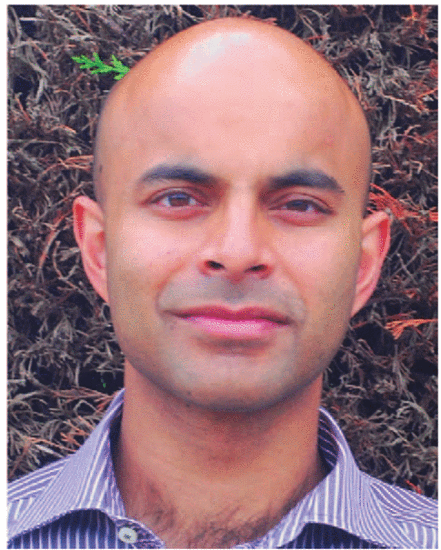 Samuel Dilshan Somasundaram合作论文数2
 Stefan Ingi Adalbjornsson合作论文数2
 Fredrik Tufvesson合作论文数Department of Electrical and Information Technology, Lund University2Khan, T.合作论文数1Ansar Rehman合作论文数1fredrik akke合作论文数1les hart合作论文数1a ehlerding合作论文数1Nilsson, T.合作论文数1
 Ted Kronvall合作论文数1
 Dennis Sundman合作论文数School of Electrical Engineering and ACCESS Linnaeus Centre, KTH - Royal Institute of Technology1John A S Smith合作论文数King's College London1Ida Johansson合作论文数1
 Michael D. Rowe合作论文数1
 Muhammad Anjum Qureshi合作论文数Bilkent University1
 Magnus Mossberg合作论文数1
 Bo Bernhardsson合作论文数1
 Dzevdan Kapetanovic合作论文数1




