A WiMedia/MBOA compliant RF transceiver for ultra-wideband data communication in the 3-5-GHz band is presented. The transceiver includes receiver, transmitter and synthesizer is completely integrated in 0.13-mu m standard CMOS technology. The receiver uses a feedback-based low-noise amplifier (LNA) to obtain an RF gain of 4 to 37 dB and an overall measured noise figure of 3.6 to 4.1 dB over the 3-5-GHz band of interest. The transmitter supports an error vector magnitude (EVM) of -28 dB up to -4 dBm output power and meets the FCC and WiMedia mask specifications. The power consumption from a single supply voltage of 1.5 V is 237 mW for the receiver and 284 mW for the transmitter, both including the synthesizer.
A WiMedia/MBOA compliant RF transceiver for ultra-wideband data communication in the 3-5-GHz band is presented. The transceiver includes receiver, transmitter and synthesizer is completely integrated in 0.13- m standard CMOS technology. The receiver uses a feedback-based low-noise am- plifier (LNA) to obtain an RF gain of 4 to 37 dB and an overall measured noise figure of 3.6 to 4.1 dB over the 3-5-GHz band of interest. The transmitter supports an error vector magnitude (EVM) of 28 dB up to 4 dBm output power and meets the FCC and WiMedia mask specifications. The power consumption from a single supply voltage of 1.5 V is 237 mW for the receiver and 284 mW for the transmitter, both including the synthesizer.
This work describes the influence of light on the treatment of nitrobenzene (NB) in aqueous solutions. Three different experimental devices were used to perform a detailed study: a photoreactor with four low-pressure mercury lamps (λ=253.7nm), a tubular photoreactor with a polychromatic Xe lamp (290<λ<1200nm), and finally a solar reactor (sunlight). TOC analyses were performed in order to monitor and compare the extent of these processes, each of them being performed with one of the three different sources of light. The influence of Fe(II), Fe(III), H2O2, and light on the mineralization of NB in aqueous solutions was also studied. The successful use of sunlight as a source of energy and its effectiveness regarding Fenton processes as well as direct photolysis in the treatment of NB are presented.
 Koen Mertens合作论文数2
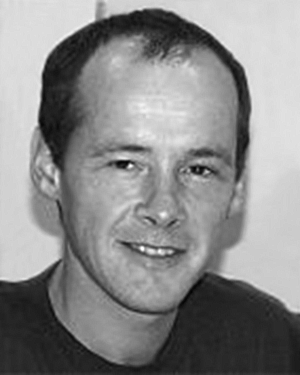 Reindl, Christian合作论文数2
 Marc Tiebout合作论文数Intel Austria GmbH2
 Zisan Zhang合作论文数2
 Christoph Sandner合作论文数Infineon Technologies Austria2
 Stefano Marsili合作论文数Dipartimento di Scienze della Terra, Università di Pisa2
 Andreas Wiesbauer合作论文数2
 Staffan Ek合作论文数2
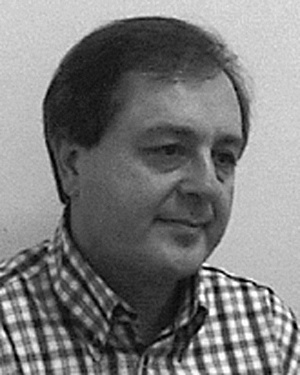 Hermann Paule合作论文数2
 Graham Leach合作论文数2Ian Winter合作论文数Department of Physiology, Development and Neuroscience, University of Cambridge2M Rodriguez合作论文数1v filimon合作论文数1Derksen, S.合作论文数1Draxelmayr, D.合作论文数1Jaime Gimenez合作论文数Facultad de Quimica, Universidad de Barcelona1
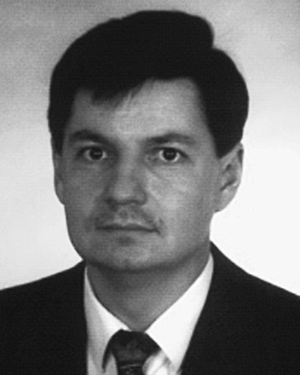 Voicu Filimon合作论文数1
 Dieter Draxelmayr合作论文数1Vitaliy I. Timokhin合作论文数1Denis Matveev合作论文数1
 Santiago Esplugas合作论文数University of Barcelona1
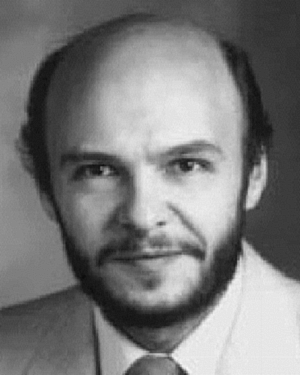 Manfred Punzenberger合作论文数1
 S. Contreras合作论文数Department d’Enginyeria Quimica i Metal·lurgia, Universitat de Barcelona1
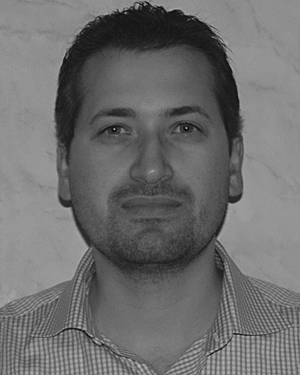 Raffaele Salerno合作论文数1




