Both dual-population and two-phase strategies are effective for utilizing infeasible solution information and significantly enhancing the ability of algorithms to solve constrained multiobjective optimization problems. However, most existing algorithms tend to underperform when facing problems with complex constraints. To address these issues, a constrained multiobjective evolutionary algorithm named DPTPEA, which combines dual-population and two-phase strategies, is proposed in this article. DPTPEA employs two collaborative populations [the exploitive population (expPop) and the tractive population (tracPop)] and divides the evolutionary process of the tracPop into two phases (Phase 1 and Phase 2). In Phase 1, the tracPop ignores constraints and drags the expPop across the infeasible region by sharing offspring information. In Phase 2, the tracPop adopts the epsilon-constrained method to converge toward the constrained Pareto front and to guide the expPop exploiting different feasible regions. Moreover, a dynamic cooperation strategy, a boundary point direction sampling strategy, and a dynamic environmental selection are proposed to improve the exploration ability of tracPop for solving complex problems. Comprehensive experiments on three popular test suites demonstrate that DPTPEA outperforms seven state-of-the-art algorithms on most test problems.
Background/Objectives: Since 2022, outbreaks of monkeypox have raised widespread concern and have been declared a public health emergency of international concern by the World Health Organization. There is an urgent need to develop a safe and effective vaccine against the monkeypox virus (MPXV). Recombinant protein vaccines play a significant role in the prevention of infectious diseases due to their high safety and efficacy. Methods: We used the A29, E8, M1, A35, and B6 proteins of MPXV as candidate antigens to generate a panel of multi-component MPXV vaccine candidates, which were administered subcutaneously to immunize mice. Results: The results showed that the vaccine candidates Mix-AEM, Mix-AEMA, Mix-AEMB, and Mix-AEMAB effectively elicited strong neutralizing antibody responses and demonstrated significant protection against vaccinia virus (VACV) infection in a murine model. The vaccine candidate Mix-AEM induced significantly higher levels of neutralizing antibodies, cellular immunity capacity, and virus clearance compared to the vaccine candidate Mix-AE (lacking M1). Single-component immunization showed that M1 induced higher levels of neutralizing antibodies than A29 and E8. These results indicated that M1 is a critical and essential antigen in the MPXV vaccine. The number of cells secreting IFN-γ was significantly increased in the Mix-AEMA and Mix-AEMAB groups compared to the A35-deficient vaccine candidates, demonstrating the important role of A35 in inducing IFN-γ secreting. In addition, the neutralizing antibodies induced by these multi-component vaccine candidates were maintained at high levels six months after the third immunization. Conclusions: In summary, this study lays the groundwork for combining antigens to develop multi-component subunit vaccines.
Optimising objectives and satisfying constraints present significant challenges in solving constrained multi-objective optimisation problems. In this paper, we propose an algorithm that incorporates the push-and-pull search framework and a two-ranking fitness function named ToR-PPS. The algorithm is divided into three stages: the push stage, transitional stage, and pull stage. In the push stage, the population is directed toward the unconstrained Pareto front, without consideration of constraints. In the transitional stage, a diversity expansion strategy is proposed to optimise the diversity of the population. In the pull stage, the fitness function with two rankings is utilised to pull the population toward the constrained Pareto front. Experiments are conducted to compare the algorithm with five state-of-the-art constrained multi-objective optimisation evolutionary algorithms on two benchmark suites. The results clearly illustrate the superiority and efficiency of the algorithm.
In this work, we study the complete convergence for arrays of rowwise m-widely acceptable random variables under sub-linear expectations. Some general results are established, which extend and improve some existing ones in sub-linear expectation space.
In recent years, considerable attention has been drawn to the development of algorithms for subgraph matching in distributed scenarios. Many distributed engines inherently support join-based methods, which can lead to numerous redundant intermediate results and redundant processing. In contrast, exploration-based algorithms, though effective at limiting such extraneous results, necessitate arbitrary access to data. This paper introduces an efficient subgraph matching algorithm that leverages dual-role paths, which is implemented within the framework of partial evaluation and unifies the strengths of binary join and pre-processing enumeration approaches. During the partial evaluation phase, we decompose queries into dual-role paths to enhance the parallel capabilities of the system. For assembly, dual-role paths are treated as vertices for preprocessing enumeration, which reduces invalid intermediate results and avoids a large communication cost. The proposed algorithm has been implemented in a state-of-the-art distributed graph database system, and the comprehensive testing indicates that our proposed algorithm has increased efficiency by up to three times based on the partial evaluation framework.
High resistance connection (HRC) is a typical permanent magnet motor fault, which is caused by material fatigue and overheating in the motor winding. If it is not handled in time, the fault will cause more serious faults and even fire, so its HRC fault diagnosis is of great significance. This paper presents an HRC fault diagnosis method based on monitoring the magnetic field signal, which uses sensor to collect the magnetic field signal, processes the test data characteristics through neural network, and then identifies the HRC fault category of permanent magnet motor. The simulation results show that it is very effective to detect the high resistance contact fault of PMSM by using the magnetic field signal and the accuracy reaches 98%.
To improve the power level of a diode rectifier, a multi-phase diode rectifier can be employed to increase the current rating. This brief proposes a passive current balancing method for a multi-phase diode rectifier in a series-series compensated wireless power transfer system. For an N-phase diode rectifier, the receiver-side compensating capacitance is split into N branches, forming a parallel resonant network with the newly added parallel resonant inductors. The circulating currents can be greatly suppressed by the parallel resonant network. The resonant inductors only withstand differential-mode currents, which are small. Thus, these inductors are small and low-cost. Experimental results reveal that the proposed method can well balance the phase currents of the three-phase diode rectifier.
Fine-Grained Visual Classification (FGVC) is known as a challenging task due to subtle differences among subordinate categories. Many current FGVC approaches focus on identifying and locating discriminative regions by using the attention mechanism, but neglect the presence of unnecessary features that hinder the understanding of object structure. These unnecessary features, including 1) ambiguous parts resulting from the visual similarity in object appearances and 2) noninformative parts (e.g., background noise), can have a significant adverse impact on classification results. In this paper, we propose the Semantic Feature Integration network (SFI-Net) to address the above difficulties. By eliminating unnecessary features and reconstructing the semantic relations among discriminative features, our SFI-Net has achieved satisfying performance. The network consists of two modules: 1) the multi-level feature filter (MFF) module is proposed to remove unnecessary features with different receptive field, and then concatenate the preserved features on pixel level for subsequent disposal; 2) the semantic information reconstitution (SIR) module is presented to further establish semantic relations among discriminative features obtained from the MFF module. These two modules are carefully designed to be light-weighted and can be trained end-to-end in a weakly-supervised way. Extensive experiments on four challenging fine-grained benchmarks demonstrate that our proposed SFI-Net achieves the state-of-the-arts performance. Especially, the classification accuracy of our model on CUB-200-2011 and Stanford Dogs reaches 92.64% and 93.03%, respectively.
A brushless dc (BLDC) motor with an outer rotor has great potential for emerging electric vehicle (EV) applications as an in-wheel hub motor. Interturn short circuit faults (ISCFs) are common electrical faults in these applications, and their fault diagnosis is of critical importance. This article proposes a signal analysis-based method to detect and quantitatively analyze the ISCF in a BLDC motor under a six-step commutation control strategy. The zero-sequence voltage component (ZSVC) and three-phase currents are simultaneously determined while the fundamental frequency amplitude of the ZSVC is developed as a fault indicator for diagnostic purposes. Thereafter, the faulty phase is identified, and the fault severity is estimated by jointly analyzing the ZSVC and faulted phase current. The proposed technique entails creating an analytical model, a simulation model, and experimental tests. Experimental results demonstrate that the proposed technique has excellent accuracy, quick response, and real-time fault diagnosis for BLDC motors. This technique will accelerate the use of BLDC-based hub motors in EVs and the widespread application of EVs to reduce the carbon emissions.
Data sources for medical image segmentation can be quite extensive, and models trained with data from a source domain may perform poorly on data from the target domain owing to domain shift issues. To overcome the impact of domain shift, we propose a novel meta-learning-based multi-source domain adaptation framework for medical image segmentation. Specifically, we designed a domain discriminator module to produce category prediction over the latent features, and an image reconstruction module to reconstruct the foreground and background of the target domain image separately. Furthermore, we constructed a large-scale multi-modal prostate dataset, which contained 495,902 magnetic resonance images of 419 cases, with prostate and lesion masks, as well as diagnostic descriptions for each patient. We evaluated our proposed method through extensive experiments using the proposed and the benchmark datasets. Experimental results show that our model achieves better segmentation and generalization performance compared to state-of-the-art approaches.(c) 2022 Elsevier Ltd. All rights reserved.
Duplicate address detection (DAD) is a necessary process before the host uses a new IP address to ensure its uniqueness. In the traditional DAD process, the detection target is public, thus making the detection process vulnerable to attacks, especially to denial-of-service attacks. A new detection method called Se-DAD is proposed in this paper to improve the security of DAD. In Se-DAD, the detected target is not disclosed to prevent the attacking node from forging a spoofing response. The hidden source MAC address also effectively prevents DoS attacks. Experiments show that Se-DAD is better than the previous detection methods considering address configuration failure rate, CPU, and memory overhead.
Mobile edge computing (MEC) is a promising paradigm to accommodate the increasingly prosperous delay-sensitive and computation-intensive applications in 5G systems. To achieve optimum computation performance in a dynamic MEC environment, mobile devices often need to make online decisions on whether to offload the computation tasks to nearby edge terminals under the uncertainty of future system information (e.g., random wireless channel gain and task arrivals). The design of an efficient online offloading algorithm is challenging. On one hand, the fast-varying edge environment requires frequently solving a hard combinatorial optimization problem where the integer offloading decision and continuous resource allocation variables are strongly coupled. On the other hand, the uncertainty of future system parameters makes it hard for the online decisions to satisfy long-term system constraints. To address these challenges, this article overviews the existing methods and introduces a novel framework that efficiently integrates model-based optimization and model-free learning techniques. We suggest some promising future research directions for online computation offloading control in MEC networks.
Singlet oxygen (1 O2 ) with electrical neutrality and long lifetime holds great promise in producing high-added-value chemicals via a selective oxidation reaction. However, photocatalytic 1 O2 generation via the charge-transfer mechanism still suffers from low efficiency due to the mismatched redox capacities and low concentration of photogenerated carriers in confined systems. Herein, by taking bismuth oxysilicate (Bi2 O2 SiO3 ) with alternating heterogeneous layered structure as a model, it is shown that iodine doping can facilitate the spatial redistributions of bands on alternated [Bi2 O2 ] and [SiO3 ] layers, which can promote the separation and transfer of photogenerated charge carriers. Meanwhile, the band positions of Bi2 O2 SiO3 are optimized to match the redox potential of 1 O2 generation. Benefiting from these features, iodine-doped Bi2 O2 SiO3 exhibits efficient 1 O2 generation with respect to its pristine counterpart, leading to promoted performance in the selective sulfide oxidation reaction. A new strategy is offered here for optimizing charge-transfer-mediated 1 O2 generation.
The regional distribution of antibiotic resistance genes has been caused by the use and preference of antibiotics. Not only environmental factors, but also the population movement associated with transportation development might have had a great impact, but yet less is known regarding this issue. This research study has investigated and reported that the high-speed railway train was a possible mobile reservoir of bacteria with antibiotic resistance, based on the occurrence, diversity, and abundance of antibiotic resistant bacteria (ARB), antibiotic resistance genes (ARGs), and mobile gene elements (MGEs) in untreated train wastewater. High-throughput 16S rRNA sequencing analyses have indicated that opportunistic pathogens like Pseudomonas and Enterococcuss were the predominant bacteria in all samples, especially in cultivable multi-antibiotic resistant bacteria. The further isolated Enterococcus faecalis and Enterococcus faecium exhibited multi-antibiotic resistance ability, potentially being an indicator for disinfection proficiency. Positive correlations amongst ARGs and MGEs were observed, such as between intI1 and tetW, tetA, blaTEM, among Tn916/154 and mefA/F, qnrS, implying a broad dissemination of multi-ARGs during transportation. The study findings suggested that the high-speed railway train wastewater encompassed highly abundant antibiotic-resistant pathogens, and the wastewater discharge without effective treatment may pose severe hazards to human health and ecosystem safety.
With the maturity of unmanned aerial vehicle (UAV) technology, UAV plays an important role in communication due to its high mobility. In this paper, we study a dual-UAVs assisted communication system to combat both UAV eavesdropper and multiple eavesdroppers on the ground. Our goal is to maximize the minimum average secrecy rate among all ground users by jointly optimizing the UAV basestation trajectory, auxiliary interference UAV trajectory, transmit power control and user scheduling. To tackle this problem, we propose an efficient algorithm based on successive convex approximation (SCA) and block coordinate descent (BCD) to make the problem approximate convex. Specifically, we consider a more complex scene with eavesdroppers on the ground and in the air, and we adapt the Rician fading channel model with small scale fading and large scale fading for air-to-ground communication, and the free space fading model for air-to-air communication. Compared with the single fading channel model, a more realistic situation is presented. The simulation results show joint design of dual-UAVs can significantly improve the average secrecy rate compared with the single UAV-Aided scheme, and when only ideal line of sight (LoS) fading is considered, the secrecy rate is slightly higher than our proposed scheme. However, if the trajectory of the UAVs considering only LoS is put into our proposed model, the result will be slightly lower than our proposed algorithm.
Carbon fiber reinforced polymer (CFRP) blades are often exposed to wild and even harsh environments. The durability of the blade can be greatly improved by adhesively bonding a Ni erosion shield to the leading edge. In a traditional bonding process, the permeation of adhesive is poor at the interface, which gives an insufficient micromechanical interlocking. In this study, ultrasonic vibration was applied during the bonding process of sandblasted Ni plates and CFRP laminates. The values of shear strength were measured by tensile tests to verify the strengthening effect of applying ultrasonication. The cross-section of the bonded interface was characterized by scanning electron microscopy (SEM) and energy-dispersive spectroscopy (EDS), and the surfaces with different treatments were explored by atomic force microscopy (AFM). The cross-sectional morphology and failure model of the samples were investigated. The strengthening mechanism was then studied by a molecular dynamics method. For the simulation of molecular dynamics, the CFRP/Ni bonding interface model was designed using the Materials Studio software package. The Perl scripts were used to simulate the ultrasonic vibration with different frequencies and amplitudes. The results showed that the ultrasonic process could improve the permeability and uniformity of the adhesive, enhancing the micromechanical interlocking effect.
Output tracking of stochastic high-order nonlinear systems perturbed by second-order moment process has not been investigated in literature. In this paper, we propose a new design method where piecewise functions are suitably constructed to deal with coupling terms between nonlinear functions and the noise, a state feedback controller is successfully designed, which guarantee that the closed-loop system has a unique solution, all states are bounded in probability, and the tracking error can be arbitrarily small by adjusting the parameters. Finally, a simulation example is given to illustrate the effectiveness of controller designed.
 Pei Li合作论文数43
 Paul Dupuis合作论文数Division of Applied Mathematics, Brown University17
 Jiajun Cheng合作论文数16
 Zhaoyun Ding (丁兆云)合作论文数nudt11
 Wei li合作论文数10Zhihong Jiang (姜志宏)合作论文数10
 Weilong Cong合作论文数Department of Industrial, Manufacturing, and Systems Engineering, Whitacre College of Engineering, Texas Tech University10
 Pengyi Fan合作论文数10
 Yuhan Sun (孙予罕)合作论文数Huairou Laboratory, Shanxi Research Institute;Shanghai Advanced Research Institute, Chinese Academy of Sciences10
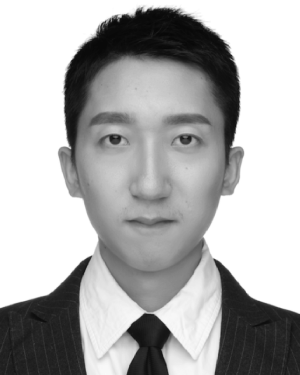 Sheng Zhang合作论文数Natl Univ Def Technol, Coll Informat Syst & Management, Changsha, Hunan, Peoples R China8
 Su He合作论文数8
 Yanghua Xiao (肖仰华)合作论文数School of Computer Science, Fudan University;Knowledge Works Research Laboratory, Fudan University;Shanghai Key Laboratory of Data Science8
 Liangshu Zhong (钟良枢)合作论文数Shanghai Advanced Research Institute, Chinese Academy of Sciences;University of Chinese Academy of Sciences7
 Yingbin Hu合作论文数7
 Songlin Feng (冯松林)合作论文数Institute of High Energy Physics, Chinese Academy of Sciences, Beijing 100049, China7Li Tian (田犁)合作论文数7
 Xin Zhang (张欣)合作论文数School of Information and Communication Engineering, Beijing University of Posts and Telecommunications7
 Fengcai Qiao合作论文数6
 Fuda Ning合作论文数Dalian University of Technology, Dalian Univ. of Technol.6
 Peng Gao (高鹏)合作论文数Shanghai Advanced Research Institute, Chinese Academy of Sciences4
 Wei Wang (汪卫)合作论文数Shanghai Key Laboratory of Data Science, School of Computer Science, Fudan University;Intelligent Medicine Institute, Fudan Universtiy4Kevin Leder合作论文数University of Minnesota4Song Guangjia合作论文数4
 Ioannis Karatzas合作论文数Department of Mathematics, Columbia University;Departments of Statistics, Columbia University4
 Zunkai Huang合作论文数Chinese Acad Sci, Shanghai Adv Res Inst, Shanghai 201210, Peoples R China3
 Li Tao (陶丽)合作论文数School of Life, Sciences Fudan University3
 Xinxing Wang合作论文数Chinese Academy of Sciences, Chinese Academy of Sciences3
 Kai Xing (邢凯)合作论文数School of Computer Science and Technology, University of Science and Technology of China3
 Momiao Xiong合作论文数School of Public Health, University of Texas Health Science Center at Houston3
 Bo Zhao合作论文数3
 Yu Fei (虞飞)合作论文数3
 Rongyong Xie合作论文数2
 Yunlei An合作论文数2
 Zhongzheng Zhang (张中正)合作论文数University of Chinese Academy of Sciences;Shanghai Advanced Research Institute, Chinese Academy of Sciences2
 Tiejun Lin (林铁军)合作论文数Shanghai Advanced Research Institute, Chinese Academy of Sciences;University of Chinese Academy of Sciences2Yuanchen Li合作论文数2Yanzhang Yang合作论文数2
 Shanshan Dang合作论文数Institute of Translational Medicine, Shenzhen University2Yi-Na Wu合作论文数2Lin Zhao合作论文数2
 Yini Zhang合作论文数University at Buffalo2
 Dai Yuanyuan合作论文数2
 Xincheng Lu合作论文数Wuhan Univ Technol, Sch Mech & Elect Engn, Wuhan 430070, Hubei, Peoples R China2YongFa Ling (凌永发)合作论文数2
 Yongxin Zhu (祝永新)合作论文数Shanghai Advanced Research Institute, Chinese Academy of Sciences;University of Chinese Academy of Sciences2
 Lin Xia (夏霖)合作论文数Shenzhen Institutes of Advanced Technology, Chinese Academy of Science2
 Buyun Sheng (盛步云)合作论文数School of Mechanical and Electronic Engineering, Wuhan University of Technology;School of Mechanical and Electrical Engineering, Wuhan Donghu University2




