The superposition of ultrasonic frequency vibrations to conventional machining techniques is known and practiced since the 1950s under the name of ultrasonic machining. Using ultrasound, many good properties appear including reduced thrust force, improved surface finish, reduced residual stress in machined material, etc…In this paper we present a new assembly technique based on the same principles: ultrasonic press–fitting. Feasibility and energy reduction are demonstrated through experiments under industrial production conditions.
A new assembly method for silicon micro-parts with non-planar steel parts is proposed: low-temperature soldering. Existing techniques for micro-mechanical assemblies are analyzed and compared to the proposed method, the method is explained and validated on an existing product using functional tests. Performances of the reference method (adhesive bonding) are not yet fully reached, but the results are close and partially fulfil the specifications of the current production.
In luxury industry and, in particular in watch making, the quality of a surface is fully associated with its visual appearance and represents a corollary to the technical mastery necessary to manufacture valuable products. Traditionally, the inspection of these surfaces is carried out by human experts. Their judgment is influenced by several factors, which are not easy to control and which introduce variability in quality inspection. Nevertheless, experts have the capacity to handle different situations and they only give access to the specific knowledge related to the inspection of aesthetic surfaces. For these reasons, in the development of systems for automated visual inspection, experts are considered as the reference. The main goal the work presented in this paper is to provide automated tools for the quantitative estimation of the quality of aesthetic surfaces, in order to reduce the variability of the inspection. The different parts of an artificial vision system for surface quality control are investigated and a parallel is drawn with the inspection carried out by human experts. The adopted inspection process is based on three steps: the identification of defects, their quantification and the judgment about their acceptability.
Technological solutions for obstacle-detection systems have been proposed to prevent accidents in safety-transport applications. In order to avoid the limits of these proposed technologies, an obstacle-detection system utilizing stereo cameras is proposed to detect and localizemultiple objects at level crossings. Background subtraction is first performed using the color independent component analysis technique, which has proved its performance against other well-known object-detection methods. The main contribution is the development of a robust stereo-matching algorithm which reliably localizes in 3D each segmented object. A standard stereo dataset and real-world images are used to test and evaluate the performances of the proposed algorithmto prove the efficiency and the robustness of the proposed video-surveillance system.
This paper proposes an obstacle detection system for the purpose of preventing accidents at level crossings. In order to avoid the limits of already proposed technologies, this system uses stereo cameras to detect and localize multiple targets at the level crossing. In a first step, a background subtraction module is performed using the Color Independent Component Analysis (CICA) technique which allows to detect vehicles even if they are stopped (the main cause of accidents at Level Crossings). A novel robust stereo matching algorithm is then used to reliably localize in 3D each segmented object. Standard stereo datasets and real-world images are used to evaluate the performances of the proposed algorithm, showing the efficiency and robustness of the proposed video surveillance system.
Achieving an accurate disparity map in a reasonable processing time is a real challenge in the stereovision field. For this purpose, we propose in this paper an original approach which aims to accelerate matching time while keeping a very good matching accuracy. The proposed method allows us to shift from a dense to a sparse disparity map. Firstly, we have computed scores for all pairs of pixels using a new dissimilarity function recently developed. Then, by applying a confidence measure on each pair of pixels, we keep only couples of pixels having a high confidence measure which is computed relying on a set of new local parameters.
This paper describes the design and fabrication of a hermetic LTCC package for an optical MEMS chip designed for space applications. The package ensured electrical and optical connections, mechanical positioning, atmosphere control, and finally low thermally induced stress on the MEMS during the final packaging operation. The package consisted of a 10-layer LTCC case with a recessed cavity for the MEMS chip, and a glass lid (with antireflection coating and thin-film metallization for soldering) for optical I/O. The chip was mechanically attached to the bottom of the cavity with a silicone adhesive, and electrically connected through gold wire bonds. The gold wire bonding pads were routed through the LTCC module to a MegArray BGA connector. Hermetic closure of the cavity was carried out by soldering the glass lid onto the case in a controlled atmosphere. The two main difficulties involved in such a package were the high electrical connection density (400 connections) and low-temperature hermetic sealing. LTCC design rules for small-pitch lines, thick- and thin-film materials selection, screen printing, lamination techniques, and soldering methods are described in this paper.
Press-fitting is a very common assembly process used in many fields, especially in the watchmaking industry. It consists of introducing a shaft in a hole (also called receptor) with a certain value of tightening (or interference). However, this process is not straightforward and it is often observed that some assemblies do not manage to hold out the time and function they are meant to. In order to solve this problem, influent parameters had been searched and are now studied. The shape of the receptor has appeared as a critical one. Indeed, new machining processes have been developed this last decade and we are now able to make new designs which could cope perfectly with this application. The article will deal with the influence of the two main parameters involved in a press-fitting assembly: the maximal press-fitting force, measured axially; and the resistive torque exercised between the shaft and the receptor. The main purpose will be to find which kind of design allows the contact to become less stiff, which means less internal constraints. Thus, the tolerances, especially those of the receptor (they are less well controlled than those of the shaft) could be enlarged and this would be a great improvement for the industrial world.
Sorting and mating is a very common practice in high precision manufacturing, as well in the watch industry, biomedical or automotive industry. This strategy helps to increase the assembly yield, but is costly and time-consuming. The question is, when is it necessary to apply sorting and mating, and when can it by avoided without loss in product quality? We furthermore show in this paper that the measurement precision is often lower than that of manufacturing. New and more precise manufacturing equipment and assembly devices allow for narrower distributions, and this raises many questions: is it possible to stop sorting? how can we be sure of the quality of the components and of the products? A case study at the company MPS AG, manufacturer of miniature ball bearings, illustrates this trend. We propose another manufacturing and assembly strategies, and show what the conditions are that are necessary to permit this approach.
A decision making tool is proposed to evaluate assembly costs of micro-products (< 1 dm(3)) and to compare different assembly strategies for a given product or product family. The tool takes into account equipment costs as well as running costs, for manual and automatic assembly. Its specificity lies in its ability to deal with different production mixes and production volumes over the life cycle of the product family. The underlying concept of the tool is that the cost of a given assembly function (or process) is constant for different technical solutions. This paper describes a cost evaluation for reconfigurable, manual, automatic or semiautomatic assembly lines, and shows its easiness of use through a simple test case.
Vision-based tracking is used in nearly all robotic laboratories for monitoring and extracting of agent positions, orientations, and trajectories. However, there is currently no accepted standard software solution available, so many research groups resort to developing and using their own custom software. In this paper, we present Version 4 of SwisTrack, an open source project for simultaneous tracking of multiple agents. While its broad range of pre-implemented algorithmic components allows it to be used in a variety of experimental applications, its novelty stands in its highly modular architecture. Advanced users can therefore also implement additional customized modules which extend the functionality of the existing components within the provided interface. This paper introduces SwisTrack and shows experiments with both marked and marker-less agents.
Mechanical and electrical connecting of piezoelectric actuator is often done using conductive glue. Its advantage is not to heat the piezoelectric actuator during connection. But there are many disadvantages to gluing; the main one is curing time. Welding is another alternative, but when done in an oven, the temperature needed for this operation might destroy the heat sensitive actuator. The method described in this paper is laser soldering of piezoelectric actuator. The piezo actuator is mechanically and electrically connected to an alumina substrate by the use of tin solder heated by the mean of a laser diode. The advantage of the laser diode is its ability to selectively heat needed areas. Moreover, it is possible to control the energy brought to the system during the soldering process, thus reducing thermal impact on the piezoelectric actuator. Finally, the temperature can be monitored during the soldering process, allowing to control if the piezoelectric actuator was exposed to high temperature.
A novel laser soldering method for hermetic packaging of temperature sensitive devices such as organic electronics, micro- and nanostructures is presented in this work. The package combines a thermally optimized LTCC (Low Temperature Co-fired Ceramic) base with a glass lid. These two parts are soldered together by the use of a laser diode. The advantages of the laser soldered joint is its hermeticity to water and air in regard to glue and plastic, as well as the possibility to heat only the soldered joint. The power of the laser diode has to be controlled during the soldering process. We propose a solution based on temperature monitoring by the mean of a pyrometer. Heat transfer from the heated solder joint to the encapsulated device can be reduced by structuring the LTCC base, which also reduces the required optical power. Several schemes such as cavities under the joint and local thinning of the base are studied. Key words: Packaging, LTCC, laser soldering, thermal impact
In the field of mobile robotics, trajectory details are seldom taken into account to qualify robot performance. Most metrics rely mainly on global results such as the total time needed or distance traveled to accomplish a given navigational task. Indeed, usually mobile roboticists assume that, by using appropriate navigation techniques, they can design controllers so that the error between the actual and the ideal trajectory can be maintained within prescribed bounds. This assumption indirectly implies that there is no interesting information to be extracted by comparing trajectories if their variation is essentially resulting from uncontrolled noisy factors. In this paper, we will instead show that analyzing and comparing resulting trajectories is useful for a number of reasons, including model design, system optimization, system performance, and repeatability. In particular, we will describe a trajectory analysis method based on point distribution models (PDMs). The applicability of this method is demonstrated on the trajectories of a real differential- drive robot, endowed with two different controllers leading to different patterns of motion. Results demonstrate that in the space of the PDM, the difference between the two controllers is easily quantifiable. This method appears also to be extremely useful for comparing real trajectories with simulated ones for the same set-up since it affords an assessment of the simulation faithfulness before and after appropriate tuning of simulation features.
Mechanical and electrical connecting of piezoelectric actuator is often done using conductive glue. Its advantage is not to heat the piezoelectric actuator during connection. But there are many disadvantages to gluing; the main one is curing time. Welding is another alternative, but when done in an oven, the temperature needed for this operation might destroy the heat sensitive actuator. The method described in this paper is laser soldering of piezoelectric actuator. The piezo actuator is mechanically and electrically connected to an alumina substrate by the use of tin solder heated by the mean of a laser diode. The advantage of the laser diode is its ability to selectively heat needed areas. Moreover, it is possible to control the energy brought to the system during the soldering process, thus reducing thermal impact on the piezoelectric actuator. Finally, the temperature can be monitored during the soldering process, allowing to control if the piezoelectric actuator was exposed to high temperature.
Tolerance allocation is a critical issue in precision engineering and in microassembly. Generally, manufacturing components within the required tolerances is hard because of the high precision necessary to satisfy the product function. In this paper, a case study shows that tightening component tolerances doesn't always increase the yield. An efficient control strategy is a better approach to ensure the product functions and to increase the number of conforming products. The proposed control strategy is based on sampling tests to control the assembly process, and on a full batch test to guarantee the functions of the assembled product. The redesign of a micro product control strategy illustrates the interest of multiphysic functional tolerancing and testing in precision engineering.
At small sizes, piezoelectric bending actuators are more practical and have more favorable downscaling properties than traditional electromagnets in the field of microfluidics. However, their application is limited by the difficulty of ensuring proper clamping during assembly. Emerging PZT thick-film technologies are promising as they solve the clamping problem, but their performance is still unsatisfactory for most applications. Therefore, the use of bulk PZT benders assembled onto LTCC or alumina by gluing/soldering often still represents the most practical solution. The present work will address the issues involved when assembling a commercial PZT bender onto an alumina substrate, simulating an electrovalve. This study will focus on the loss of bending capability (amplitude and force) resulting from the mechanical strength and stiffness of the joint suffering from thermal cyclic fatigue effects, and the degree of the PZT depoling as a function of the assembly method and conditions. We will show that glues performed better than solders, at the expense of the processing time.
This article shows the consequences of using parts with scrap in an automatic assembly system. The scrap is the percentage of parts that do not reach the required conformity and will cause either a defective assembly or a jam in the system. The two consequences considered here are extra cost and loss of productivity. To show this, we will focus on one part assembly operation anywhere in the process, which consists of feeding, assembling the part and inspecting the resulting sub-assembly. We will show that the effect of scrap can be huge and depends strongly on how the bad part is detected. 4 cases are considered: 1.The parts are sorted before feeding 2.The bad parts jam in the feeder 3.The bad parts jam while assembling 4.The sub-assembly with bad parts is ejected after inspection. By evaluating each case in 3 examples, we will show that case 3 is often the worst. We will also define the conditions where it is better to sort the parts first (1), let them jam in the feeder (2) or sort the sub-assemblies (4).
 Sulzmann, A.合作论文数19Sandra Koelemeijer合作论文数15Frank Seigneur合作论文数14Yuri L. De Meneses合作论文数13Y. L. De Meneses合作论文数12S. Koelemeijer Chollet合作论文数10
 Pierre Lambert合作论文数Bio Electro and Mechanical Systems Department, Université Libre de Bruxelles9Bourgeois, F.合作论文数7Peter Ryser合作论文数7
 Thomas Maeder合作论文数6leon benmayor合作论文数5
 Jean-Marc Breguet合作论文数Institut de syst;Swiss Federal Institute of Technology;Institut de syst, Swiss Federal Institute of Technology5g meylan合作论文数4
 Yannick Fournier合作论文数4
 Pierre Roduit合作论文数Swarm-Intelligent System Group (SWIS),, École Polytechnique Fédérale de Lausanne4
 Alain Delchambre合作论文数Universite Libre de Bruxelles4
 Nizar Fakhfakh合作论文数Ecole Polytechnique Fédérale de Lausanne (EPFL),, French National Institute for Transport and Safety Research (INRETS),4
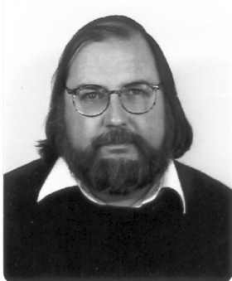 Max-Olivier Hongler合作论文数4Alain Dufaux合作论文数3Bellino, M.合作论文数3
 Alcherio Martinoli合作论文数Distributed Intelligent Systems and Algorithms Laboratory, Environmental Engineering Institute, School of Architecture, Civil and Environmental Engineering, Ecole Polytechnique Fédérale de Lausanne3F. Bourgeois合作论文数3
 Fabien Bourgeois合作论文数3Florent Monay合作论文数Ams OSRAM3
 Louahdi Khoudour合作论文数3klaus ganz合作论文数2Romanowicz, R.合作论文数2cedric wulliens合作论文数2Jean-Luc Bruyelle合作论文数2
 Sigfrid Straessler合作论文数Laboratoire de Production Microtechnique, Ecole Polytechnique Fédérale de Lausanne2Louis-Séverin Bieri合作论文数2Jose Luis Lamas合作论文数2Silvia Allegro-Baumann合作论文数2L.-S. Bieri合作论文数2
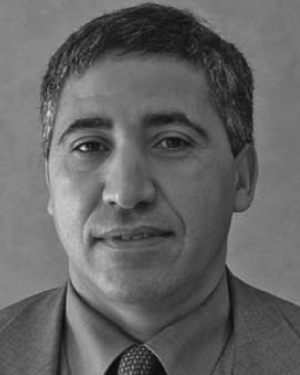 El-Miloudi El-Koursi合作论文数INRETS 20, Rue Elisée Reclus 59650 Villeneuve d’Ascq France2El Miloudi El Koursi合作论文数1Y. Fournier合作论文数1F Arrieta合作论文数1Christopher Cianci合作论文数1B. Romanowicz合作论文数1L. Khoudour合作论文数1
 Philippe J. Renaud合作论文数Ecole Polytech Fed Lausanne, Lab Microsyst LMIS4, CH-1015 Lausanne, Switzerland1
 Yves Bellouard合作论文数Department of Microengineering, Ecole Polytechnique Federale de Lausanne1
 Flurin Pfiffner合作论文数Department of ENT, Head and Neck Surgery, University of Bern1Richard, R.合作论文数1Gfeller, J.合作论文数1Andreas Schwarzhaupt合作论文数1Damien Berlie合作论文数1Csaba Laurenczy合作论文数1




