This study introduces and validates an alternative approach for modeling microwave FETs using power-dependent electrical equivalent circuits extracted from conventional X-parameters (Z L = 50 Omega). The proposed method expands the use of the conventional X-parameters measurements by generating a model that is more practical and intuitive. It enables the extraction of intrinsic elements through a procedure similar to that used in small-signal analysis. Moreover, the nonlinear intrinsic elements are expressed as functions of input power, and the resulting model can be readily implemented in commercial microwave simulators. Experimental validation using the GaN FET CGH40010F demonstrates that the proposed model achieves improved prediction accuracy for power-added efficiency (PAE) and drain efficiency compared to the manufacturer's model. One-tone test errors are below 5 dB, PAE prediction errors are under 2%, and the estimation of the optimal load impedance for maximum PAE is significantly more accurate with the proposed model.
In this work, a procedure to obtain two-port admittance models of buried cables illuminated by incident electromagnetic fields for the analysis of transients in the frequency domain is presented. The procedure is based on cascading two-port admittance models of various cable segments, avoiding the numerical problems that chain matrix representations may have. To obtain results in the time domain, the Numerical Laplace Transform method is used.
In this work, saturation and hysteresis loops are included in a four-port transformer model for electromagnetic transients computation in the frequency domain. Approximations with linear segments of the hysteresis characteristic and saturation curve are used. To obtain time domain results, the numerical Laplace transform is employed and the results are compared with those obtained from ATP.
This article presents an improved nonlinear empirical I/V model suitable for GaAs and GaN FETs. The new drain-to-source current formulation accurately represents the symmetric and the asymmetric bell-shaped transconductance (gm) for all VDS values. Besides modeling with high accuracy the I/V characteristic, the proposed model can fit the first and second derivatives of the transconductance, from the ohmic to the saturation region, including the pinch-off region. The high correlation between experimental and simulated data of the I/V curves of GaAs and GaN FETs, ACPR, load-pull, and a class-J power amplifier designed in S-band corroborates the usefulness of the proposed model, considering only the static I/V model as the main nonlinear element of the electrical equivalent circuit model of the transistor.
This letter demonstrates for the first time the usefulness of the X-parameters under 50- $\Omega $ load condition (conventional X-parameters) for simulating and designing RF feedback oscillator circuits. The measurement procedure to characterize a GaAs FET ATF34143 with conventional X-parameters is presented. The measured X-parameters’ data are subsequently used in the design of an RF feedback oscillator at 2.47 GHz. The comparison of the experimental results with the harmonic balance simulations demonstrates the strengths and weakness that conventional X-parameters have to predict the electrical behavior of the feedback oscillator.
In this paper, a model of aerial multiconductor transmission lines with frequency-dependent electrical parameters for the simulation of time-domain electromagnetic transients due to incident electromagnetic fields is presented. The frequency dependency of the electrical parameters is taken into account using the penetration impedance; this allows applying the method of characteristics without having to resort to modal transformations. With this alternative approach, transforming the transmission line partial differential equations to ordinary differential equations is performed in the phase domain, which simplifies the mathematical development of the method and also the numerical solution. The validity of the proposed model is shown with five study cases involving different transmission systems and excitations.
In this paper a model for Nonuniform Transmission Lines for electromagnetic transient analysis that incorporates frequency dependency of electrical parameters, variation of line electrical parameters with respect to distance, and distributed excitations due to incident electromagnetic fields is presented. The model is developed using the Method of Characteristics in the actual physical domain instead of the Modal Domain; this simplifies the mathematical development and the final equations. Moreover, the equations of the resultant model are valid either for two-conductor lines or for multiconductor lines without any change; this can be an advantage when the computer programming language considers a scalar as a 1x1 matrix. The proposed numerical model is developed under the hypothesis that the dielectric surrounding the conductors is homogenous. It is shown that in this case the characteristic curves of a Nonuniform Transmission Line become straight lines. Finally, the model is validated by comparison with results obtained using the Numerical Laplace Transform method.
PurposeThe power systems behavior is nonlinear, and this is reflected in that the measurement signals are composed by multi-components. Thus, this paper aims to present a method for analyzing multi-component signals that allow calculating signal parameters such as frequency, damping constant, amplitude and phase for each component, as well as determining the direct current component.Design/methodology/approachThe method proposed is based in the Z-transform of a damped sinusoidal signal with direct current. Only the Z-transform poles are used to form equation systems which are used to obtain frequency and damping. Then, the amplitude, the phase and the direct current component are determined by the above results.FindingsThe method is able to determine frequencies, damping constants, phases and amplitudes of the different modal components of a signal using only a few measurements. Moreover, the method does not require filter banks tuned with some previous knowledge of signal’s characteristics. The presented test cases of field measured signals show the good performance of the proposed method, which is able to obtain the parameters of interest with a very short observation window.Originality/valueOne quality of this method is that it has a very short delay to reach the first solution and from there you get one result each sample; the delay time is equivalent to 2 + 4C samples where C is the number of components in the signal. Finally, it is concluded that because of the small number of samples that are needed and the low algorithmic complexity of the methodology, the method is apt to make applications in real time.
This paper deals with a simple and low-cost test setup capable to measure the impedances needed for designing a FET resistive mixer. The proposed method uses an external signal generator along with one port S-parameters measurement and signal flow theory to determine the impedances at the RF, LO and IF frequencies. A packaged GaN FET is used to design a high linearity FET resistive mixer suitable to down-convert a 2.4 GHz LTE signal to a 0.1 GHz IF signal and the experimental results show a conversion loss of 6.9 dB and ACLR better than 45 dBc.
In this work, a compact microstrip lowpass-bandpass diplexer using radial stubs (RSs) is proposed. By controlling the input impedance of the RS resonators, it is possible to obtain a selective lowpass filter (LPF) and a narrow bandpass filter (BPF) with a fractional bandwidth of 5%, without increasing the insertion losses (ILs) of both filters. The design methodology is explained in details and verified through the design of a diplexer achieving very low IL, 0.15 dB for the LPF and 1.2 dB for the BPF. Moreover, the isolation between the ports is 25 dB making the proposed diplexer useful for designing mixer circuits. Experimental results exhibit high correlation with EM simulation data validating the proposed methodology.
El constante aumento de los componentes que contiene un sistema on-chip ha incrementado la complejidad de comunicacion entre los elementos de procesamiento (EPs) del sistema. Un recurso utilizado para disminuir la complejidad es el diseno de enrutamiento de conexiones (cableado), el cual ha sido suficiente para interconectar algunos EPs, dicho diseno se conoce como redes en chip o por sus siglas en ingles NoC (Network on Chip), de manera alternativa, enrutar paquetes permite una mayor escalabilidad de las redes, tener una latencia aceptable y una utilizacion moderada de area. Sin embargo, las redes en chip (NoC) suelen ser implementadas en tecnologias rigidas y deterministas como los ASIC (Circuito Integrado de Aplicacion Especifica), limitando la flexibilidad, arquitectura y modularidad que ofrece una NoC de enrutamiento de paquetes. Este trabajo propone una arquitectura de una red en chip de switcheo o enrutamiento unidireccional utilizando un router generico para topologia de mariposa, de enrutamiento de paquetes, implementado en una FPGA de la familia Xilinx. Donde el diseno permite enviar paquetes desde 16 puntos de origen, hacia 16 puntos de destino, asi como la flexibilidad de enviar paquetes de diferentes tamanos, divididos en flits. Este diseno tiene como resultado una arquitectura compacta, permitiendo dejar el mayor espacio posible para los EPs. Palabra(s) Clave(s): arquitectura de router, control de flujo, FPGA, NoC, redes en chip.
In this article, the effect of the second harmonic on the microwave performance of RF feedback oscillators is investigated. A microstrip bandpass filter, which combines the characteristics of a 1st order coupled line and a hairpin filter allowing to reject the second harmonic, is used as feedback circuit. It is demonstrated that by mitigating the effect of the second harmonic the phase noise as well as the drain efficiency of the feedback oscillator are improved without affecting the output power at the oscillation frequency. Two RF feedback oscillator circuits based on GaAs FET were designed at 2.45 GHz with and without reducing the output power at the second harmonic. Experimental and simulated data have a high correlation and the results show that when the output power of the second harmonic is reduced it is obtained an improvement in the drain efficiency, phase noise, and second harmonic reduction of 36.61%, 14.75 dB, and 15.51 dB, respectively.
Background Some of the most common adverse effects of protease inhibitors in treatment of HIV are dislypidaemia, diabetes and other metabolic disorders. These adverse effects should be recognised by health professionals so that they can perform an intervention to minimise the cardiovascular risk of the patient. Purpose To analyse the impact of the metabolic adverse effects in HIV patients on darunavir/cobicistat monotherapy treatment. Material and methods This work is a descriptive observational study which took place in the outpatient consultation of a Hospital Pharmacy in a third-level hospital. We made a search of clinical variables as well as results of analytical tests. The variables included in this study were age, smoking habit, systolic blood pressure, presence of antihypertensive treatment, presence of diabetes mellitus, and HDL and total cholesterol serum concentrations at the beginning of treatment and at 6 and 12 months after. With these data, we calculated the Framingham Risk Score (FRS) at these months and we performed a statistical analysis. Results Patients (n=30) had a mean age of 50.2±11.6 years and 66.6% were males. They were all on treatment with a daily tablet of darunavir/cobicistat (800 mg/150 mg) as a single drug for HIV treatment. The median of FRS at the beginning of the treatment was 9.3 (3.9–22.7). At month 6 of treatment the median of FRS was 8.9 (4.2–20.8) and after 12 months was 8.9 (3.4–21.7). None of the patients had an increase of more than 4 points. A small group of patients (n=7) from this sample, who had an initial FRS over 25 were separately studied. Their mean FRS were 38.2 (28.4–39.4) at the beginning, 32.1 (28.9–36.4) at month 6 and 30.5 (25.2–37) at month 12. Five of these seven patients had a decrease in FRS of more than 4 points. Only one of them had an increase (2 points). Conclusion Based on these findings, we can affirm that there was no increase in the cardiovascular risk of the patients on treatment with darunavir/cobicistat, but there was also an improvement. Even patients at greater risk reduced their Framingham Risk Score. We want to show the importance of knowing the drugs deeply to prevent their adverse effects. No conflict of interest
Background HIV therapies are usually based on the action of various antiretroviral drugs coadministered in order to achieve a good virologic (viral loads<50 copies/ml) and immune response (percentage of T CD4 lymphocytes between 32 and 60). In the past few years a single drug therapy based on a protease inhibitor has been used to control HIV infection. Purpose To analyse the virologic and immune response in patients on darunavir/cobicistat monotherapy. Material and methods This work is a descriptive observational study. In it, we have made a search of clinical variables as well as the results of analytical tests. The variables included in this study were sex, age, viral loads at the beginning of the treatment and at months 6 and 12, and percentage of T CD4 lymphocytes in blood samples. After that, we performed a statistical analysis. Results Patients (n=30) had a mean age of 50.2±11.6 years and 66.6% were males. They were all on treatment with a daily tablet of darunavir/cobicistat (800 mg/150 mg) as a single drug for HIV treatment. At the beginning of treatment, 76% of patients had undetectable viral load, at month 6.83% and at month 12.73%. Patients with viral load over 50 copies/ml were 20% at the beginning of treatment, 13% at month 6, and 10% at month 12. Only 50% of patients who began the treatment without virological response could achieve it at month 12. Only 6% of patients with virological response failed it at month 12. In terms of immune response, patients without it at the beginning (percentage of T CD4 lymphocytes below 32%) represented 36.7% and they did not achieve it during 12 months. Every patient with immune response at the beginning of the treatment maintained this response. Only one patient had both virologic and immune failures. Thirty-three per cent of patients had no immune response with virologic response. Conclusion Based on these findings we can confirm that monotherapy is a great strategy in patients who already have a good control of the HIV infection. Immune and virologic response is difficult to achieve after 12 months in patients who began the treatment without them. No conflict of interest
ABSTRACTThis paper deals with modeling of drain current IDS(VGS,VDS) and intrinsic nonlinear capacitances Cgs(VGS,VDS) and Cgd(VGS,VDS) of the CMOS FET by means of empirical analytical expressions. The proposed models are based on exponential series allowing modeling of the CMOS FET from the linear to the breakdown region. Several High Voltage CMOS (HVMOS) FETs were used to validate the proposed models under pulsed DC, small and large signals. The high correlation between simulated and measured data supports the capability of the proposed empirical model to predict the electrical behavior of the CMOS FET. © 2017 Wiley Periodicals, Inc. Microwave Opt Technol Lett 59:563–567, 2017
In this study, a model of one-phase transformers with saturation effects, suitable for low- and mid-frequency electromagnetic transient simulations using the numerical Laplace transform is presented. Substitution and superposition theorems are invoked to convert the saturation non-linear condition of the transformer into a series of time-sequential switching manoeuvres. Model advantage is that frequency dependence of electrical parameters is naturally taken into account and, together with the capability of including non-linear phenomena, leads to a valuable tool to validate time-domain models based on convolutions.
Purpose – Most systems have a non-linear (NL) behavior and measured signals reflect this non-linearity such that in general they are composed with more than one sinusoidal component. NL analysis methods represent an option for analyzing such signals, however these methods have been developed for single frequency signals, this forces to implement a components separation procedure before performing the signal analysis. The purpose of this paper is to present a new method for analyzing multi-component signals that allows calculating amplitude, frequency and damping constants of the contained sinusoidal components. The method is able to simultaneously identify the different components within a detection bandwidth without previous separation of mono-components, as needed for most methods in used today. Design/methodology/approach – The method proposed in this work characterizes sinusoidal signals determining their amplitude, frequency and damping constant. This method is based on transforming from the time domain to the z-domain an oscillatory signal that may or may not possess damping. Since frequency and damping of a signal can be determined knowing its z-domain poles, using the signal in z-transform domain an equations system to find the signal poles can be written. Findings – From the results it can be concluded that the proposed method is reliable and consistent. One quality of the method is its short delay, when the procedure starts there is a delay equal to the time needed to accumulate four samples for each detectable frequency in order to perform the first calculation, after this, the algorithm can deliver a result at each sampling instant. This short delay and the low complexity of the algorithm can permit using the method in real time applications. Originality/value – The proposed method is able to determine frequencies, damping constants and amplitudes of the components of a signal without a previous separation of mono-components, in contrast with other methods that require filter banks tuned using a previous knowledge of the signal. Moreover unlike techniques such as the Hilbert-Huang Transform the proposed method can be applied to signals with components having very close frequencies.
This paper presents a novel band-pass microstrip filter based on a 1st order parallel coupled microstrip filter with minimum fractional bandwidth. One of the main characteristic of the proposed microstrip filter is its high rejection level at the 2nd harmonic of the resonance frequency (f(0)). Electromagnetic simulations based on the method of Momentum indicates that the level rejection is controlled with the adjustment of the length of a microstrip line. Experimental results of a band-pass filter with resonance frequency of 1.8 GHz (f(0)) designed with the proposed technique are compared to the response of a typical 1st order coupled line filter, achieving a level rejection of 20 dB at 3.6 GHz (2f(0)).
This paper presents a novel Field Programmable Gate Array (FPGA) architecture for hardware implementation of Multilayer Feedforward Neural Networks (MFNNs) suitable for Digital Pre-Distortion (DPD) technique. This architecture consists of a single neuron, several storage units and multiplexors that allow the reconfiguration via software of the FPGA to handle different numbers of inputs, layers, neurons and threshold functions of the MFNN. This novel FPGA architecture offers the advantage of using FPGAs with less logical resources than those found in a Virtex-6. The usefulness of this novel FPGA architecture is demonstrated by the modeling of the AM-AM and AM-PM characteristics of a GaN class F PA and a Doherty PA in a Virtex-6 FPGA from Xilinx configured with two different MFNNs, using a 2.1 GHz LTE signal of 5 MHz of bandwidth. The results obtained with the FPGA implementation are compared with data computed with MATLAB achieving Normalize Mean Square Error (NMSE) better than -50 dB.
In this study, a new model for aerial multiconductor transmission lines with frequency dependent electrical parameters is presented. The new model is called here A-line model and is a two-port model based on the method of characteristics and finite differences that does not require segmenting the transmission line. The frequency dependence of electrical parameters due to field penetration in conductors and Earth is taken into account by means of the penetration impedance or skin impedance. Moreover, in the proposed model there is no need of splitting in propagation modes; therefore, the numerical implementation is very simple. With the purpose of validation, results from the numerical Laplace transform and universal line model are employed. From the results, it is found that the A-line model is accurate and robust with an execution speed that makes it a strong candidate for real-time simulations.
 J. L. Naredo合作论文数24
 José Raúl Looyau合作论文数Centro de Investig. y de Estudios Av. del I. P. N. Unidad Guadalajara;c23J.A. Reynoso Hernández合作论文数10
 Pablo Gomez合作论文数Electr. Eng. Dept., Inst. Politec. Nac. (IPN),;c;Electr. Eng. Dept., Inst. Politec. Nac. (IPN),10J. L. Guardado合作论文数ITM, Morelia, Mich., México10
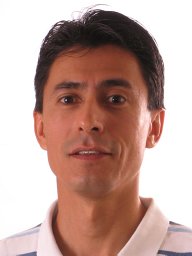 Abner Ramirez合作论文数6H. J. Saavedra-Gomez合作论文数5
 Lina Maria Aguilarlobo合作论文数5S. Ortega Cisneros合作论文数4J. L. Urbina-Martínez合作论文数4Cain Perez-Wences合作论文数Ctr Tecnol Avanzada, CIATEQ AC4
 Susana Ortega-Cisneros合作论文数4
 Apolinar Reynoso合作论文数4
 Marisol Davila合作论文数4
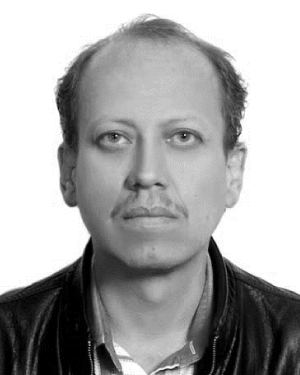 Jose Alberto Gutierrezrobles合作论文数3Chavez, A.R.合作论文数3
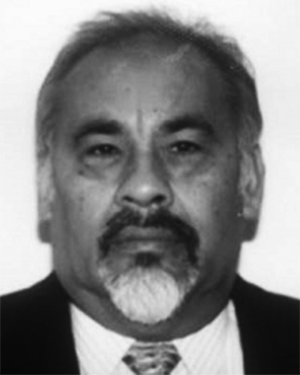 Jose M Canedo合作论文数3
 J. Apolinar Reynosohernandez合作论文数3
 F. A. Uribe合作论文数Instituto Tecnológico de Morelia3J. A. R. Gutierrez合作论文数3Juan José Raygoza-Panduro合作论文数3P. Nieto Gomez合作论文数2A Rodriguez Delgado合作论文数2J.C. Olivares合作论文数2A. Garcia-Osorio合作论文数2I. Casas Hidalgo合作论文数2Susana Ortega Cisneros合作论文数2Juan Luis Del Valle-Padilla合作论文数2Ismary Lavandera-Hernandez合作论文数2julian sotelo castanon合作论文数2M Valle Corpas合作论文数2
 Jorge Luis García-Sánchez合作论文数CINVESTAV, Unidad Guadalajara2
 Eduardo Salvador Banuelos-Cabral合作论文数CINVESTAV, Unidad Guadalajara2
 Jose Rodrigo Camacho Perez合作论文数Intel Corp2
 veronica adriana galvan sanchez合作论文数Department of Mechanical and Electrical Engineering, CUCEI—University of Guadalajara2
 V Jose Luis Naredo合作论文数Dept. of Electr. Eng., British Columbia Univ.;c;Dept. of Electr. Eng., British Columbia Univ.2
 Avisai Sanchez Alegria合作论文数2
 Johan Driesen合作论文数Department of Electrical Engineering, Faculty of Engineering Science, KU Leuven2Juan Escamilla合作论文数2
 Robert G. Olsen合作论文数College of Engineering and Architecture, Washington State University;School of Electrical Engineering and Computer Science, Washington State University2
 Federico Sandoval合作论文数CINVESTAV2Juan Carlos Escamilla合作论文数2R. Escarela-Perez合作论文数2
 Jose E. Rayas Sanchez合作论文数ITESO Universidad Jesuita de Guadalajara2R. Alvarez Sanchez合作论文数1Armando Guzman合作论文数1C. Garcia Fernandez合作论文数1S. Belda Rustarazo合作论文数1Marlon Molina-Ceseña合作论文数1




