(3) Globespan Inc. Tech. 100 Schulz Drive Red Bank NJ 07701 U SA Email : jay@onera.fr, ovarlez@onera.fr, declercq@ensea. fr, pdu@globespan.net
Alien noise in the vectored very-high-speed digital subscriber line (VDSL) system is part of the additive noise at the receiver and exhibits strong correlation among users. We present a per-tone co-operative alien noise cancellation (CoMAC) algorithm for the upstream (US) VDSL that can be applied subsequent to any self far-end-crosstalk (FEXT) mitigation strategy. CoMAC operates by predicting the noise seen by a given user based on the error samples from the remaining users. These errors are conveniently obtained after slicing the self-FEXT canceled signal of all the vectored users. We show that if the estimation of these errors is accurate, the proposed alien canceler achieves the Cramer-Rao lower bound (CRLB). In practice, the seamless rate adaptation (SRA) operation, which enables increased bit rate by increasing the bit-loading per-tone, can cause decision errors in any decision directed strategy. We also analyze the impact of these decision errors - an issue not addressed in the literature. We propose a strategy for bit-loading during the SRA operation by formulating a max-min optimization problem and demonstrate a possibility of a guaranteed (minimum) improvement in the per-user rate. Simulations indicate that performance of the algorithm can exceed the minimum value significantly in practical situations.
This article surveys the existing literature on the most widely used factor models employed in the realm of a financial asset pricing field. Through the concrete application of evaluating risks in the hedge fund industry, this article demonstrates that signal processing techniques are an interesting alternative to the selection of factors and can provide more efficient estimation procedures than classical techniques.
This paper presents a simple and efficient exogenous outlier detection & estimation algorithm introduced in a regularized version of the Kalman Filter (KF). Exogenous outliers that may occur in the observations are considered as an additional stochastic impulse process in the KF observation equation that requires a regularization of the innovation in the KF recursive equations. Regularizing with a l1- or l2-norm needs to determine the value of the regularization parameter. Since the KF innovation error is assumed to be Gaussian we propose to first detect the possible occurrence of an exogenous impulsive spike and then to estimate its amplitude using an adapted value of the regularization parameter. The algorithm is first validated on synthetic data and then applied to a concrete financial case that deals with the analysis of hedge fund returns. The proposed algorithm can detect anomalies frequently observed in hedge returns such as illiquidity issues.
This contribution introduces a highly robust and content oriented detector of circumferential weld for oil pipeline intelligent inspection, achieving close to zero-miss performance. The method, named ACOD self processes the multidimensional data collected by a pipeline inspection device equipped with many ultrasonic sensors (up to 512). ACOD can be run in a standalone mode of operation as a supplement of human expert monitoring. A compression step makes it scalable in complexity. ACOD introduces a unique "circumferential oriented" feature in the detection scheme, based on higher order statistics (HOS). This feature boosts the statistical contrast between partial circumferential events (PCE) or false alarm and full circumferential events (FCE) to be detected, such as the welds that tie together two pieces of tubes. Because of its contrast boost and its scalable complexity, ACOD outperforms an existing reference method while saving 30% of processing time.
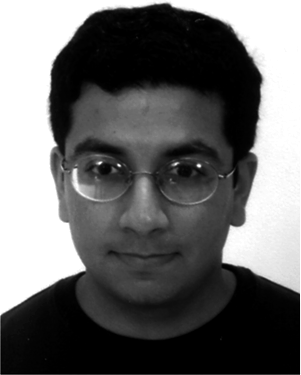 Amitkumar Mahadevan合作论文数22
 Ehud Langberg合作论文数17Julien Pons合作论文数16Laurent Pierrugues合作论文数15Sorbara, M.合作论文数Conexant Syst., Inc;c14
 Emmanuelle Jay合作论文数9oliver moreno合作论文数8
 Feng Ouyang合作论文数Globespan Virata Inc.8william scholtz合作论文数7
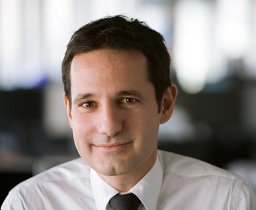 Serge Darolles合作论文数CREST7Arnaud Santraine合作论文数7vaibhav dinesh合作论文数6
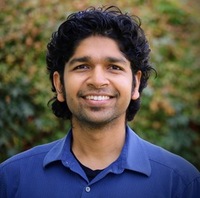 Rahul Garg合作论文数Netflix Inc.6
 David Declercq合作论文数Codelucida, Inc.6peter kleewein合作论文数5lujing cai合作论文数5kunal raheja合作论文数5laurent francis alloin合作论文数5
 Shailendra Singh合作论文数5
 Pravesh Biyani合作论文数CONEXANT Systems Inc5harish jethanandani合作论文数3Shmulyian, F.合作论文数3
 Jean-Philippe Ovarlez合作论文数Université Paris Saclay DEMR ONERA3marc marie ghislain durvaux合作论文数2shareq rahman合作论文数2yuepeng zheng合作论文数2
 Arnaud Chretien合作论文数2hemant samdani合作论文数2Satyavardhan Maheshwari合作论文数2clement fouquet合作论文数1ravindra m lambi合作论文数1Anupama Ramalingam合作论文数1
 Surendra Prasad合作论文数Indian Institute of Technology1
 Arnaud Doucet合作论文数DeepMind;Department of Statistics, University of Oxford1Christian Gourieroux合作论文数1J. Soubielle合作论文数1
 Kunal Lal合作论文数Division of Prosthodontics, Columbia University College of Dental Medicine1
 Dalila Benboudjema合作论文数1
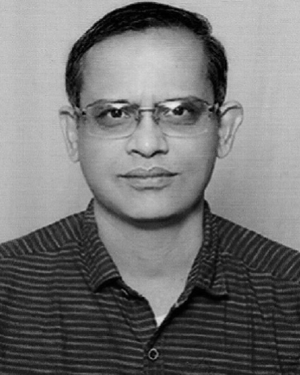 S. Prakriya合作论文数Department of Electrical Engineering, Indian Institute of Technology Delhi1




