Modern big data workflows are characterized by computationally intensive kernels. The simulated results are often combined with knowledge extracted from AI models to ultimately support decision-making. These energy-hungry workflows are increasingly executed in data centers with energy-efficient hardware accelerators since FPGAs are well-suited for this task due to their inherent parallelism. We present the H2020 project EVEREST, which has developed a system development kit (SDK) to simplify the creation of FPGA-accelerated kernels and manage the execution at runtime through a virtualization environment. This paper describes the main components of the EVEREST SDK and the benefits that can be achieved in our use cases.
We present an architecture for field-programmable gate arrays (FPGAs) to expose RESTful web services. This architecture allows clients to access accelerated web services from any platform and programming language that can perform RESTful API calls. By using this architecture, the client's application benefits from a high throughput and low latency web service interface. Traditionally, FPGAs are deployed in CPU-centric infrastructures as worker devices in the form of accelerators. However, for FPGA-centric applications, the overhead of a host CPU diminishes the performance, scalability and energy efficiency. cloudFPGA solves these issues by deploying FPGAs as standalone, disaggregated resources in the DC. Building on top of the cloudFPGA platform, the presented architecture simplifies the integration of FPGA-accelerated functions with cloud applications. A configurable hardware block that can be generated from an OpenAPI-based specification of the web service is used to deploy an FPGA-based application. We compare a natural language processing (NLP) application that is exposed as a web service using the traditional server infrastructure and our RESTful service layer. Measurements show an improvement of 20x in terms of throughput and 4x reduction in mean latency.
The evolution of cloud applications into loosely-coupled microservices opens new opportunities for hardware accelerators to improve workload performance. Existing accelerator techniques for cloud sacrifice the consolidation benefits of microservices. This paper presents CloudiFi, a framework to deploy and compare accelerators as a cloud service. We evaluate our framework in the context of a financial workload and present early results indicating up to 485 x gains in microservice response time.
Boolean models are a powerful abstraction for qualitative modeling of gene regulatory networks. With the recent availability of advanced high-throughput technologies, Boolean models have increasingly grown in size and complexity, posing a challenge for existing software simulation tools that have not scaled at the same speed. Field Programmable Gate Arrays (FPGAs) are powerful reconfigurable integrated circuits that can offer massive performance improvements. Due to their highly parallel nature, FPGAs are well suited to simulate complex molecular networks. We present here a new simulation framework for Boolean models, which first converts the model to Verilog, a standardized hardware description language, and then connects it to an execution core that runs on an FPGA coherently attached to a POWER8 processor. We report an order of magnitude speedup over a multi-threaded software simulation tool running on the same processor on a selection of Boolean models. Analysis on a T-cell large granular lymphocyte leukemia (T-LGL) demonstrates that our framework achieves consistent performance improvements resulting in new biological insights. In addition, we show that our solution allows to perform attractor detection at an unprecedented speed, exhibiting a speedup ranging from one to three orders of magnitude compared to alternative software solutions.
Verification is indispensable for building reliable of hardware/software co-designs. However, the scope of formal methods in this domain is limited. This is attributed to the lack of unified property specification languages, the semantic gap between hardware and software components, and the lack of verifiers that support both C and Verilog/VHDL. To address these limitations, we present an approach that uses a bounded co-verification tool, HW-CBMC, for formally validating hardware/software co-designs written in Verilog and C. Properties are expressed in C enriched with special-purpose primitives that capture temporal correlation between hardware and software events. We present an industrial case-study, proving bounded safety properties as well as discovering critical co-design bugs on a large and complex text analytics FPGA accelerator from IBM ® .
Unstructured text data is being generated at an unprecedented rate in the form of Twitter feeds, machine logs or medical records. The analysis of this data is an important step to gaining significant insight regarding innovation, security and decision-making. The performance of traditional compute systems struggles to keep up with the rapid data growth and the expected high quality of information extraction. To cope with this situation, a compilation framework is presented that can transform text analytics queries into a hardware description. Deployed on an FPGA, the queries can be executed 60 times faster on average compared to a multi-threaded software implementation. The performance has been evaluated on two generations of high-end server systems including two generations of FPGAs, demonstrating the performance gains from advanced technology.
FPGAs (Field Programmable Gate Arrays) are making their way into data centers (DC). They are used as accelerators to boost the compute power of individual server nodes and to improve the overall power efficiency. However, this approach limits the number of FPGAs per node and hinders the acceleration of large-scale distributed applications.We propose a system architecture to deploy large-scale DC applications on standalone FPGAs, independently of the number of CPUs. In our architecture, the FPGAs are directly attached to the DC network, making the FPGA infrastructure scalable and flexible. This FPGA infrastructure enables the creation of flexible multi-FPGA fabrics by connecting several FPGAs together over the DC network.We implemented a prototype of the network-attached FPGA and ported a distributed text-analytics application onto such a multi-FPGA fabric. We compared our approach with a SW-only implementation and an implementation accelerated with PCIeattached FPGAs. The results show that the network-attached FPGAs outperform both other implementations by large margins.
With the ever growing amount of unstructured data, high-speed content analysis becomes ever more important. Enabling efficient search functions to help locate specific and relevant information hidden in this big data is a crucial task of today's enterprise systems, and can lead to valuable insights. A key component of content analysis systems are text parsers, which transform unstructured text data into structured information. Cascaded grammars offer a popular and powerful representation of text parsers by enabling the definition of more complex patterns in terms of simpler ones in a hierarchical fashion. This work presents a compilation framework to generate an optimized FPGA pipeline from a cascaded grammar description. We also describe the system integration and the way FPGA-based accelerators can be used as part of larger analysis tasks within Unstructured Information Management Application (UIMA) pipelines. We compare the performance of the hardware-accelerated system and a commercial software implementation using real-life UIMA pipelines from the healthcare domain. We show that the FPGA-accelerated system processes the parsing stage of a UIMA pipeline up to 31 times faster than the software implementation running on a high-end server, which results in an acceleration of up to 5 times for the complete pipeline.
In this paper we analyze the power consumption and energy efficiency of general matrix-matrix multiplication (GEMM) and Fast Fourier Transform (FFT) implemented as streaming applications for an FPGA-based coprocessor card. The power consumption is measured with internal voltage sensors and the power draw is broken down onto the systems components in order to classify the energy consumed by the processor cores, the memory, the I/O links and the FPGA card. We present an abstract model that allows for estimating the power consumption of FPGA accelerators on the system level and validate the model using the measured kernels. The performance and energy consumption is compared against optimized multi-threaded software running on the POWER7 host CPUs. Our experimental results show that the accelerator can improve the energy efficiency by an order of magnitude when the computations can be undertaken in a fixed point format. Using floating point data, the gain in energy-efficiency was measured as up to 30 % for the double precision GEMM accelerator and up to 5 × for a 1k complex FFT.
Big Data applications require efficient processing of large graphs to unveil information that is hidden in the structural relationships among objects. In order to cope with the growing complexity of data sets many graph algorithms can be expressed to apply linear algebra operations for which highly efficient algorithms exist. In this paper we present an FPGA implementation of a stochastic matrix function estimator, a powerful framework for statistical approximation of general matrix functions. We apply the accelerator to the subgraph centrality method for ranking nodes in complex networks. Performance and energy consumption results are based on actual measurements of a POWER8 hybrid compute platform. A single FPGA co-processor improves the runtime by more than 50% compared to multi-threaded software while delivering the same estimation quality. In terms of energy consumption the FPGA outperforms CPU and GPU solutions by a factor of 13× and 3×, respectively. Our results show that FPGA co-processors can provide significant gains for graph analytics applications and are a promising solution for energy efficient computing in the data center.
Despite the performance and power efficiency gains achieved by FPGAs for text analytics queries, analysis shows a low utilization of the custom hardware operator modules. Furthermore the long synthesis times limit the accelerator's use in enterprise systems to static queries. To overcome these limitations we propose the use of an overlay architecture to share area resources among multiple operators and reduce compilation times. In this paper we present a novel soft-core architecture tailored to efficiently perform relational operations of text analytics queries on multiple virtual streams. It combines the ability to perform efficient streaming based operations while adding the flexibility of an instruction programmable core. It is used as a processing element in an array of cores to execute large query graphs and has access to shared co-processors to perform string-and context-based operations. We evaluate the core architecture in terms of area and performance compared to the custom hardware modules, and show how a minimum number of cores can be calculated to avoid stalling the document processing.
In recent years, the amount of data produced has been exploding at a rate far greater than the increase in computing power of even large supercomputers. As a result, modern computer systems are unable to analyze all the available data - a situation that will become even worse in the foreseeable future. We follow an approach to data analytics where the computational complexity is fundamentally reduced by performing the majority of the computation in an approximated or even stochastic framework while the high precision solution is guaranteed by an iterative refinement process.This paper presents a parallel heterogeneous system implementing a mixed-precision iterative refinement solver for large linear systems, which is a building block for many other complex algorithms. In our solver, the backward step is implemented as a novel variant of the conjugate gradient (CG) method running on an FPGA using fixed point data types. The low precision of the backward step is compensated for by the forward step running in high precision on a GPU, which iteratively updates the current solution until a given working precision has been reached.We have implemented our CG solver using Altera's OpenCL SDK for FPGAs and use NVIDIA's CUBLAS library for the forward step on the GPU. Through the combination of GPU and FPGA we were able to achieve a speedup of 3.7x for large dense 24,064 x 24,064 matrices and require 3.5x less energy per solved right-hand side compared to a tuned multi-threaded CPU solver based on the ATLAS linear algebra library. (C) 2015 Elsevier Inc. All rights reserved.
For years, Microsoft Corporation CEO Bill Gates was against open source. But today he appears to have changed his mind.“We can be open source. We love the concept of shared source,” said Bill Veghte, a Microsoft VP.“That is a super-important shift for us in terms of code access.”
The energy efficiency of computer systems can be increased by migrating computational kernels that are known to under-utilize the CPU to an FPGA based coprocessor. In contrast to traditional I/O-based coprocessors that require explicit data movement, coherently attached accelerators can operate on the same virtual address space than the host CPU. A shared memory organization enables widely accepted programming models and helps to deploy energy efficient accelerators in general purpose computing systems. In this paper we study an FFT accelerator on FPGA attached via the Coherent Accelerator Processor Interface (CAPI) to a POWER8 processor. Our results show that the coherent attached accelerator outperforms device driver based approaches in terms of latency. Hardware acceleration delivers a 5× gain in energy efficiency compared to an optimized parallel software FFT running on a 12-core CPU and improves single thread performance by more than 2×. We conclude that the integration of CAPI into heterogeneous programming frameworks such as OpenCL will facilitate latency critical operations and will further enhance programmability of hybrid systems.
The amount of textual data has reached a new scale and continues to grow at an unprecedented rate. IBM's SystemT software is a powerful text-analytics system that offers a query-based interface to reveal the valuable information that lies within these mounds of data. However, traditional server architectures are not capable of analyzing so-called big data efficiently, despite the high memory bandwidth that is available. The authors show that by using a streaming hardware accelerator implemented in reconfigurable logic, the throughput rates of the SystemT's information extraction queries can be improved by an order of magnitude. They also show how such a system can be deployed by extending SystemT's existing compilation flow and by using a multithreaded communication interface that can efficiently use the accelerator's bandwidth.
 Christoph Hagleitner合作论文数Physical Electronics Laboratory, Swiss Federal Institute of Technology20
 Kubilay Atasu合作论文数* 2002 - 2003 : Research Assistant at Processor Architecture Laboratory, Swiss Federal Institute of Technology Lausanne (EPFL)
* 2001 - 2002 : M.Eng. in Embedded Systems Design, Advanced Learning and Research Institute (ALaRI), University of Lugano
* 1996 - 2000 : B.Sc. in Computer Engineering, Bogazici University, Istanbul12
Kubilay Atasu合作论文数* 2002 - 2003 : Research Assistant at Processor Architecture Laboratory, Swiss Federal Institute of Technology Lausanne (EPFL)
* 2001 - 2002 : M.Eng. in Embedded Systems Design, Advanced Learning and Research Institute (ALaRI), University of Lugano
* 1996 - 2000 : B.Sc. in Computer Engineering, Bogazici University, Istanbul12 Heiner Giefers合作论文数IBM Research Zurich8
 Laura Chiticariu合作论文数IBM Research6
 Frederick Reiss合作论文数IBM6
 Tobias Werner合作论文数5
 Huaiyu Zhu合作论文数IBM Research4
 H. Peter Hofstee合作论文数Quantum & Computer Engineering Department, Faculty of Electrical Engineering, Mathematics and Computer Science, Delft University of Technology4
 Michael Kugel合作论文数3
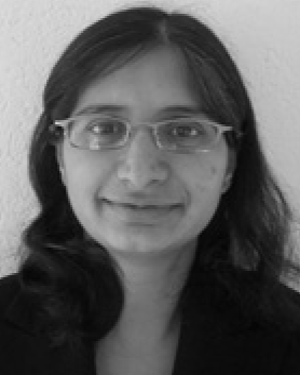 Mitra Purandare合作论文数ETH Zürich3alexander woerner合作论文数2
 Burkhard Ringlein合作论文数IBM Res Europe, Zurich, Switzerland2
 Jagath Weerasinghe合作论文数Kyushu Institute of Technology2
 Yuen H. Chan合作论文数IBM2Akihiro Nakayama合作论文数2
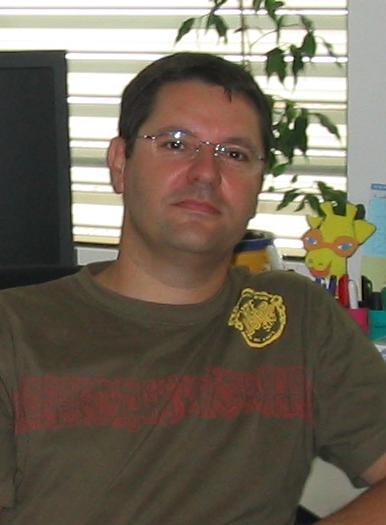 François Abel合作论文数IBM Research GmbH|Zurich Research Laboratory2
 Beat Weiss合作论文数IBM Research GmbH;Zurich Research Laboratory2Paulo Silva合作论文数1Eva Sitaridi合作论文数1david poulet合作论文数1Frederick R Reiss合作论文数1Tom Slooff合作论文数1
 Roberto Rocco合作论文数1Cesar Berrospi Ramis合作论文数1silke penth合作论文数1anthony parent合作论文数1Felix Suchert合作论文数1
 Mattia Tibaldi合作论文数1
 Francesco Regazzoni合作论文数1Stephanie Soldavini合作论文数1
 Karl Friedrich Alexander Friebel合作论文数1
 Rajdeep Mukherjee合作论文数Amazon1
 Stefan Payer合作论文数1Andrea Parodi合作论文数1
 Serena Curzel合作论文数Politecnico di Milano, Milan, Italy1Fabien Brocheton合作论文数1
 Jakub Beránek合作论文数Technical University of Ostrava1
 Sutanay Choudhury合作论文数Pacific Northwest National Laboratory1Christoph M. Angerer合作论文数1Michele Paolino合作论文数1
 Mark A. Lantz合作论文数Zurich Research Laboratory, IBM Research1
 Gianluca Palermo合作论文数Department of Electronics, Information and Bioengineering, Politecnico di Milano1
 Antonino Tumeo合作论文数Pacific Northwest National Laboratory1John Feo合作论文数Pacific Northwest National Laboratory1
 Babak Falsafi合作论文数Parallel Systems Architecture Laboratory, Institute of Computer and Communication Sciences, School of Computer and Communication Sciences, EPFL;SDEA1
 Daniel Kroening合作论文数Department of Computer Science, University of Oxford1
 Rajeev Balasubramonian合作论文数School of Computing, University of Utah1
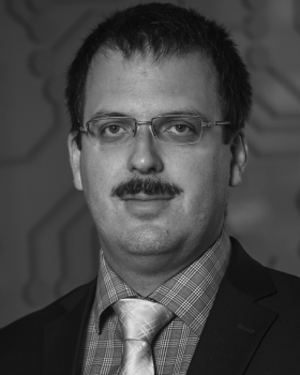 Jan Martinovic合作论文数Department of Computer Science, VŠB - Technical University of Ostrava1
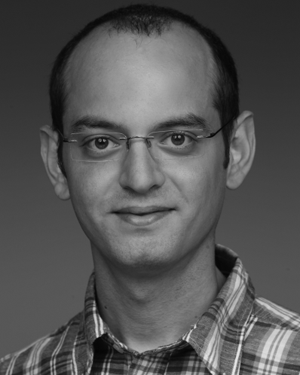 Vito Giovanni Castellana合作论文数Politecnico di Milano1




