The exponential growth of Internet of Things (IoT) ecosystems is driving a paradigm shift from centralized cloud computing towards decentralized architectures to mitigate latency and bandwidth constraints. While edge computing addresses some of these challenges, data transmission to local gateways still raises critical security and privacy concerns. This study explores the Compute Continuum by pushing intelligence to the extreme edge using TinyML. We propose a secure, privacy-preserving multimodal biometric authentication system designed for resource-constrained embedded devices. Our solution implements a hierarchical processing chain: an ultra-lightweight person-detection filter acts as an intelligent wake-up mechanism, followed by robust facial and voice authentication modules. Operating as a strict hierarchical pipeline, the system achieves a combined False Acceptance Rate (FAR) of just 0.12%. Experimental results on an ESP32 microcontroller demonstrate exceptional energy efficiency, requiring only 0.15 J per inference cycle. This allows the system to operate autonomously for over 39 h of continuous inference on a standard 600 mAh battery, proving the viability of standalone, privacy-by-design biometric sensors in intelligent IoT environments.
Hyperdimensional Computing (HDC) has proven effective in solving a wide range of classification tasks, often outperforming traditional Machine Learning techniques, particularly in terms of robustness to noise, low computational complexity, and suitability for hardware-efficient implementations due to its highly parallelizable algebra. However, the main barrier to HDC adoption in memory-constrained embedded systems lies in its high memory requirements, on the order of 𝒪(n× D) , where n is the number of hypervectors stored in memory and D is their dimension. In this work we present ByteHD, a lightweight compression library that reduces the memory footprint of bipolar hypervectors through efficient byte-level encoding. To test our approach, we implemented an HDC-based framework serving anomaly detection in emergency lighting devices and evaluated its impact on memory usage, execution time and classification accuracy. Experimental results show that ByteHD enables HDC implementation even on very resource constrained embedded systems of the Internet of Things, e.g. RPI Pico 2, while maintaining classification performance comparable to uncompressed implementations. These findings underscore the potential of HDC as a practical and energy-efficient learning paradigm for edge intelligence, bridging the gap between theoretical advances and real-world embedded deployments.
The Internet of Things (IoT) is increasingly composed of numerous sensing devices with limited power availability, which rely on energy storage solutions such as batteries or supercapacitors to sustain their operation. To ensure a reliable power supply for continuous functioning and energy replenishment, energy harvesting systems have been proposed. However, energy harvesting is not without limitations, including high equipment costs and limited feasibility in certain environments. This paper investigates a star-connected IoT network, in which the central coordinator node is equipped with a solar energy harvesting system. The harvested energy is used not only to power the coordinator’s own operations but also to activate nearby end devices via Wireless Power Transmission (WPT). Based on the estimated amount of power each end device can receive, determined by its distance from the coordinator, we propose an algorithm to compute optimal task scheduling that maximizes overall quality while satisfying the energy neutrality condition. Simulation results demonstrate the feasibility of integrating energy harvesting with WPT to efficiently power IoT devices.
The proliferation of the Internet of Things (IoT) has ledto the widespread deployment of sensor nodes characterized by constrained energy availability, often powered by limitedcapacity storage components such as batteries or super-capacitors. To sustain uninterrupted operation and enable periodic energy replenishment, energy harvesting (EH) techniques have emerged as a viable solution. This paper investigates an advanced architecture for a star-topology IoT network, wherein the central coordinator node is equipped with a solar-based energy harvesting system. The energy accrued is utilized not only to maintain the coordinator’s operational integrity but also to facilitate Wireless Power Transmission (WPT) to neighboring peripheral nodes. This work introduces a novel task scheduling algorithm that optimizes application-level utility while satisfying the energy neutrality constraint of the overall platform. Simulation outcomes validate the effectiveness and viability of integrating EH and WPT mechanisms to ensure sustainable and efficient power delivery within IoT ecosystems.
The automation of insect pest control activities implies the use of classifiers to monitor the temporal and spatial evolution of the population using computer vision algorithms. In this regard, the popularisation of supervised learning methods represents a breakthrough in this field. However, their claimed effectiveness is reduced regarding working in real-life conditions. In addition, the efficiency of the proposed models is usually measured in terms of their accuracy, without considering the actual context of the sensing platforms deployed at the edge, where image processing must occur. Hence, energy consumption is a key factor in embedded devices powered by renewable energy sources such as solar panels, particularly in energy harvesting platforms, which are increasingly popular in smart farming applications. In this work, we perform a two-fold performance analysis (accuracy and energy efficiency) of three commonly used methods in computer vision (e.g., HOG+SVM, LeNet-5 CNN, and PCA+Random Forest) for object classification, targeting the detection of the olive fly in chromatic traps. The training and testing of the models were carried out using pictures captured in various realistic conditions to obtain more reliable results. We conducted an exhaustive exploration of the solution space for each evaluated method, assessing the impact of the input dataset and configuration parameters on the learning process outcomes. To determine their suitability for deployment on edge embedded systems, we implemented a prototype on a Raspberry Pi 4 and measured the processing time, memory usage, and power consumption. The results show that the PCA-Random Forest method achieves the highest accuracy of 99%, with significantly lower processing time (approximately 6 and 48 times faster) and power consumption (approximately 10 and 44 times lower) compared with its competitors (LeNet-5-based CNN and HOG+SVM).
Energy neutrality in an energy harvesting Internet of Things (IoT) device ensures continuous operation of the device by trading performance with energy consumption, and a way to achieve this is by adopting a task-based model. In this model, the device embeds several alternative tasks with different ratio energy-cost/quality and a scheduler that, depending on the current energy production and battery level, runs at any time the best task to maximize the performance while guaranteeing energy neutrality. In this context, this work proposes a novel scheduling algorithm that takes into account also the stability of the device, by minimizing the leaps of quality between two consecutive tasks in the scheduling. We show by simulation and by experiments on a low-power IoT platform that the proposed algorithm greatly improves the stability of the device with respect to the state-of-the-art algorithms, with a marginal worsening of the overall quality of the tasks executed.
In image processing, a connected components algorithm is a method used to identify and label the different objects or regions present in a digital image. This algorithm can be useful for a variety of image processing tasks, such as object recognition, image segmentation, and feature extraction. This work presents the implementation of a single-pass algorithm on an FPGA-based device suitable for high-performance edge computing vision applications, the Ultra96-V2 computing board. The design and implementation of the IP core have faced challenges using the AMD-Xilinx HLS workflow and tools, which require efficient and optimized use of resources, as well as the re-engineering of the algorithm to comply with the requirements imposed by the development framework. The performance of the proposed accelerator has been thoroughly analysed using the YACCLAB benchmarking framework against a high-end and a low-end CPU. The results show an expected loss in performance due to memory and clock frequency limitations. However, concerning energy efficiency, the hardware multicore architecture outperforms the software alternatives with an improvement between two and five times, depending on the size and complexity of the images.
As the term smart begins to move away from inflationary usage, mostly related to communication capabilities, and towards a more effective dimension, there is room for research into the systematic process of transforming the things that were not originally designed to be smart. Such a process is referred to as smartification, which evokes the digital refinement of an existing product by embedding digital technologies and smart services. The state of the art shows only a few articles that investigate such methodological approaches to provide smartness on several application domains (e.g., home appliances, buildings, cities), while the smart university domain has not been deeply faced up yet. Based on the hypothesis that a methodology synthesizes a set of suitable procedures oriented to simplify the process of measuring the degree of smartification, we propose in this work a methodology that uses technological and academic criteria for designing a tool to measure the smartification of universities. The main conclusions of this work are the following: (1) The review of the current state of the art related to smart universities and smartification reveals the need for a new vision for a more adequate and accurate assessment of the degree of smartness of universities; (2) A formal method based on Multiple-Attribute Decision Making and case study research aimed at assessing the degree of smartification within the scope of smart universities; (3) A demonstration of the feasibility and application of our method to quantify the smartification degree of the School of Computer Science (ESI) at the University of Castilla-La Mancha under the project Smart ESI; and (4) A valuable method that allows equal comparison between smart universities through a set of standardized indicators, which offers the opportunity to analyze in depth the strength and weakness, and potential achievements of any smart initiatives. To the authors' knowledge, this is the first approach aimed at assessing the extent of the smartification process in smart universities through a formal method. The outcome of this research can benefit different stakeholders: university community, researchers, and, ultimately, the digital transformation of society.
Energy neutrality of Internet of Things devices powered with energy harvesting is a concept introduced to let these devices operate uninterruptedly. A method to achieve it is by letting the device scheduling different tasks characterized by different energy costs (and quality), depending on the current energy production of the energy harvesting subsystem and on the residual battery charge. In this context, we propose a novel scheduling problem that aims at keeping the energy neutrality of the scheduling while maximizing the overall quality of the executed tasks and minimizing the leaps of quality among consecutive tasks, so to improve the stability of the output of the device itself. We propose for this problem an algorithm based on a dynamic programming approach that can be executed even on low-power devices. By simulation we show that, with respect to the state of the art, the scheduling by our algorithm greatly improve the stability of the device with a minor penalty in terms of overall quality.
Onboard data processing for on-the-fly decision-making applications has recently gained momentum in the field of remote sensing. In this context, hyperspectral anomaly detection has received special attention since its main purpose lies in the identification of abnormal events in an unsupervised manner. Nevertheless, onboard real-time hyperspectral image processing still poses several challenges before becoming a reality. This is why there is an emerging trend toward the development of hardware-friendly algorithmic solutions embedded in reconfigurable devices. In this context, this work contributes to a hardware architecture that ensures a progressive line processing in time-sensitive applications limited by the scarcity of hardware resources. In this sense, we have implemented the state-of-the-art hardware-friendly line-by-line fast anomaly detector for hyperspectral imagery (HW-LbL-FAD) detector on a reconfigurable hardware for a real-time performance. Specifically, we have selected a cost-optimized field-programmable gate array (ZC7Z020-CLG484) to implement our solution whose results draw up a good tradeoff between the following three features: time performance, energy consumption, and cost. The experimental results indicate that our hardware component is able to process hyperspectral images of 825x1024 pixels and 160 bands in 0.51 s with a power budget of 1.3 W and costs around 150€.Regarding detection performance, the HW-LbL-FAD algorithm outperforms other state-of-the-art algorithms.
Hyperspectral imaging opens up new opportunities for masked face recognition via discrimination of the spectral information obtained by hyperspectral sensors. In this work, we present a novel algorithm to extract facial spectral-features from different regions of interests by performing computer vision techniques over the hyperspectral images, particularly Histogram of Oriented Gradients. We have applied this algorithm over the UWA-HSFD dataset to extract the facial spectral-features and then a set of parallel Support Vector Machines with custom kernels, based on the cosine similarity and Euclidean distance, have been trained on fly to classify unknown subjects/faces according to the distance of the visible facial spectral-features, i.e., the regions that are not concealed by a face mask or scarf. The results draw up an optimal trade-off between recognition accuracy and compression ratio in accordance with the facial regions that are not occluded.
Unmanned aerial vehicles (UAVs) are autonomous devices employed as data collectors in precision agriculture to support a large number of applications. These UAVs gather data from on-the-ground wireless sensor networks, especially in scenarios that lack any kind of fixed communication infrastructure or where the available infrastructure does not fit the application requirements. Sensors on the ground can store sensing data, and in scenarios that do not require a real-time observation and analysis of the data, like in smart farming, a drone can be used maybe once or two times each day to collect and report the data to a command-and-control center that use them directly, without any other infrastructure (cloud or edges). In this article, we study analytically how close the drone, that uses a LoRa radio, needs to fly over the sensors to collect data with a given quality of data collection. This can be used to properly spacing the sensors on the field at deployment time, to select among different type of drones, and to properly solve some tradeoff related to field size vs autonomy of the drones and the path used by the latter when collecting the data.
Motion estimation is the cornerstone of main video compression standards, which are based on the reduction of the temporal redundancy between consecutive frames. Although the mechanism is simple, the best method, Full Search, uses a brute-force approach which is not suited for real-time applications. This work introduces a high performance architecture for performing on-the-fly full-search block matching estimation in FPGA devices, which has been modeled using C++ programming language and synthesized with Vivado HLS for a Xilinx ZC706 prototyping board. The architecture is based on a dataflow datapath and it is configurable, enabling a fast and easy exploration of the solution space. On-board results achieve a maximum performance of 743 fps, 247 fps and 110 fps for VGA, HD and FHD video resolutions, respectively, for a typical macroblock size of 16 × 16 pixels and a search area of ± 16 pixels.
The Internet of Things (IoT) paradigm poses a great variety of application domains where million of devices work uninterruptedly to improve some aspect of our lives. To support the continuous execution of the applications working on the devices, energy harvesting systems enable to extract the energy found naturally in the environment (for instance from the sun or from the wind) and convert it into energy able to either sustain the device's operation and recharge its batteries which, in conjunction with an appropriate scheduling strategy, led to the device to an electrically sustainable state (i.e. an energy-neutral state). Most of the works found in literature oriented to achieve energy neutrality are however evaluated by means of simulation which means that, in spite of precisely modeling hardware features and energy productions, lack of the realism that we find in a real deployment. A minor part of the works are based on a real deployment but do not share the collected data that permit to replicate the analysis. With this purpose in mind, in this article we describe a testbed designed for outdoor monitoring purposes in the IoT context, equipped with several sensors for weather conditions monitoring and with a solar panel to provide application lifetimes potentially infinite. The testbed was deployed on the roof of a building and it executed uninterruptedly an application able to generate a dataset with the collected information over a period of more than two months. This dataset has been online published to be used for different researching purposes, as for instance, prediction models of the energy production.
In this work, it is proposed an scenario of collaboration between an aerial and a terrestrial vehicles devoted to obtain the best possible route for the terrestrial vehicle, as well as the adaptation to possible unexpected situations on the ground. In order to get the best response time, a solution for realtime computing of the optimal routes is built on an FPGA-based device. Though the proposed system is applicable in multiple scenarios, this paper focuses on smart farming applications. The evolution of the design flows for high-performance, heterogeneous solutions has reached a high point with the widespread adoption of design flows based on High Level Synthesis (HLS) technology for FPGAs. However, the claim about the potential use of legacy code, or code written by non-FPGA experts, almost straightforwardly and smoothly, needs to be further developed. This work contributes to this objective, introducing the concept of a generic-programming framework for FPGA-based solutions. The HLS Template Library supports a quick and easy development flow from models written in standard high-level languages that make it use of software abstract data types. These structures are well-known artifacts provided by many software libraries such as Glib (ANSI C) or STL (C++) and are intensively used in multiple engineering and scientific fields.
Framed within the PLATINO research project we have prototyped an energy-harvesting device specifically designed for supporting a set of smart farming applications. To this purpose, our prototype is equipped, among other components, with several sensors for environmental and energy conditions monitoring and a LoRa communication module to enable a Low-Power Wide Area Network. The physical network will be composed of dozens of PLATINO devices acting as end-nodes and of a drone with limited time of flight acting as a mobile gateway, which will receive the data temporally stored on the end-devices. This paper analyzes the set of constraints imposed by the European LoRa regulations and by the drone itself to design an efficient communication protocol between the drone and the end-devices.
To make sustainable large IoT deployments in smart cities, a promising approach is to develop a new generation of solar energy harvesting IoT devices based on the concept of energy neutrality. Key to this concept are the models for the forecast of energy production, which provide input to the energy-neutral schedulers governing the activities of the IoT devices. The development of such models however need to be validated against real-world conditions. To this purpose we propose a testbed aimed at the collection of real-world dataset about the energy parameters of energy harvesting IoT devices, and, on the base of such a dataset, we perform a comparative assessment of state of the art and novel energy production forecast models.
Outdoor Internet of Things (IoT) applications usually exploit energy harvesting systems to guarantee virtually uninterrupted operations. However, the use of energy harvesting poses issues concerning the optimization of the utility of the application while guaranteeing energy neutrality of the devices. In this context, we propose a new dynamic programming algorithm for the optimization of the scheduling of the tasks in IoT devices that harvest energy by means of a solar panel. We show that the problem is NP-hard and that the algorithm finds the optimum solution in a pseudo-polynomial time. Furthermore, we show that the algorithm can be executed with a small overhead on three popular IoT platforms (namely TMote, Raspberry PI, and Arduino) and, by simulation, we show the behavior of the algorithm with different settings and at different conditions of energy production.
 Juan Carlos López合作论文数22
 Stefano Chessa合作论文数Comput. Sci. Dept., Univ. of Pisa, Pisa, Italy20
 Jesus Carretero合作论文数??rea de Arquitectura y Tecnolog??a de los Computadores;Catedr??tico de Universidad19
 Fernando Rincón合作论文数12
 Jesús Barba合作论文数Ciudad Real, Universidad de Castilla-La Mancha11
 Antonio Mario Caruso合作论文数Dipartimento di Inf., Pisa Univ., Italy|c|9
 Xavier del Toro Garcia合作论文数Sch. of Electron., Glamorgan Univ.;c;Sch. of Electron., Glamorgan Univ.9
 Felix Jesús Villanueva合作论文数School of Computer Science, University of Castilla-La Mancha9
 David Villa合作论文数8
 Julián Caba合作论文数School of Computer Science, University of CastillaLa Mancha7
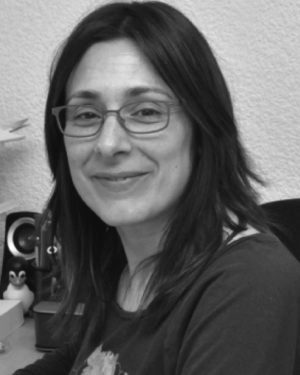 Maria J. Santofimia合作论文数School of Computing Science, University of Castilla-La Mancha7
 Jose A. de la Torre合作论文数5Félix García Carballeira合作论文数Universidad Carlos III de Madrid.;epartamento de Inform??tica4
 Florin Isaila合作论文数Department of Computer Science and Engineering, University Carlos III de Madrid4
 Susanna Pelagatti合作论文数Dipartimento di Informatica
Universita di Pisa3Maria-Cristina Marinescu合作论文数Barcelona Supercomputing Center3
Susanna Pelagatti合作论文数Dipartimento di Informatica
Universita di Pisa3Maria-Cristina Marinescu合作论文数Barcelona Supercomputing Center3 Javier Fernández合作论文数2
 Alejandro Calderón Mateos合作论文数2
 Melisa Kuzman合作论文数2
 Manuel Jose Abaldea Garcia-Pliego合作论文数School of Computer Science, University of Castilla-La Mancha2
 Jose Maria Perez Menor合作论文数Universidad Carlos III de Madrid2
 Óscar Aceña合作论文数School of Computer Science, University of Castilla-La Mancha2
 Luis Sanchez合作论文数2
 Francisco P. Romero合作论文数1
 David E. Singh合作论文数1Karen Viera合作论文数1
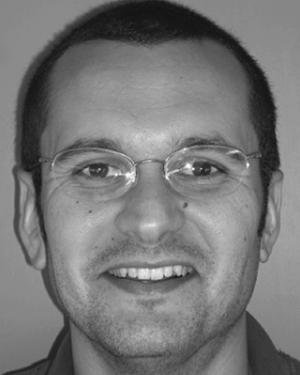 Sebastian Lopez合作论文数1Paolo Baronti合作论文数1
 Ruben Cantarero合作论文数Universty of Castilla-La Mancha1
 Raúl Guerra合作论文数Institute for Applied Microelectronics, University of Las Palmas de Gran Canaria, Las Palmas de Gran Canaria, Spain1
 Maria P. Diaz合作论文数1
 José Daniel García合作论文数Universidad Carlos III de Madrid1Jose D. Garcia合作论文数Universidad Carlos III de Madrid1
 Sebastia Galmes合作论文数1
 Julio Dondo合作论文数University of Castilla-La Mancha1
 Carlos Delgado Kloos合作论文数Universidad Carlos III de Madrid1
 Crescencio Bravo合作论文数Universidad de Castilla-La Mancha1Jose Daniel Garcia合作论文数Universidad Carlos III de Madrid1Rafael Sotomayor合作论文数1
 Maria Blanca Ibanez合作论文数Departamento de Ingeniería Telemática, Universidad Carlos III de Madrid1




