ABSTRACTMotivationSNAPSHOT USA is an annual, multicontributor camera trap survey of mammals across the United States. The growing SNAPSHOT USA dataset is intended for tracking the spatial and temporal responses of mammal populations to changes in land use, land cover and climate. These data will be useful for exploring the drivers of spatial and temporal changes in relative abundance and distribution, as well as the impacts of species interactions on daily activity patterns.Main Types of Variables ContainedSNAPSHOT USA 2019–2023 contains 987,979 records of camera trap image sequence data and 9694 records of camera trap deployment metadata.Spatial Location and GrainData were collected across the United States of America in all 50 states, 12 ecoregions and many ecosystems.Time Period and GrainData were collected between 1st August and 29th December each year from 2019 to 2023.Major Taxa and Level of MeasurementThe dataset includes a wide range of taxa but is primarily focused on medium to large mammals.Software FormatSNAPSHOT USA 2019–2023 comprises two .csv files. The original data can be found within the SNAPSHOT USA Initiative in the Wildlife Insights platform.
Fragments and edges account for most remaining forest habitats globally. Apex predators and megaherbivores often decline in these degraded habitats while smaller generalist omnivores can persist or thrive in forest edges, especially if they can utilize nonnative resources (“cross‐boundary food subsidies”). Outcomes for small‐medium carnivores (mesopredators) remain unclear or idiosyncratic. We tested responses of a widespread and common forest mesopredator to edges and the composition of the adjacent nonforested areas using 91 camera trapping surveys in Southeast Asia. Leopard cats ( Prionailurus bengalensis and Prionailurus javanensis ) showed a hump‐shaped relationship with forest cover and a positive association with oil palm plantations, but they did not increase near other types of nonnative land cover. Leopard cats' success in edges appears due to their hunting abundant rodent prey inside oil palm plantations, providing natural pest management for farmers. Abundant leopard cats also hunt and suppress native small vertebrates, which may trigger negative ecological cascades and suppress biodiversity in forest edges.
Southeast Asia supports the greatest diversity of felids globally, but this diversity is threatened by the severe forest loss and degradation occurring in the region. The response of felids to disturbances appears to differ depending on their ecology. For example, the largely terrestrial and nocturnal leopard cat (Prionailurus bengalensis) thrives near forest edges and in oil palm plantations where it hunts rodents (Muridae) at night, thereby avoiding human activity peaks. Conversely, we hypothesized that the sympatric and similar-sized marbled cat (Pardofelis marmorata) would respond negatively to edges and relatively open oil palm plantations as they are more arboreal than leopard cats, rely on tree connectivity for hunting, and are diurnal so have less potential to temporally avoid humans. We used camera trapping from Southeast Asia to test habitat associations at multiple spatial scales using zero-inflated Poisson generalized linear mixed models and hierarchical occupancy modeling. We found that marbled cats were positively associated with large intact forests and, in contrast to leopard cats, negatively associated with oil palm plantations. Furthermore, we found preliminary evidence suggesting marbled cats may adapt their diel activity to become more crepuscular in degraded forests, likely shifting their activity to avoid humans. These findings suggest that the marbled cat's International Union for Conservation of Nature (IUCN) Red List conservation status should potentially be upgraded from Near Threatened to Vulnerable, matching other forest-dependent felids in the region. We posit our findings may be generalizable such that semi-arboreal and diurnal felids could face greater threats from habitat degradation than their terrestrial and nocturnal relatives.
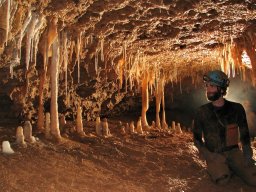
Cave entrances directly connect the surface and subsurface geomorphology in karst landscapes. Understanding the spatial distribution of these features can help identify areas on the landscape that are critical to flow in the karst groundwater system. Sinkholes and springs are major locations of inflow and outflow from the groundwater system, respectively, however not all sinkholes and springs are equally connected to the main conduit system. Predicting where on the landscape zones of high connectivity exist is a challenge because cave entrances are difficult to detect and imperfectly documented. Wildlife research has a similar issue of understanding the complexities of where a given species is likely to exist on a landscape given incomplete information and presence-only data. Species distribution models can address some of these issues to create accurate predictions of species or event occurrence across the landscape. Here we apply a species distribution model, MaxEnt, to predict cave entrance locations in three geomorphic regions of Kentucky. We built the models with cave locations from the Kentucky Speleological Survey database and landscape predictor variables, including distance from sinkholes, distance from springs, distance from faults, elevation, lithology, slope, and aspect. All three regional models predict cave locations well with the most important variables for predicting cave entrance locations consistent between models. Throughout all three models, sinkholes and springs had the largest influence on the likelihood of cave entrance presence. This unique use of species distribution modeling techniques shows that they are potentially valuable tools to understand spatial patterns of other landscape features that are either ephemeral or difficult to identify using standard techniques.
Restoring and maintaining biodiversity in a changing world is increasingly challenging due to the competing needs of species for suitable space and resources. One ecosystem that has seen considerable anthropogenic changes in extent and structure is the longleaf pine ( Pinus palustris ) ecosystem. Understanding how wildlife responds to restoration is important to informing forest restoration and conservation. We monitored game birds and mid-large-sized mammal occupancy in and around hardwood patches embedded within a longleaf pine woodland at The Jones Center at Ichauway in Newton, GA. We found that 11 species use the transition zone between the longleaf pine and hardwood hammocks. Gray squirrels ( Sciurus carolinensis ), Virginia opossums ( Didelphis virginiana ), and nine-banded armadillos ( Dasypus novemcinctus ) occupancy increased along the gradient while fox squirrel ( Sciurus niger ) declined. Our results suggest that oak patches and transitional zones are important to maintaining biodiversity within the longleaf pine ecosystem.
Wolves (Canis lupus) can exert top-down pressure and shape ecological communities through the predation of ungulates and beavers (Castor spp.). Therefore, understanding wolf foraging is critical to estimating their ecosystem-level effects. Specifically, if wolves are consumers that optimize tradeoffs between the cost and benefits of prey acquisition, changes in these factors may lead to prey-switching or negative-density dependent selection with potential consequences for community stability. For wolves, factors affecting cost and benefits include prey vulnerability, risk, reward, and availability, which can vary temporally. We described the wolf diet by the frequency of occurrence and percent biomass and characterized the diet using prey remains found in wolf scats on Isle Royale National Park, Michigan, USA, during May-October 2019 and 2020. We used logistic regression to estimate prey consumption over time. We predicted prey with temporal variation in cost (availability and/or vulnerability) such as adult moose (Alces alces), calf moose, and beaver (Castor canadensis) to vary in wolf diets. We analyzed 206 scats and identified 62% of remains as beaver, 26% as moose, and 12% as other species (birds, smaller mammals, and wolves). Adult moose were more likely to occur in wolf scats in May when moose are in poor condition following winter. The occurrence of moose calves peaked during June-mid-July following birth but before calf vulnerability declined as they matured. By contrast, beaver occurrence in wolf scat did not change over time, reflecting the importance of low-handling cost prey items for recently introduced lone or paired wolves. Our results demonstrate that the wolf diet is responsive to temporal changes in prey costs. Temporal fluctuation in diet may influence wolves' ecological role if prey respond to increased predation risk by altering foraging or breeding behavior.
Predator-prey dynamics are a fundamental part of ecology, but directly studying interactions has proven difficult. The proliferation of camera trapping has enabled the collection of large datasets on wildlife, but researchers face hurdles inferring interactions from observational data. Recent advances in hierarchical co-abundance models infer species interactions while accounting for two species' detection probabilities, shared responses to environmental covariates, and propagate uncertainty throughout the entire modeling process. However, current approaches remain unsuitable for interacting species whose natural densities differ by an order of magnitude and have contrasting detection probabilities, such as predator-prey interactions, which introduce zero inflation and overdispersion in count histories. Here, we developed a Bayesian hierarchical N-mixture co-abundance model that is suitable for inferring predator-prey interactions. We accounted for excessive zeros in count histories using an informed zero-inflated Poisson distribution in the abundance formula and accounted for overdispersion in count histories by including a random effect per sampling unit and sampling occasion in the detection probability formula. We demonstrate that models with these modifications outperform alternative approaches, improve model goodness-of-fit, and overcome parameter convergence failures. We highlight its utility using 20 camera trapping datasets from 10 tropical forest landscapes in Southeast Asia and estimate four predator-prey relationships between tigers, clouded leopards, and muntjac and sambar deer. Tigers had a negative effect on muntjac abundance, providing support for top-down regulation, while clouded leopards had a positive effect on muntjac and sambar deer, likely driven by shared responses to unmodelled covariates like hunting. This Bayesian co-abundance modeling approach to quantify predator-prey relationships is widely applicable across species, ecosystems, and sampling approaches and may be useful in forecasting cascading impacts following widespread predator declines. Taken together, this approach facilitates a nuanced and mechanistic understanding of food-web ecology.
Habitat loss and degradation threaten forest specialist wildlife species, but some generalist mesopredators exploit disturbed areas and human-derived food, which brings them into closer contact with humans. Mesopredator release is also important for human health for known zoonotic disease reservoirs, such as Asian civets (Viverridae family), since this group includes the intermediator species for the SARS-CoV-1 outbreak. Here we use camera trapping to evaluate the habitat associations of the widespread banded civet (Hemigalus derbyanus) across its range in Southeast Asia. At the regional scale, banded civet detections among published studies were positively associated with forest cover and negatively associated with human population. At the local scale (within a landscape), hierarchical modeling of new camera trapping showed that abundance was negatively associated with forest loss and positively associated with distance to rivers. These results do not support mesopredator release and suggest a low likelihood overlap with humans in degraded habitats and, therefore, a low risk of zoonotic disease transmission from this species in the wild. We also estimate that banded civet distribution has contracted to under 21% of its currently recognized IUCN Red List range, only 12% of which falls within protected areas, and a precipitous recent decline in population size. Accordingly, we suggest the banded civet's Red List status should be re-evaluated in light of our findings.
Habitat loss and degradation can undermine wildlife communities and ecosystem functioning. However, certain generalist wildlife species like mesopredators and omnivores can exploit these disturbed habitats, sometimes leading to population increases (e.g. 'mesopredator release' in degraded areas). Although mesopredator release may cause negative effects on food webs and zoonotic disease management, some disturbance-tolerant species may help perpetuate important ecological interactions, such as seed dispersal. We evaluated the habitat associations of common palm civets Paradoxurus hermaphroditus, which are widespread generalist mesopredators in Southeast Asia. Common palm civets are also high-quality seed dispersers, and potential zoonotic disease hosts. We used published and new camera trapping data to map their probability of presence across Southeast Asia and evaluate regional-scale associations between capture rates and habitat variables such as elevation, ecoregion intactness and Human Footprint Index, among others. We also assessed the influence of habitat variables on their relative abundance at the local scale. At the regional scale, we found that common palm civets showed significant positive associations with landscapes characterized by lower ecoregion intactness, higher Human Footprint Index and lower elevations. At the local scale, their relative abundance showed a significant positive association with higher Human Footprint Index, but only to a certain point, after which it started decreasing. They also favoured lower elevations at the local scale. These multi-scale results indicate that common palm civets' abundance can increase under certain levels of human disturbances, consistent with the 'mesopredator release' hypothesis. This suggests they may be crucial seed dispersers in degraded forest landscapes, especially where more sensitive seed dispersers have disappeared. Our results are also consistent with previous studies reporting that habitat degradation increases populations of potential zoonotic disease hosts, and thus risks of transmission to humans.
Variability in landscapes drives patterns in biological communities and is often used to understand biological systems. Rarely, however, have biological systems been used to understand landscape evolution. Here, we review the geomorphic history of cave development in the southern Sierra Nevada Mountains and look at the detail that modern biological systems can add to our understanding of this region's geomorphic history. Cave development has occurred in isolated bands of marble. As water has dissolved rock and downcut through the mountain range, macro-invertebrate communities have colonized these new habitats. Over time, as connectivity patterns have changed between caves, these communities have been isolated from each other. Through looking at similarities and differences between communities, we can delve further into how cave features are connected or have been connected in the past. We calculated Jaccard distance to assess community similarity between caves in the Kaweah River Basin, California. Caves in the same marble band had similar biota, and caves with distinct geomorphic histories had divergent biological communities. This suggests that ecosystems can inform us about the evolution of these landscapes and that this approach may be used to answer other landscape evolution questions.
Invasive predators have caused catastrophic declines in native wildlife across the globe. Though research has focused on the initial establishment, rapid growth, and spread of invasive predators, our understanding of prey resilience to established invasive predators remains limited. As a direct result of invasive Burmese pythons (Python molurus bivittatus), medium- to large-bodied native mammals decreased drastically across much of southern Florida as early as 2003. By 2014, most of these mammal species were exceedingly rare within the core invasion area, while pythons expanded outward to newly invaded areas. We used python observations to delineate the core python invasion area from the more recently invaded invasion front, and we compared changes in mammal occurrence from 2014 to 2019 between these two areas. We surveyed mammal communities using camera traps and scat surveys and used these observations to quantify the changes in occurrence among mammal species. As expected, occurrence of medium- and large-bodied mammals declined within the invasion front. However, contrary to our expectation, we observed little evidence of resilience among mammals within the invasion core. Of the 15 species detected in 2019, invasive black rats were the only species to increase in occurrence within the invasion core. Additionally, we observed declines in occurrence among native rodents within the invasion core, which were previously thought to be resistant to the effects of pythons. The continued presence of invasive pythons appears to be shifting the diverse mammal communities of southern Florida to one primarily composed of invasive species.
Anthropogenically modified systems tend to have homogenous wildlife communities. While this process is well documented, the mechanisms driving the convergence of species in human-modified systems are unclear. There are at least two compelling ecological explanations for the loss of specialized species in these settings; changes to the distribution and quality of resources (i.e. environmental conditions) and changes to competitive interactions. Without a better understanding of the mechanisms behind biotic homogenization, it is difficult to take appropriate conservation and management actions to maintain diverse communities. We investigated the roles of environmental conditions and competition in driving biotic homogenization in one of the world's most imperiled ecosystems; the longleaf pine (Pinus palustris) savanna of the American Southeast. Specifically, we investigated how generalist gray squirrels (Sciurus carolinensis) are replacing the more specialized fox squirrels (S. niger) in shrub and hardwood encroached Southeastern savannas. To test how changes to habitat and competition affect the specialist fox squirrel, we undertook a landscape scale manipulation. We experimentally manipulated competition by removing gray squirrels from closed-canopy patches embedded in longleaf pine savanna. Fox squirrels showed a strong response to gray squirrel removal, increasing their activity by 300% in the interior of closed-canopy patches. Fox squirrels in control patches did not use the interior of closed-canopy patches. Our experimental results support the hypothesis that biotic homogenization occurs when human-induced changes to the environment alter competitive interactions.
Some of the world's deadliest diseases and greatest public health challenges are zoonoses from wildlife, such as Ebola (Ebolavirus). Due to the increasing number of cases in recent years, it has been widely hypothesized that increasing human population densities and anthropogenic disturbance largely explain outbreaks of Ebola virus disease in humans. While studies indicate that ebolaviruses are likely hosted by bats (Chiroptera), their role in outbreaks of the disease remains unclear. We tested whether bat species richness (total and within families), human population density, and anthropogenic disturbance explained the occurrence of Ebola virus disease spillovers within Africa using both generalized linear models and Maxent models. We demonstrate that spillover occurred in areas with high species richness of nycterid bats and low levels of both anthropogenic disturbance and human population density. Outbreaks of Ebola virus disease have devastating effects on people and communities and our results provide an important step toward understanding how and where Ebola virus disease may spill over to human populations.
Human activities are changing the environments that animal communities utilize, altering competition and co-existence dynamics as well as changing species distributions. A global consequence of human activity is increased woody cover, which changes environmental conditions on landscape, local, and fine spatial scales. These multi-scale processes are likely to change species interactions and distributions in unexpected ways. To elucidate these effects, we investigated the co-occurrence of two interacting species in a rapidly changing ecosystem. Eastern fox (Sciurus niger) and gray (Sciurus carolinensis) squirrels occur sympatrically throughout the southeastern United States. We used single-season, two-species occupancy modeling to understand what factors influence competition between the squirrels at three spatial scales. We found evidence that fox and gray squirrels compete at fine scales but not at local and landscape scales. The best model to explain fox and gray squirrel co-occurrence at fine scales was an additive fine-scale understory and tree canopy closure model. Increased fine-scale canopy closure correlated with increased fox and gray squirrel occupancy, while increased fine-scale understory cover correlated with decreased gray and fox squirrel occupancy. Fox squirrel occupancy probability declined in the presence of gray squirrels. The intensity of interaction was modified by fine-scale canopy cover and understory density. These findings support the hypothesis that species interactions can be an important factor in structuring biotic communities; however, the strength of the effect changes across spatial scales. Our results support the importance of considering species interactions at multiple scales when predicting and addressing changes in community composition in human modified and managed systems.
Occupancy modeling may be the most effective tool for studying the occurrence of secretive fossorial squamates. Our objective was to use occupancy models to test whether Florida Crowned Snakes (Tantilla relicta) are a suitable model species for other, more-secretive fossorial squamates. Tantilla relicta are easier to study than other fossorial squamates and likely respond to habitat management (e.g., fire frequency) similarly to these harder-to-study species of concern. We sampled T. relicta using 24 groups of drift fences in longleaf pine-wiregrass sandh ills, Ocala National Forest, Florida, USA to assess how habitat characteristics and weather influenced their occupancy, detection, colonization, and extinction rates. We predicted that temperature, rainfall, substrate composition, and prescribed burn history would influence T. relicta occupancy, detection, and movement in variable directions. The best-supported multiseason occupancy model included 1) initial occupancy influenced by time since last burn, 2) extinction and colonization as random processes, and 3) detection influenced by percent leaf litter and rainfall. Tantilla relicta were most likely to occupy recently burned sites and were most easily detected during dry periods and at sites with low leaf litter cover. Our results are consistent with research suggesting that short-return prescribed fires benefit many reptile species in central Florida's xeric longleaf pine-wiregrass forests. Further, our results provide modest evidence that T. relicta are suitable model organisms for studying fossorial squamate assemblages.
Animals change their daily activity patterns in response to season, food availability and the presence of competitors. Competition may be an important driver of a species' daily activity pattern, as animals manage conflict by avoiding each other temporally. We evaluated how vegetation structure and the presence of competitors changed the daily activity patterns of closely related fox squirrels, Sciurus niger, and grey squirrels, Sciurus carolinensis. We monitored squirrel activity in north and central Florida using passive game cameras at two spatial scales: local and point. To understand how seasonality and competition interact to drive behaviour, we compared squirrel activity during the leaf-off (1 January - 15 March) and leaf-on (16 March - 1 July) seasons. We tested for a relationship between squirrel activity and canopy cover by fitting a von Mises kernel distribution. To test how season and competition affected squirrel behaviour, we compared activity by computing a kernel density overlap function, ranging from 0 (no overlap: the squirrels are never active at the same time) to 1 (complete overlap: the squirrels have identical activity patterns). We found that daily squirrel behaviour was not influenced by canopy cover (P = 0.61). Fox squirrels had a single activity peak occurring around midday. In contrast, grey squirrels had a bimodal activity pattern with peaks shortly after sunrise and before sunset. The intensity of this partitioning existed on a gradient and changed with season and the presence of competitors. Fox and grey squirrel daily patterns overlapped the most when they were allopatric in the leaf-on season (overlap = 0.70, P < 0.001) and the least while sympatric in the leaf-on season (overlap = 0.24, P < 0.08). This ephemeral response to competition highlights that various axes of resource partitioning can promote coexistence between closely related species. (C) 2019 The Association for the Study of Animal Behaviour. Published by Elsevier Ltd. All rights reserved.
Understanding the distributions and environmental associations of rare species is a critical 1st step in their conservation and management. Federally endangered Florida bonneted bats (Eumops floridanus) are endemic to southern Florida and are believed to have one of the most limited geographic distributions of any bat in the United States. We conducted a large-scale acoustic survey of 330 points spread across approximately 38,000 km(2) over a 2-year period and used a hierarchical Bayesian approach accounting for imperfect detection to model the distribution and environmental associations of the Florida bonneted bat. Bat occupancy was negatively correlated with the amount of developed land within 5 km of the sampling point and positively correlated with the amount of crop-based agriculture within 5 km of the sampling point. Bat occupancy probabilities increased with the 30-year mean for minimum spring temperature and levels of annual precipitation, and decreased with the 30-year mean for levels of spring precipitation. Bat detection was positively influenced by Julian date and minimum temperature of the survey night. This study offers new insight into the habitat use of this endangered species. Results confirm that predicted changes in land cover and climate will be threats to the Florida bonneted bat.
Our understanding of the effects of invasive species on faunal diversity is limited in part because invasions often occur in modified landscapes where other drivers of community diversity can exacerbate or reduce the net impacts of an invader. Furthermore, rigorous assessments of the effects of invasive species on native communities that account for variation in sampling, species‐specific detection and occurrence of rare species are lacking. Invasive Burmese pythons (Python molurus bivittatus) may be causing declines in medium‐ to large‐sized mammals throughout the Greater Everglades Ecosystem (GEE); however, other factors such as urbanization, habitat changes and drastic alteration in water flow may also be influential in structuring mammal communities. The aim of this study was to gain an understanding of how mammal communities simultaneously facing invasive predators and intensively human‐altered landscapes are influenced by these drivers and their interactions.
Untangling the causes of native species loss in human-modified systems is difficult and often controversial. Evaluating the impact of non-native species in these systems is particularly challenging, as additional human perturbations often precede or accompany introductions. One example is the ongoing debate over whether mammal declines within Everglades National Park (ENP) were caused by either the establishment of non-native Burmese pythons (Python molurus bivittatus) or the effects of other anthropogenic stressors. We examined the influence of both pythons and a host of alternative stressors-altered hydrology and habitat characteristics, mercury contamination and development-on the distribution of the marsh rabbit (Sylvilagus palustris), a once common mammal in ENP. Distance from the epicenter of the python invasion best explained marsh rabbit occurrence in suitable habitat patches, whereas none of the alternative stressors considered could explain marsh rabbit distribution. Estimates of the probability of marsh rabbit occurrence ranged from 0 at the python invasion epicenter to nearly 1.0 150 km from the invasion epicenter. These results support the hypothesis that invasive pythons shape the distribution of marsh rabbits in southern Florida. The loss of marsh rabbits and similar species will likely alter trophic interactions and ecosystem function within the Everglades, an internationally important hotspot of biodiversity. Further, our results suggest that non-native species can have profound impacts on mainland biodiversity.
To address the ongoing debate over the impact of invasive species on native terrestrial wildlife, we conducted a large-scale experiment to test the hypothesis that invasive Burmese pythons (Python molurus bivittatus) were a cause of the precipitous decline of mammals in Everglades National Park (ENP). Evidence linking pythons to mammal declines has been indirect and there are reasons to question whether pythons, or any predator, could have caused the precipitous declines seen across a range of mammalian functional groups. Experimentally manipulating marsh rabbits, we found that pythons accounted for 77% of rabbit mortalities within 11 months of their translocation to ENP and that python predation appeared to preclude the persistence of rabbit populations in ENP. On control sites, outside of the park, no rabbits were killed by pythons and 71% of attributable marsh rabbit mortalities were classified as mammal predations. Burmese pythons pose a serious threat to the faunal communities and ecological functioning of the Greater Everglades Ecosystem, which will probably spread as python populations expand their range.
 Robert Alan Mccleery合作论文数Department of Wildlife and Fisheries Sciences, Texas A&M University10
 Zach Amir合作论文数School of Biological Sciences, University of Queensland Brisbane5
 Matthew S Luskin合作论文数5
 Jonathan Moore合作论文数4
 Calebe Mendes合作论文数School of Biological Sciences, University of Queensland Brisbane4
 Kristen M. Hart合作论文数Davie Field Office, U.S. Geological Survey Florida Integrated Science Center4
 Henri Decoeur合作论文数3Bastien Dehaudt合作论文数3Ilyas Nursamsi合作论文数3
 L. Mike Conner合作论文数Joseph W. Jones Ecological Research Center3Daniel U. Greene合作论文数2Ashlea Dunn合作论文数2
 Benjamin Tobin合作论文数University of Kentucky2
 Robert J. Fletcher合作论文数Department of Wildlife Ecology and Conservation, School of Natural Resources and Environment, College of Agricultural and Life Sciences, University of Florida2
 Jerrold L. Belant合作论文数Department of Fisheries and Wildlife, College of Agriculture & Natural Resources, Michigan State University2
 Robert N. Reed合作论文数2Maximilian L. Allen合作论文数1Mark C. Romanski合作论文数1Kyle D. Dougherty合作论文数1Thomas E. Lee合作论文数1
 Luke Gibson合作论文数1Isaac Lord合作论文数1Leah E. McTigue合作论文数1Luanne Johnson合作论文数1Cody Wallace合作论文数1Sara Cendejas-Zarelli合作论文数1Amanda M. Bailey合作论文数1
 Heide Deditius Island合作论文数1Claire Bresnan合作论文数1Marius van der Merwe合作论文数1Petros Chrysafis合作论文数1Michael S Rentz合作论文数1Daniel A Bogan合作论文数1Caroline N Ellison合作论文数1Adam Zorn合作论文数1Jennifer Sevin合作论文数1
 Carissa N. Ganong合作论文数1Justin A Compton合作论文数1
 Amy E. Mayer合作论文数1Jessica R Patterson合作论文数1Tori Bird合作论文数1Kayleigh Mullen合作论文数1Brigit Rooney合作论文数1Kathryn R Remine合作论文数1Erin Barding合作论文数1
 Austin B Smith合作论文数1Marcus A.H. Chua合作论文数1
 Olivia Cosby合作论文数1
 Mary Pendergast合作论文数1




