We specify and evaluate a new software-defined clock network architecture, Stitch. We use Stitch to derive all subsystem clocks from a single local oscillator (LO) on an embedded platform, and enable efficient radio frequency synchronization (RFS) between two nodes' LOs. RFS uses the complex baseband samples from a low-power low-cost narrowband transceiver to drive the frequency difference between the two devices to less than 3 parts per billion (ppb). Recognizing that the use of a wideband channel to measure clock frequency offset for synchronization purposes is inefficient, we propose to use a separate narrowband radio to provide these measurements. However, existing platforms do not provide the ability to unify the local oscillator across multiple subsystems. We demonstrate Stitch with a reference hardware implementation on a research platform. We show that, with Stitch and RFS, we are able to achieve dramatic efficiency gains in ultra-wideband (UWB) time synchronization and ranging. We demonstrate the same UWB ranging accuracy in state-of-the-art systems but with 59% less utilization of the UWB channel.
This paper presents a method to estimate the six-degree-of-freedom pose of a magnetic capsule, with an embedded permanent magnet and Hall-effect sensors, using a rotating dipole field. The method's convergence properties as a function of the number of distinct rotation axes of the applied field and the number of complete rotations about each axis are characterized. Across our tested workspace, the localization error was 4.9 ± 2.7 mm and 3.3 ± 1.7 degrees (mean ± standard deviation). We experimentally demonstrate this is sufficient for propulsion of a screw-type magnetic capsule through a lumen using a single dipole to both propel and localize the capsule.
We introduce an platform architecture and algorithm to frequency synchronize multiple devices. The platform allows clock unification among oscillator, microcontroller, and radio. The platform accesses complex baseband samples from the radio, estimates the carrier frequency offset, and iteratively drives the main local oscillator (LO) frequency difference between two devices to zero.
A radio transceiver normally provides received signal strength (RSS) quantized with 1 dB or higher step size. Currently, we know of no application which has demonstrated a need for sub-dB RSS estimates. In this paper, we demonstrate the need for, and benefits of, greater resolution in RSS for breathing rate monitoring and gesture recognition. Measuring RSS requires orders of magnitude less bandwidth than measuring OFDM channel state information (CSI) or frequency modulated carrier wave (FMCW) channel delay. We have designed a prototype with an off-the-shelf low-power transceiver and a processor to achieve an RSS estimate with a median error of 0.013 dB. We experimentally verify its performance in non-contact breathing monitoring and gesture recognition. We demonstrate that simply decreasing the step size of RSS lower than 1 dB can enable significant benefits, enabling extremely low bandwidth RF sensing systems. Results indicate that RFIC designers could enable significant gains for RF sensing applications with four more bits of RSS quantization.
As underwater communications adopt acoustics as the primary modality, we are confronting several unique challenges such as highly limited bandwidth, severe fading, and long propagation delay. To cope with these, many MAC protocols and PHY layer techniques have been proposed. In this paper, we present a research platform that allows developers to easily implement and compare their protocols in an underwater network and configure them at runtime. We have built our platform using widely supported software that has been successfully used in terrestrial radio and network development. The flexibility of development tools such as software defined radio, TinyOS, and Linux have provided the ability for rapid growth in the community. Our platform adapts some of these tools to work well with the underwater environment while maintaining flexibility, ultimately providing an end-to-end networking approach for underwater acoustic development. To show its applicability, we further implement and evaluate channel allocation and time synchronization protocols on our platform.
A radio tomographic imaging (RTI) system uses the received signal strength (RSS) measured by RF sensors in a static wireless network to localize people in the deployment area, without having them to carry or wear an electronic device. This paper addresses the fact that small-scale changes in the position and orientation of the antenna of each RF sensor can dramatically affect imaging and localization performance of an RTI system. However, the best placement for a sensor is unknown at the time of deployment. Improving performance in a deployed RTI system requires the deployer to iteratively guess-and-retest, i.e., pick a sensor to move and then re-run a calibration experiment to determine if the localization performance had improved or degraded. We present an RTI system of servo-nodes, RF sensors equipped with servo motors which autonomously dial it in, i.e., change position and orientation to optimize the RSS on links of the network. By doing so, the localization accuracy of the RTI system is quickly improved, without requiring any calibration experiment from the deployer. Experiments conducted in three indoor environments demonstrate that the servo-nodes system reduces localization error on average by 32% compared to a standard RTI system composed of static RF sensors.
Solutions to outdoor air pollution require societal changes; however, we focus on indoor home air quality to allow for individual control over the breathing environment. We present AirFeed: a real time air quality monitoring system that provides measurements on particulate matter, temperature, and humidity. Interactions with users based on data analysis and user/sensor feedback form distinguishable patterns between several types of activities. We can better inform the user how daily habits affect living environments. Several deployments are actively collecting data for future data analysis and improved pattern recognition.
In the last couple of years, cloud computing records a rapidly increasing popularity due to scalable, elastic infrastructures that are charged according to their usage and do not have to be maintained. However, the offerings of cloud providers sometimes drastically differ and therefore, it gets more and more difficult for users to compare clouds and choose a proper provider for a specific service. Furthermore, the demand of changing the provider and migrating existing services results from the growing market. The main problems and obstacles that follow the migration of services from the technical point of view are: First, cloud providers are using own platforms or APIs so services have to be adapted to them, and second, services cannot be migrated without an interruption. Besides the technical aspects, there are also economical ones. Companies have to spend a lot of time comparing different offerings and adapt their applications. This paper proposes the dynamic Platform as a Service (dynPaaS), a new form of Platform as a Service provider that addresses these issues. The dynPaaS framework abstracts existing clouds, finds the optimal cloud for a service according to its requirements and provides transparency about the underlying clouds. It monitors clouds and hosted services, dynamically migrates services between clouds on the basis of changing parameters, and optimizes the resource usage of integrated clouds. The result is a price reduction for both, the cloud users and the dynPaaS provider.
We present WRENSys, a system that allows for a low cost, rapidly deployable, large-scale and easy to maintain wireless mobile network, with minimal subject interference, to study contact networks of a population. We discuss our experiences with several hardware designs, including our new WREN sensor, base stations for charging and programming 2000 motes in parallel, software applications, and our deployment experiences and results. We deployed the system at 26 different locations with an average of 500 participants per school, the largest having more than 1,500 sensors, resulting in 35 million contact data points. On average, our system required only 30 minutes of preparation time and 30 minutes of deployment time with one graduate student and two additional personnel. Our system allowed for contact networks with coverages at approximately 80%. This shows a sustainable platform for studying human contact networks.
We present Literacy in Technology (LIT), a low power, low cost audio processor for information dissemination among illiterate people groups in developing regions. The 265 K gate, 8 million transistor, 23 mm(2), ARM Cortex M0 processor uses a novel memory hierarchy consisting of an on chip 128 kB true LRU cache and off-chip NAND Flash. LIT reduces initial acquisition cost through a high-level of integration that results in a low board-level component count. In addition, it also reduces recurring cost through design decisions that lower energy consumption. LIT's multiple power operational modes and power management schemes are specifically designed for efficient operation on Carbon Zinc batteries. These are commonly found in developing regions and allow LIT to be priced at a point that is viable for illiterate people groups in developing regions.
ABSTRACTWireless sensor networks (WSNs) have come a long way to reach their ubiquitous state known today through scalable cost, low-power optimizations, and data management. As WSNs scale in size, the necessity for system designs - from low-level hardware implementations to data collection and management procedures - to account for handling extensive amounts of data is crucial. Several prominent papers address these issues for limited deployments of less than 200 nodes, but there are little resources available for multiple consecutive deployments of over 500 nodes. We present the engineering perspective on sensor data collection, management, and processing while collaborating with epidemiologists for the Wireless Ranging Enabled Node (WREN) network system for human contact research. The WREN and all supporting systems (base stations, software, and data procedures) sustain multiple high density, mobile deployments with fast turnovers. The WRENs completed 13 deployments over a period of 8 months to mine over 35 million contact points. We present our design considerations, challenges/experiences, and solutions to account for and correct time synchronization issues, along with our methodology for collecting, managing, and processing data.
Wireless sensor networks (WSNs) have come a long way to reach their ubiquitous state known today through scalable cost, low-power optimizations, and data management. As WSNs scale in size, the necessity for system designs - from low-level hardware implementations to data collection and management procedures - to account for handling extensive amounts of data is crucial. Several prominent papers address these issues for limited deployments of less than 200 nodes, but there are little resources available for multiple consecutive deployments of over 500 nodes.
 Mani Srivastava合作论文数Networked & Embedded Systems Laboratory, University of California, Los Angeles;Electrical and Computer Engineering Department, Samueli School of Engineering, University of California, Los Angeles;Amazon33
 Prabal Dutta合作论文数Department of Electrical Engineering and Computer Science, University of California, Berkeley;Gridware;NLine;CubeWorks, Inc.18
 Zainul Charbiwala合作论文数University of California, Los Angeles16
 Jonathan Friedman合作论文数14
 andreas zirkler合作论文数10
 Ludger Fiege合作论文数Siemens10johannes riedl合作论文数9Michael Armbruster合作论文数8
 Young H. Cho合作论文数University of Southern California - Informational Sciences Institute.7Roy Shea合作论文数7
 Ye-Sheng Kuo (郭昱昇)合作论文数EECS Department, University of Michigan6
 Anh Luong合作论文数University of Utah6Andrzej Forys合作论文数5
 Neal Patwari合作论文数The Preston M. Green Department of Electrical & Systems Engineering, McKelvey School of Engineering, Washington University in St. Louis;Department of Computer Science & Engineering, McKelvey School of Engineering, Washington University in St. Louis4Tad Dreier合作论文数4
 Younghun Kim合作论文数Department of Chemical Engineering, Kwangwoon University4
 Kyeong T. Min合作论文数University of Utah4
 Dustin Torres合作论文数3Sadaf Zahedi合作论文数3Joanne Mikkelson合作论文数2Apoorva Bansal合作论文数2Steve Boswell合作论文数2
 Enoch Lee合作论文数2
 Alemayehu Solomon Abrar合作论文数2
 Mark Hansen合作论文数Department of Education, School of Education & Information Studies, University of California, Los Angeles2
 Warren Pettey合作论文数2
 C. Schmidt合作论文数Literacy Bridge2
 Ram Ramanathan合作论文数GoTenna Inc.2Alberto Medina合作论文数2
 David Blaauw合作论文数Department of Electrical Engineering and Computer Science, College of Engineering, University of Michigan2
 Peter M. Chen合作论文数Department of Electrical Engineering and Computer Science, University of Michigan2Jon Davies合作论文数2
 Alexander M. Wyglinski合作论文数Department of Electrical and Computer Engineering, Worcester Polytechnic Institute2Nick Goffee合作论文数2
 Deborah Estrin合作论文数Cornell Tech, Cornell University;Weill Cornell Medical College, Cornell University2Eric Blossom合作论文数2Armando Caro合作论文数BBN Technologies, Cambridge, MA, USA2Gregory D. Troxel合作论文数2
 Zhiyoong Foo合作论文数Computer Science and Engineering Division, Electrical Engineering and Computer Science Department, College of Engineering, University of Michigan;CubeWorks, Inc.2David Wiggins合作论文数2Talib S. Hussain合作论文数Queen ' s University2
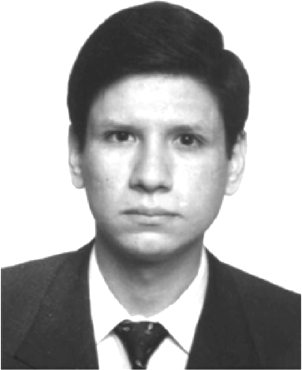 Cesar A. Santivanez合作论文数Internetwork Research Department, BBN Technology2
 Vikas Kawadia合作论文数Meta2Wanja Hofer合作论文数2Alex Colvin合作论文数2Molly Leecaster合作论文数2Robert S. Vincent合作论文数2Gary J Minden合作论文数Electrical Engineering & Computer Science
The University of Kansas2
Vikas Kawadia合作论文数Meta2Wanja Hofer合作论文数2Alex Colvin合作论文数2Molly Leecaster合作论文数2Robert S. Vincent合作论文数2Gary J Minden合作论文数Electrical Engineering & Computer Science
The University of Kansas2 Jake J. Abbott合作论文数Department of Mechanical Engineering, University of Utah2




