KCipher-2 is a word-oriented stream cipher and an ISOJEC 18033 standard. It is listed as a CRYPTREC cryptographic algorithm for Japanese governmental use. It consists of two feedback shift registers and a non-linear function. The size of each register in KCipher-2 is 32 bits and the non-linear function mainly applies 32-bit operations. Therefore, it can be efficiently implemented as software. SNOW-family stream ciphers are also word-oriented stream ciphers, and their high performance has already been demonstrated. We propose optimised implementations of KCipher-2 and compare their performance to that of the SNOW-family and other eSTREAM portfolios. The fastest algorithm is SNOW 2.0 and KCipher-2 is the second fastest despite the complicated irregular clocking mechanism. However, KCipher-2 is the fastest of the feasible algorithms, as SNOW 2.0 has been shown to have a security flaw. We also optimise the hardware implementation for the Virtex-5 field-programmable gate array (FPGA) and show two implementations. The first implementation is a rather straightforward optimisation and achieves 16,153 Mbps with 732 slices. In the second implementation, we duplicate the non-linear function using the structural advantage of KCipher-2 and we achieve 17,354 Mbps with 813 slices. Our implementation of KCipher-2 is around three times faster than those of the SNOW-family and efficiency, which is evaluated by "Throughput/Area (Mbps/slice)", is 3.6-times better than that of SNOW 2.0 and 8.5-times better than that of SNOW 3G. These syntheses are performed using Xilinx ISE version 12.4.
A key issue for an organization that is responsible for disaster and emergency management becomes how to gather reliable and useful information during a major disaster. We consider an information-gathering platform for large-scale disasters and emergencies based on mobile terminals. A simple solution to realize an information-gathering system is to construct a server where information is uploaded and published. However, such a centralized approach is not flexible nor is it robust. For example, it is very hard to find an appropriate system to which the user can upload information during a disaster, and the centralized server may be down because of overload or has been physically destroyed. We must consider a distributed and dynamic architecture for the system. Security and privacy issues are another concern that should be addressed for providing information from user's mobile terminals. We focus on a design of a privacy preserving data upload mechanism for the information-gathering system. We design the mechanism that accommodates privacy requirements and present a feasibility analysis of the mechanism.
Stream cipher-based hash function (SCH) is the one of new approachs to construct hash functions. However, the security and the design policy of SCH have not yet been studied sufficiently. In this paper, we analyze the security of SCHs focusing on the stream cipher function. First, we propose a model of SCHs which consist of a pre-computation function and a stream cipher. Then, we show that attacks against a stream cipher can also be threats to SCHs and discuss the security on each phase of SCH; message injection, blank rounds, and hash generation. Finally we derive the necessary conditions on the stream cipher function for an SCH to be secure.
In this paper, we present a first step for designing a privacy leakage diagnosis and protection system using two privacy definitions and a new definition, and then evaluate a prototype program. The diagnosis is based on major notions of privacy: k-anonymity and (c, l)-diversity. Furthermore, the diagnosis include another method that analyze sensitivity of each attribute values. The prototype program realizes a computation time of less than 1 ms for the diagnosis and updating of data. Thus, it provides a privacy-leakage level within a feasible computation time.
In this paper, the authors propose a new multisignature scheme with pairing-based cryptography, which can describe the tree structure of signers. In order to denote the relationship among a parent and its child signers, a dedicated middle key is generated on our scheme. In addition, we prove that our scheme is provably secure under the Gap-Diffie-Hellman assumption. Based on our proposal, we also implement the prototype of a document circulation system. In this system, a document is signed by members, who are divided into multiply layered groups. The browsing history can be confirmed by verifying the final signature on the document. The computational performance of the system is evaluated, and the result shows a good performance.
A challenging task in privacy protection for public data is to realize an algorithm that generalizes a table according to requirements of a data user. In this paper, we propose an anonymization scheme for generating a k-anonymous and l-diverse table, and show evaluation results using three different tables. Our scheme is based on both top-down and bottom-up approaches for full-domain and partial-domain generalization, and the requirements are automatically incorporated into the generated table. The generated table meets user's requirements and can be employed in the services provided by users without any modification or evaluation.
We present the design of an apparatus that creates a personal private communication channel over computer-embedded devices. The prototype implementation of the apparatus demonstrated that it can securely and intuitively link devices with no contact with an online server while imposing low overhead.
When a cellular phone is lost or stolen, it may be used improperly or the personal information may be stolen from it by a malicious user. Biometric authentication such as palm-print recognition is the strongest of the personal authentication technologies designed to prevent such misuse. Ito et al. proposed several palmprint recognition schemes using correspondence matching based on the phase-only correlation among various schemes. However, these schemes require a palmprint image to be captured with the hand touching the dedicated device, while palmprint images must be captured without such physical contact when using cellular phones. Thus these schemes cannot be applied to cellular phones since there are large positioning gaps and large differences in brightness and distortion between the images. Furthermore, they are not implemented in the cellular phone and their performances are not evaluated either. In this paper, we describe the palmprint recognition algorithm that adds Yörük et al.'s preprocessing technique to Ito et al.'s schemes, which are robust against the aforementioned problems. We propose a remote system, which has several advantages than the local system and thus is the main theme of this paper, between the cellular phone and authentication server using the aforementioned algorithm. We implement the proposed system, specially for the Android phone as a terminal of the user side. We also show the validity of the proposed system by confirming and considering the tested accuracy level. We furthermore show that the proposed system is practical by confirming the processing time.
In this paper we provide the first side-channel analysis of the K2 stream cipher. K2 is a fast and secure stream cipher built upon the strengths of SNOW 2.0. We apply timing attacks, power analysis, and differential fault analysis to K2. We show that naively implemented K2 is vulnerable to cache-timing attacks, and describe how to implement efficient countermeasures to protect K2 against side-channel attacks in hardware and software.
The complexity of the mobile phones has led to that many mobile phone manufacturers have entered into projects where the Linux operating system is made as a base for their mobile platforms. In this paper, we present some potential vulnerabilities of ALP 2.4 originate in the Linux kernel and propose countermeasures against them. Our proposal to eliminate these vulnerabilities contributes secure mobile services on ALP 2.4 or subsequent LiMo.
Many implementations of pairings on embedded devices such as mobile phones, sensor nodes, and smart cards have been developed. However, pairings at the security level equivalent to 128-bit AES key have not been implemented in mobile phones without a high-level OS such as Windows. The R-ate pairing is one of the fastest pairings over large prime fields. In this study, we implemented the R-ate pairing at the security level equivalent to 128-bit AES key on BREW mobile phones. We compared the processing time of the R-ate pairing with those of the Ate pairing and ηT pairing. In the results, the R-ate pairing was fastest pairing. Also, we compared the processing time of pairings with those of RSA and ECC on ARM9 225MHz. In the result, the processing time of the R-ate pairing was similar those of RSA and ECC.
This paper presents a flaw in the permission scheme of Android. The Android framework enforces a permission-based security policy where an application can access the other parts of the system only when the application is explicitly permitted. The security of the framework depends to a large extent on the owner of a device since the authorization decisions are mainly made by the user. As a result, the permission scheme imposes much of the administrative burden on the user instead of keeping it simple. Moreover, the framework does not impose enough controls nor support dynamic adjustment in the following respects: No naming rule or constraint is applied for a new permission declaration; once an application acquires a permission, the permission is never revoked during the lifetime of the application, two different permissions can be in use having the same name. These features of the framework can result in a security flaw. We explain how we found the flaw, demonstrate an exploit example, and discuss the solution.
This paper proposes a ternary subset difference method (SD method) that is resistant to coalition attacks In order to realize a secure ternary SD method we design a new cover finding algorithm label assignment algorithm and encryption algorithm These algorithms are required to revoke one or two subtrees simultaneously while maintaining resistance against coalition attacks We realize this two way revocation mechanism by creatively using labels and hashed labels Then we evaluate the efficiency and security of the ternary SD method We show that the number of labels on each client device can be reduced by about 204 percent The simulation results show that the proposed scheme reduces the average header length by up to 15 0 percent in case where the total number of devices is 65 536 On the other hand the computational cost imposed on a client de vice stays within O(log n) Finally we prove that the ternary SD method is secure against coalition attacks
In order to enhance user privacy and reduce management costs for identity providers, in this paper, a federated authentication mechanism with cryptographic ID management method is proposed. Based on the proposal, a proto-type was implemented and performance evaluations were carried out. The evaluation results shows feasible performance for practical implementation.
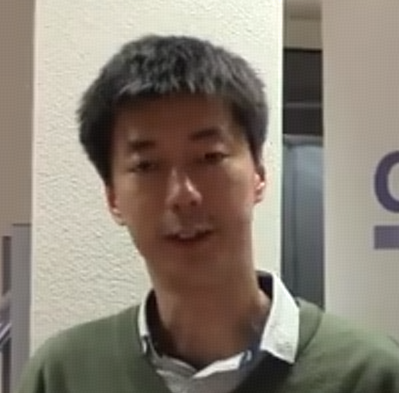 Shinsaku Kiyomoto合作论文数KDDI R&D Laboratories Inc.61
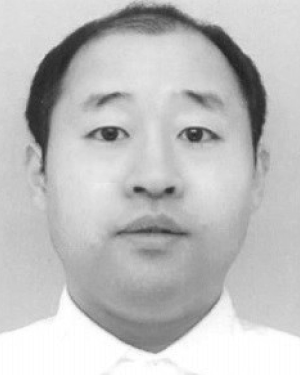 Kazuhide Fukushima合作论文数29
 Jun Kurihara合作论文数KDDI R&D Laboratories, Inc.12
 Kouichi Sakurai (櫻井幸一)合作论文数Department of Informatics, Faculty of Information Science and Electrical Engineering, Kyushu University11
 Haruki Ota合作论文数10Wook Shin合作论文数Illinois Security Lab., Department of
Computer Science, University of Illinois at Urbana-
Champaign, USA9
Haruki Ota合作论文数10Wook Shin合作论文数Illinois Security Lab., Department of
Computer Science, University of Illinois at Urbana-
Champaign, USA9 Ryu Watanabe合作论文数Department of Rheumatology and Hematology, Tohoku University Graduate School of Medicine9Masaki Inamura合作论文数8
 Yutaka Miyake合作论文数6Yuto Nakano合作论文数5toshiyuki fujisawa合作论文数4
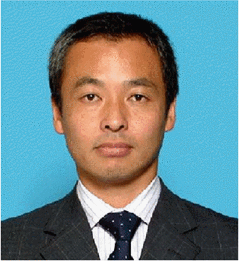 Kazuto Ogawa合作论文数Science & Technical Research Laboratories, Japan Broadcasting Corporation4Kazuki Yoneyama合作论文数NTT Information Sharing Platform Laboratories3
 Akira Yamada合作论文数Department of Cardiology, Nagoya University Graduate School of Medicine3
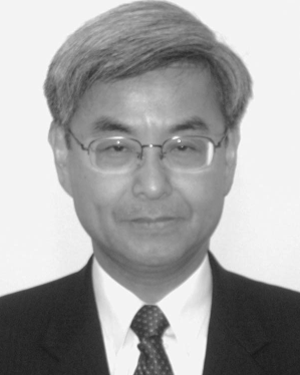 Kazuo Ohta合作论文数The University of Electro-Communications3Masahiro Kuroda合作论文数2Takeshi Kimura合作论文数2Koji Nakao合作论文数2
 Tsuyoshi Takagi合作论文数Department of Mathematical Informatics, Graduate School of Information Science and Technology, University of Tokyo2Mariko Yoshida合作论文数2
 Ayumu Kubota合作论文数2
 Satoshi Hada合作论文数IBM Research-Tokyo2Wun-She Yap合作论文数1Motoi Yoshitomi合作论文数1hideo matsuki合作论文数1tomoyoshi oono合作论文数1Shinsaku Kiyomoto合作论文数1Takemori, K.合作论文数1Oono, T.合作论文数1Takanashi, H.合作论文数1Matsuki, H.合作论文数1
 Carl A. Gunter合作论文数Department of Computer Science, The Grainger College of Engineering, University of Illinois at Urbana-Champaign1Yasushi Kondo合作论文数1Yoshinori Mitamura合作论文数1
 Ito Koichi (伊藤公一)合作论文数Laboratory of Biomedical Electromagnetics, Chiba University1Makoto Nishikawa合作论文数1H. Ohtsuka合作论文数1
 Keiichi Iwamura合作论文数1Tsukasa Ishiguro合作论文数1Osamu Nakamura合作论文数1
 Takafumi Aoki合作论文数Graduate School of Information Sciences,Tohoku University1
 Sanghoon Kwak合作论文数Dept. of EE, Sogang University1Matthew Henricksen合作论文数1




