Specification, simulation and optimization of sensors and actuators can be done through behavioral modeling using analog hardware description languages. The resulting models can be used in conjunction with models of the associated electronics to simulate a complete microsystem. This paper presents VHDL 1076.1 modeling considerations applicable to microsystem design and simulation. The methodology will be applied in the case of a Hall magnetic sensor.
In this paper we make use of a mixed analogue-digital HDL to model sampled-data systems. Modelling solutions are presented to code some sampled-data behaviour using either analogue or digital constructs of the language. Two key operations — sampling and shifting — are presented first. Then, these facilities are used to code difference equations. This approach is validated on the example of a sampled-data filter. Finally, a ‘real-life’ switched-capacitor A to D converter is modelled and simulated. The results are compared with a transistor-level description.
Miniaturized, integrated sensors and actuators are more and more used in m i c r o s y s t e m applications. In order to promote their use further, specialists must make them more accessible t o system designers. This can be done through behavioral modeling of sensors and actuators. The resulting models can be used in conjunction w i t h models of the associated electronics to simulate a complete microsystem. Additionally, models of t h e non-electrical environment (stimuli, other d e v i c e s ) should be developed too. This paper presents our contribution to solve this modeling and s i m u l a t i o n problem. We propose to use and eventually ex tend existing analog and mixed electronic design t o o l s in such a way that microsystems can be s imulated globally at an early stage of the design.
A method for the graphical specification and the automatic generation of analogue behavioural models is presented. This method has been implemented as a new software tool called ABSynth. The behaviour of the component to model is described as a functional diagram, which is then automatically translated into a VHDL-A-like analogue hardware description language. No syntax knowledge is necessary and the modelling time is reduced.
In order to master the growing complexity of analogue electronic systems, modelling and simulation of analogue hardware at various levels is absolutely necessary. This paper presents an original modelling method based on the graphical description of analogue electronic functional blocks. This method is intended to be automated and integrated into a design framework: specialists create behavioural models of existing functional blocks, that can then be used through high-level selection and specification. Applications of behavioural modelling are discussed.< >
The analytical modeling and simulation of conservative electrostatic, electromagnetic and electrodynamic transducers found in microsystems using a non-linear lumped-parameter approach is presented in this paper. A comparison is made between this approach and the linearized equivalent circuit method. All models of transducers are written in HDL-A/sup TM/, a proprietary analogue hardware description language (HDL). System-level simulation is performed in the SPICE simulator using behavioral models of the transducers. Finally, a parameter extraction and HDL model generation tool for devices is presented.
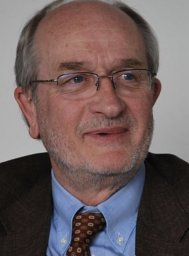 Fausto Pellandini合作论文数Institute of Microtechnology;University of Neuchâtel;Institute of Microtechnology, University of Neuchâtel8
 Hans Peter Amann合作论文数7A Boegli合作论文数5
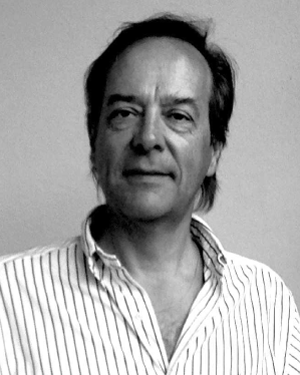 Philippe J. Renaud合作论文数Ecole Polytech Fed Lausanne, Lab Microsyst LMIS4, CH-1015 Lausanne, Switzerland4m laudon合作论文数4B. Romanowicz合作论文数3Philippe Lerch合作论文数3Astier, L.合作论文数1Romanowicz, B.合作论文数1
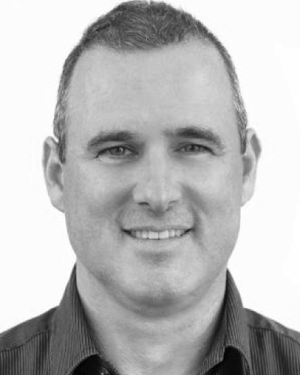 Christian Schott合作论文数1Pascal Nussbaum合作论文数1
 Radivoje Popovic合作论文数Swiss Federal Technology Institute of Lausanne1




