The study of bat species and their distribution is vital for understanding the origins and transmission pathways of epidemic diseases. However, the detection of wild bats faces significant challenges due to their complex natural habitats and frequent occlusions caused by social behavior. To address these issues, we propose an object detection method based on the improved You Only Look Once version 7 (YOLOv7) to achieve efficient wild bat detection (WB-YOLO). This method integrates a Vision Transformer encoder module to improve global context integration, adopts deformable convolution, and optimizes the spatial pyramid pooling structure for effective multi-scale feature fusion while reducing computational complexity. Furthermore, a hybrid attention mechanism is introduced to capture both spatial and channel information, enhancing robustness in complex environments. Experimental results in a data set of wild bat images collected in Anhui Province demonstrate that WB-YOLO achieves a precision of 90. 7%, a recall of 89. 0%, and a mean average precision (mAP) of 94. 7%, significantly outperforming other deep learning models in detecting bats in complex scenes and under occlusion. Our approach offers an efficient and accurate solution for the detection of wild bats in real time, with potential applications in ecological research and disease prevention. Code and data related to this work are publicly available at https://github.com/macandzzz/WB-YOLO.
针对传统支持向量机网格搜索算法寻优时间长,提出了一种识别率较高而且计算快速的人脸表情识别的方法.首先,使用Gabor小波技术获取人脸表情纹理特征,然后,经主成分分析法降维,得到 图像的 关键特征,将这些特征输入到 经麻雀搜索 算法(sparrow search algorithm,SSA)优化的支持向量机(support vector machine,SVM)进行表情的 分类.在JAFFE 数据集上进行实验识别率可达90.69%,在CK+数据集上识别率可达99.00%,并且在此数据集上和传统的网格搜索算法对比,在寻优的时间上更有优势.
针对无线可充电传感网(WRSNs)存在的充电难、效率低等问题,提出了一种多无人机协同无线可充电传感网充电路径规划方案(MC-CPP).首先描述了多无人机路径规划问题并建立了数学模型,然后针对问题模型提出了相应的深度强化学习(DRL)算法,算法借助了神经网络、贪婪策略和经验回放等获取无人机的充电飞行路径;最后无人机沿着规划的路径为网络中各待充电节点进行充电.实验结果表明,与传统Q学习方案相比,MC-CPP方案在获得了较优规划路径的同时,不仅能够减少充电无人机的数量和强化学习迭代次数,而且提高了无人机的能量利用率;与TSCA、NJNP、GC等方案相比,该方案能有效减少无人机飞行时间、节点死亡的数量及无人机能量消耗.
Aiming at the problem of how to improve the energy utilization rate of UAV (Unmanned Aerial Vehicle) in the charging process of wireless rechargeable sensor network, a charging path planning scheme for multi-UAV wireless rechargeable sensor network based on deep reinforcement learning is proposed. Firstly, the multi-UAV path planning problem is described and a network model is established, and then the network model is optimized by using the improved dynamic clustering algorithm of HEED, and then an intelligent path optimization algorithm based on the intelligent algorithm and deep reinforcement learning IA-DRL is proposed for the problem model. According to this algorithm, the optimal charging path of multiple drones is obtained, and finally the drones charge each node to be charged in the network. The experimental results show, compared with other traditional heuristic methods, IA-DRL has more advantages in solving small and medium-scale UAV path planning problems, and compared with the neural network model without PSO, the minimum AVG performance of IA-DRL is improved by about 3.8% and has a faster convergence speed about 550 episodes.
Information diffusion may lead to behaviors related to information content. This paper considers the co-existence of information and behavior diffusion in social networks. The state of users is divided into six categories, and the rules and model of collaborative diffusion of information and behavior are established. The influence of different parameters and conditions on the proportions of behavior diffusion nodes and information diffusion ones is analyzed experimentally. The results show that the proportion of nodes taking action in uniform networks is higher than that in non-uniform networks. Although users are more likely to take actions related to information content after spreading or knowing information, the results show that it has little influence on the proportion of users taking action. The proportion is mainly affected by the probability that users who do not take action become ones who take. The greater the probability, the less the proportion of nodes who know information. In addition, compared with choosing the same node as the initial information and behavior diffusion node, choosing different nodes is more beneficial to the diffusion of behaviors related to information content.
Due to the breakthrough of wireless power transfer technology, wireless rechargeable sensor networks (WRSNs) have the potential to provide sustainable work. Most existing researches on WRSNs usually focus on the cases that mobile charging vehicle moves freely through the sensors. However, for some applications, such as bridge monitoring, WRSNs are implemented in a three-dimensional space with obstacles, so the charging path may be blocked by the obstacles. To cope with this problem, charging scheduling to replenish a wireless rechargeable sensor network for bridge monitoring by an unmanned aerial vehicle (UAV) is studied. The problem is formulated as an optimization problem through optimizing UAV navigation path and sensor energy allocation collaboratively. This optimization problem is hard to be solved as both path navigation and energy allocation are required to be optimized simultaneously. To circumvent this challenge, an improved ant colony system algorithm (IM-ACS) is proposed to plan the trajectory of the UAV between sensors. By integrating enhancement factors and dynamic pheromone intensity coefficients, the convergence of the algorithm is accelerated. Then, a two-stage algorithm is proposed to schedule charging sequence and assign energy with limited energy carried by the UAV in each charging period. Experiments and simulations show that the proposed approach achieves shorter feasible trajectory paths and longer network lifetime than those obtained by the compared methods.
Charging optimization is an important research issue in wireless rechargeable sensor networks. The current researches on wireless charging mainly consider a single mobile charger to replenish sensors. However, a single mobile charger is difficult to meet the energy request of a large number of sensors. In this paper, a multiple mobile chargers replenishment approach is studied. First, an optimization problem is formulated to reduce charging energy consumption and path cost for enhancing charging efficiency. Then, due to the difficult of the problem, an improved bee colony algorithm is designed to schedule multiple charging vehicles for sensor energy replenishment at each period. Further, in order to decrease the number of starved sensors, a dynamic insertion method is integrated to insert the sensors with real-time request into the charging queue. Finally, the validity and feasibility of the proposed algorithm are evaluated by simulation in terms of the length of charging path, the total energy consumption of charging and the number of nodes violating constraints. The results demonstrate that the proposed approach can obtain more excellent solution than the compared approaches.
The one-to-one charging method for Wireless Rechargeable Sensor Networks (WRSNs) mobile chargers has some problems such as low charging efficiency and lack of directional charging model. To cope with the problems, a one-to-many directed charging scheduling scheme based on Maximizing Utility Charging (MUC) is proposed. In this scheme, the directed coverage subsets with the largest charging gain in the network is first searched; Then the charging anchor points are determined according to the directed coverage subset and the charger movement path is planned; Finally, the constraints of mobile charger energy and charging cycle are considered and the charging time is optimized Experimental results show that in comparation with Average Energy Charge (AEC) and Fixed Energy Charge (FEC) charging time optimization schemes, the charging efficiency of this scheme is increased by 13.7% and 32.7% respectively. In comparation with Maximum Node Coverage (MNC) and Maximum Average Gain Coverage (MAGC) subset screening schemes, the charging efficiency is increased by 4.4% and 35.9% respectively. In addition, the number of starved nodes in the network is significantly reduced compared with the MNC, MAGC schemes.
为了有效提取极短文本中的关键特征信息,提出了一种基于支持向量机的极短文本分类模型.首先对原数据进行数据清洗并利用jieba分词将清洗过的数据进行处理;再将处理后的数据存入数据库,通过TF-IDF进行文本特征的提取;同时,利用支持向量机对极短文本进行分类.经过1-0检验,验证了模型的有效性.实验以芜湖市社管平台中的9906条极短文本数据作为样本进行算法检验与分析.结果表明在分类准确率方面,该方法相比于朴素贝叶斯、逻辑回归、决策树等传统方法得到有效提高;在误分度与精确度指标上匹配结果更加均衡.
With the rapid development of mobile networks and the proliferation of mobile devices, Spatial Crowdsourcing (SC) has attracted the interest of industry and research groups. In addition to considering the specific spatial constraints in the existing research spatial crowdsourcing, each task has an effective duration, operational complexity, number of workers required, and incentive budget constraints. In this scenario, we studied the MQC-TA (Maximum Quality and Minimum Cost Task Assignment) problem. Firstly, the worker incentive model is established. The MQC-GAC algorithm is designed according to the MQC-TA problem to maximize the task completion quality and minimize the incentive budget. The algorithm combined the fast convergence of Genetic Algorithm and the positive feedback mechanism of Ant Colony Optimization Algorithm. Finally, the effectiveness and efficiency of the proposed method are verified by a comprehensive experiment on the data set.
如何进行高效合理的任务分配是当前空间众包(SC)研究中的关键问题之一.针对SC分配效能低的问题,建立了最佳质量任务分配模型(maximum quality task assignment model,MQTAM),并提出了基于改进粒子群算法的空间众包任务分配算法(SCTAM_PSO).该模型充分考虑了工作者到达工作地点后完成任务的时间延迟、完成任务的可信度等因素,通过SCTAM_PSO算法智能搜索最佳分配方案以最大化提高任务完成质量.实验结果及分析表明,MQTAM和SCTAM_PSO具有一定的有效性与可行性.
当下经济格局稳定但发展略有停滞,"一带一路"秉承区域合作理念,以中国的蓬勃发展为推动力,以"共商、共享、共建"实现沿线国家的政治、经济等交流与合作.本文搜集了近五年来一带一路的文献,通过中心性分析学术界的研究热点和社会关注的焦点.基于文献数据挖掘的角度阐释了"一带一路"的国际影响力,解读了其政策的合理性与高瞻性.
The selfishness of node or the non-cooperation of node in an opportunistic social network often leads to a decrease in the ef-ficiency of message transmission. To solve this problem,this paper proposes a node cooperative forwarding mechanism based on Merk-le hash tree. Firstly, the node encountering position prediction model is established according to the moving characteristics of the nodes. Secondly,the Merkle hash tree is constructed which can detect and delete selfish nodes. In addition,the updating the entire Merkle hash tree method is proposed. Finally,the appropriate forwarding node is selected according to the encounter distance which can ensure the collaborative forwarding of messages. The experiment results show that the proposed algorithm can accurately detect selfish nodes in the network and ensure the transmission of messages efficiently. Additionally,it is superior to the traditional Epidemic and DirectDelivery algorithms in terms of message delivery rate and transmission delay.
在傅里叶频域中,由于逆滤波对加性噪声特别敏感,使得恢复后的图像仍然非常模糊.针对这一问题,我们提出了一种基于维纳滤波器和生成对抗网络的动态模糊图像处理方法.首先使用维纳滤波去模糊算法,通过均方差最小化去除噪声,但由于无法判断拍摄装置的移动范围并未得到预期效果.再考虑使用自由性强、不受预定条件分布的生成对抗网络模型(GAN).定义一个类生成器G(y)和类判别器D(x),通过机器学习的方式进行反复学习和反馈,直至达到模型无法判别生成数据样本S(y)和真实数据样本r(x)时,图像近似还原成功.同时,引入"模糊核"概念,模拟图像的模糊轨迹,进行精确还原.最后,由于肉眼很难对图像的还原程度做定量判断.因此我们利用三个评价指标对这些图像进行客观评价——峰值性噪比PSNR、模糊系数KBlur、质量因素Q.实验结果表明,在该方法下的图像的三个评价指标在一定程度上有所改善,从而得到图像还原较为成功的结论.
近年来,随着生活节奏的提高和互联网的迅速发展,人们更倾向于在众多社交平台上用短文本进行交流,进而可能有人通过发布垃圾文本妨碍人们的正常社交,扰乱网络的绿色环境.为了解决这个问题,我们提出了基于TF-IDF和改进BP神经网络的社交平台垃圾文本检测的方法.通过该方法,实现对社交平台上的垃圾文本过滤.首先,通过结巴分词和去停分词构造关键词数据集;其次,对文本表示的关键词向量运用计算各关键词的权重从而对文本向量进行降维,得到特征向量;最后,在此基础上,运用BP神经网络分类器对短文本进行分类,检测出垃圾文本并进行过滤.实验结果表明用该方法在1000维文本特征向量的情况下分类平均准确率达到了97.720%.
选择合适的节点并将消息迅速转发到目标节点是机会社会网络关键问题之一.现有研究的不足主要是未充分考虑节点的社会属性以及节点的动态性.本文提出了一种基于贝叶斯概率树的转发节点选择(Bayesian Probabilistic Tree Forward Node Selection,BFANS)方法.根据节点具有的社会属性及相遇概率划分社区;社区内利用节点相遇概率值构建贝叶斯概率树;分别采用社区内和社区间两种方式进行消息的转发.实验表明,该方法在消息投递成功率上得到提高,并且降低消息的平均时延及路由开销比率.
为了有效提取极短文本中的关键特征信息,提出一种基于贝叶斯决策的极短文本分类模型.首先对原数据进行数据清洗并利用Jieba分词对清洗过的数据进行处理;然后利用Kettle工具提取分类所需关键词,并将处理后的数据存人数据库;最后利用贝叶斯决策对极短文本进行分类.通过(1-0)检验,验证模型的有效性.以一批极短文本数据作为样本进行实验,结果显示出该方法能够有效提高匹配效率,误分度与精确度指标的匹配结果更加均衡.
容忍网络中的布雷斯(Braess)路由悖论现象对于其网络拓扑设计的高效性和合理性的提升具有重要的意义。对容迟网络常用的路由算法进行了分析,得出链路状态路由算法克服了距离矢量路由算法收敛慢、容易成环的缺点;但此算法采用的是迪杰斯特拉(Dijkstra)算法,每次寻找的是最短路径,可能会在一定情况下出现悖论现象。因此通过博弈理论的基本原理分析了Braess悖论及其对偶形式的存在性,对应于上述算法中,在其他条件不变的前提下,增加网络负载权值,提高了选择过程的效率。最后,在仿真实验中随机建立容迟网络的路由节点,规定路由节点间的距离、传输速度等权值,并收集多组基于不同网络特征参数的数据样本,编程来模拟路由算法并进行数据分析,进一步验证了Braess悖论在容迟网络路由算法中的存在。
随着智能终端设备的不断普及,微信、网络即时新闻、电商客户产品评论等富含极短文本数据的信息呈爆发式增长。为了有效提取极短文本中的关键特征信息,提出了一种基于支持向量机的极短文本分类模型。首先对原数据进行数据清洗并利用Jieba分词将清洗过的数据进行处理;再将处理后的数据存入数据库,通过TF-IDF进行文本特征的提取;同时,利用支持向量机对极短文本进行分类。经过(1-0)检验,验证了模型的有效性。实验以芜湖市社管平台中的9906条极短文本数据作为样本进行算法检验与分析。结果表明在分类准确率方面,该方法相比于朴素贝叶斯、逻辑回归、决策树等传统方法得到有效提高;在误分度与精确度指标上匹配结果更加均衡。
云服务市场快速增长,为了节约运营成本,提升用户满意度,云服务定价优化问题受到学术界和云服务提供商的密切关注.本文在Tiebout模型基础上提出了一种基于多元回归的云服务定价优化方法(Optimized Pricing Model for Cloud Services,OPMCS).首先分析Tiebout模型并提炼出影响云服务定价的主要因素;再结合云服务平台特征,利用多元回归建立定价优化模型.模型采用密度峰值聚类对资源进行分类以高效合理地将资源分配给用户.此外,考虑到影响定价的因素会随时间而变化,模型引入动态时间因子进行价格修正.实验结果表明,本文提出的OPMCS具有一定的可用性和合理性.
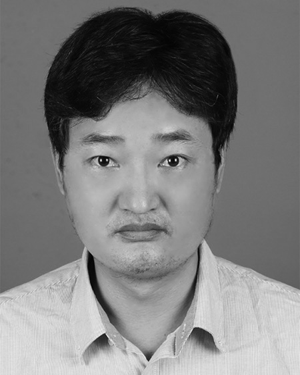 ChuanXin Zhao合作论文数School of Mathematics and Computer Science, Anhui Normal University32
 Fulong Chen (陈付龙)合作论文数Department of Computer Science and Technology, School of Computer and Information, Anhui Normal University14
 Yakun Huang (黄亚坤)合作论文数School of Computer Science, Beijing University of Posts and Telecommunications13
 ShanShan Xu (许闪闪)合作论文数7
 ChenXi Zhao (赵晨曦)合作论文数6ShaoFen Huang (黄少芬)合作论文数5
 Ruchuan Wang (王汝传)合作论文数School of Computer Science, Nanjing University of Posts and Telecommunications5YANG Na-na (杨娜娜)合作论文数4Lei Zhen (甄磊)合作论文数4Chang LI (李昌)合作论文数4Linjing Zhang (张林静)合作论文数4Shicheng Ai (艾世成)合作论文数3DeCheng Zhang (张德成)合作论文数3Yuanting Yan (严远亭)合作论文数School of Computer Science and Technology of Anhui University3Keben You (尤科本)合作论文数3
 Baohua Zhao (赵保华)合作论文数中国科学技术大学计算机系3Dan Meng (孟丹)合作论文数同盾科技3
 Xin Zhang合作论文数2ZHANG Guanghai (张广海)合作论文数2Pu-le XU (许普乐)合作论文数2Qiangjun Zhu (朱强军)合作论文数2Ming-xing WANG (王明星)合作论文数2Shu-Yi ZHANG (张舒宜)合作论文数2WenBo Song (宋文博)合作论文数2ChaoBin Wang (王朝斌)合作论文数2Kai Kang (康凯)合作论文数2Qun Fang (方群)合作论文数2WeiDong Zhang (张卫东)合作论文数2
 Zhijie Han (韩志杰)合作论文数Henan University2Qingxiang Meng合作论文数2
 Wenkai Han合作论文数Anhui Normal University, Anhui Normal University2Mengyao Wang (王梦瑶)合作论文数2Kun Deng (邓琨)合作论文数2Zhu Zhao-xia (朱朝霞)合作论文数1
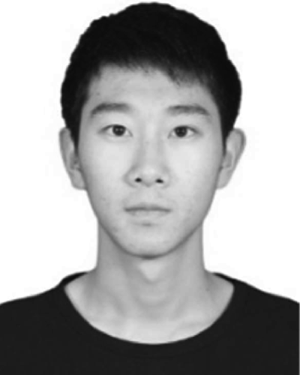 Yancheng Yao合作论文数1Hengjing Zhang合作论文数1Fei-Fan WANG (王非凡)合作论文数1Shan Tianle合作论文数1Jia-jing WU (吴家菁)合作论文数1Hui Zhang合作论文数1Xiao-Jing YAN (闫小敬)合作论文数1Na Zhang合作论文数1Min NAN (南敏)合作论文数1Xin ZHANG (张鑫)合作论文数1XiuLin Jiang (蒋秀林)合作论文数1Yu Zheng (征宇)合作论文数1Yong Ren (任永)合作论文数1HongMei Chen (陈洪美)合作论文数1ZiLong Guo (郭子龙)合作论文数1




