In representation learning, uniformity refers to the uniform feature distribution in the latent space (i.e., unit hypersphere). Previous work has shown that improving uniformity contributes to the learning of under-represented classes. However, most of the previous work focused on classification; the representation space of imbalanced regression remains unexplored. Classification-based methods are not suitable for regression tasks because they cluster features into distinct groups without considering the continuous and ordered nature essential for regression. In a geometric aspect, we uniquely focus on ensuring uniformity in the latent space for imbalanced regression through two key losses: enveloping and homogeneity. The enveloping loss encourages the induced trace to uniformly occupy the surface of a hypersphere, while the homogeneity loss ensures smoothness, with representations evenly spaced at consistent intervals. Our method integrates these geometric principles into the data representations via a Surrogate-driven Representation Learning (SRL) framework. Experiments with real-world regression and operator learning tasks highlight the importance of uniformity in imbalanced regression and validate the efficacy of our geometry-based loss functions. Code is available here.
Domain generalization aims to develop models that are robust to distribution shifts. Existing methods focus on learning invariance across domains to enhance model robustness, and data augmentation has been widely used to learn invariant predictors, with most methods performing augmentation in the input space. However, augmentation in the input space has limited diversity whereas in the feature space is more versatile and has shown promising results. Nonetheless, feature semantics is seldom considered and existing feature augmentation methods suffer from a limited variety of augmented features. We decompose features into class-generic, class-specific, domain-generic, and domain-specific components. We propose a cross-domain feature augmentation method named XDomainMix that enables us to increase sample diversity while emphasizing the learning of invariant representations to achieve domain generalization. Experiments on widely used benchmark datasets demonstrate that our proposed method is able to achieve state-of-the-art performance. Quantitative analysis indicates that our feature augmentation approach facilitates the learning of effective models that are invariant across different domains.
Generalizing to out-of-distribution (OOD) data or unseen domain, termed OOD generalization, still lacks appropriate theoretical guarantees. Canonical OOD bounds focus on different distance measurements between source and target domains but fail to consider the optimization property of the learned model. As empirically shown in recent work, the sharpness of learned minima influences OOD generalization. To bridge this gap between optimization and OOD generalization, we study the effect of sharpness on how a model tolerates data change in domain shift which is usually captured by "robustness" in generalization. In this paper, we give a rigorous connection between sharpness and robustness, which gives better OOD guarantees for robust algorithms. It also provides a theoretical backing for "flat minima leads to better OOD generalization". Overall, we propose a sharpness-based OOD generalization bound by taking robustness into consideration, resulting in a tighter bound than non-robust guarantees. Our findings are supported by the experiments on a ridge regression model, as well as the experiments on deep learning classification tasks.
Mixup is a popular data augmentation technique for training deep neural networks where additional samples are generated by linearly interpolating pairs of inputs and their labels. This technique is known to improve the generalization performance in many learning paradigms and applications. In this work, we first analyze Mixup and show that it implicitly regularizes infinitely many directional derivatives of all orders. Based on this new insight, we propose an improved version of Mixup, theoretically justified to deliver better generalization performance than the vanilla Mixup. To demonstrate the effectiveness of the proposed method, we conduct experiments across various domains such as images, tabular data, speech, and graphs. Our results show that the proposed method improves Mixup across multiple datasets using a variety of architectures, for instance, exhibiting an improvement over Mixup by 0.8% in ImageNet top-1 accuracy.
We denote by z = (x,y) the input and output pair where x ∈ X ⊆ R and y ∈ Y ⊆ R . Let fθ(x) ∈ R be the output of the logits (i.e., the last layer before the softmax or sigmoid) of the model parameterized by θ. We use l(θ, z) = h(fθ(x)) − yfθ(x) to denote the loss function. Let g(·) be the activation function. We use x(i) to index i-th element of the vector x and xj to represent j-th variable in a set. The notation list is:
We present a versatile model, FaceAnime, for various video generation tasks from still images. Video generation from a single face image is an interesting problem and usually tackled by utilizing Generative Adversarial Networks (GANs) to integrate information from the input face image and a sequence of sparse facial landmarks. However, the generated face images usually suffer from quality loss, image distortion, identity change, and expression mismatching due to the weak representation capacity of the facial landmarks. In this paper, we propose to "imagine" a face video from a single face image according to the reconstructed 3D face dynamics, aiming to generate a realistic and identity-preserving face video, with precisely predicted pose and facial expression. The 3D dynamics reveal changes of the facial expression and motion, and can serve as a strong prior knowledge for guiding highly realistic face video generation. In particular, we explore face video prediction and exploit a well-designed 3D dynamic prediction network to predict a 3D dynamic sequence for a single face image. The 3D dynamics are then further rendered by the sparse texture mapping algorithm to recover structural details and sparse textures for generating face frames. Our model is versatile for various AR/VR and entertainment applications, such as face video retargeting and face video prediction. Superior experimental results have well demonstrated its effectiveness in generating high-fidelity, identity-preserving, and visually pleasant face video clips from a single source face image.
Model-Agnostic Meta-Learning (MAML) aims to find initial weights that allow fast adaptation to new tasks. The adaptation (inner loop) learning rate in MAML plays a central role in enabling such fast adaptation. However, how to choose this value in practice and how this choice affects the adaptation error remains less explored. In this paper, we study the effect of the adaptation learning rate in meta-learning with mixed linear regression. First, we present a principled way to estimate optimal adaptation learning rates that minimize the population risk of MAML. Second, we interpret the underlying dependence between the optimal adaptation learning rate and the input data. Finally, we prove that compared with empirical risk minimization (ERM), MAML produces an initialization with a smaller average distance to the task optima, consistent with previous practical findings. These results are corroborated with numerical experiments.
Clinical applications that involves risk stratification of patients often predict the likely occurrence of an event such as the development of a complication as well as the time to the next event. Existing approaches that provide individual survival distribution across time often use baseline measurements for the risk prediction of an event occurring, and is unable to estimate the time to next event. Further, they do not deal with the complex and heterogeneous information from past visit records, and hence do not handle repeated events which are common in chronic diseases. We address the above limitations by designing a recurrent temporal time process network that incorporates longitudinal visit information to increase the accuracy of risk predictions for clinical events and to estimate the time to next event. Our proposed solution utilizes a recurrent neural network to learn a latent representation of patient visit history. This representation enables us to approximate the conditional intensity function of the temporal point process, from which we derive the survival probability function to obtain the risk of an event occurring and to estimate the time to next event. We demonstrate our approach on two real-world healthcare datasets and show that the proposed approach is able to achieve a significant performance improvement over state-of-the-art methods.
Few-shot learning ability is heavily desired for machine intelligence. By meta-learning a model initialization from training tasks with fast adaptation ability to new tasks, model-agnostic meta-learning (MAML) has achieved remarkable success in a number of few-shot learning applications. However, theoretical understandings on the learning ability of MAML remain absent yet, hindering developing new and more advanced meta learning methods in a principled way. In this work, we solve this problem by theoretically justifying the fast adaptation capability of MAML when applied to new tasks. Specifically, we prove that the learnt meta-initialization can benefit the fast adaptation to new tasks with only a few steps of gradient descent. This result explicitly reveals the benefits of the unique designs in MAML. Then we propose a theory-inspired task similarity aware MAML which clusters tasks into multiple groups according to the estimated optimal model parameters and learns group-specific initializations. The proposed method improves upon MAML by speeding up the adaptation and giving stronger few-shot learning ability. Experimental results on the few-shot classification tasks testify its advantages.
Despite the great progress made by deep CNNs in image semantic segmentation, they typically require a large number of densely-annotated images for training and are difficult to generalize to unseen object categories. Few-shot segmentation has thus been developed to learn to perform segmentation from only a few annotated examples. In this paper, we tackle the challenging few-shot segmentation problem from a metric learning perspective and present PANet, a novel prototype alignment network to better utilize the information of the support set. Our PANet learns class-specific prototype representations from a few support images within an embedding space and then performs segmentation over the query images through matching each pixel to the learned prototypes. With non-parametric metric learning, PANet offers high-quality prototypes that are representative for each semantic class and meanwhile discriminative for different classes. Moreover, PANet introduces a prototype alignment regularization between support and query. With this, PANet fully exploits knowledge from the support and provides better generalization on few-shot segmentation. Significantly, our model achieves the mIoU score of 48.1% and 55.7% on PASCAL-5i for 1-shot and 5-shot settings respectively, surpassing the state-of-the-art method by 1.8% and 8.6%.
Predicting the future is a fantasy but practicality work. It is the key component to intelligent agents, such as self-driving vehicles, medical monitoring devices and robotics. In this work, we consider generating unseen future frames from previous observations, which is notoriously hard due to the uncertainty in frame dynamics. While recent works based on generative adversarial networks (GANs) made remarkable progress, there is still an obstacle for making accurate and realistic predictions. In this paper, we propose a novel GAN based on inter-frame difference to circumvent the difficulties. More specifically, our model is a multi-stage generative network, which is named the Difference Guided Generative Adversarial Network (DGGAN). The DGGAN learns to explicitly enforce future-frame predictions that is guided by synthetic inter-frame difference. Given a sequence of frames, DGGAN first uses dual paths to generate meta information. One path, called Coarse Frame Generator, predicts the coarse details about future frames, and the other path, called Difference Guide Generator, generates the difference image which include complementary fine details. Then our coarse details will then be refined via guidance of difference image under the support of GANs. With this model and novel architecture, we achieve state-of-the-art performance for future video prediction on UCF-101, KITTI.
Meta learning is a promising solution to few-shot learning problems. However, existing meta learning methods are restricted to the scenarios where training and application tasks share the same out-put structure. To obtain a meta model applicable to the tasks with new structures, it is required to collect new training data and repeat the time-consuming meta training procedure. This makes them inefficient or even inapplicable in learning to solve heterogeneous few-shot learning tasks. We thus develop a novel and principled HierarchicalMeta Learning (HML) method. Different from existing methods that only focus on optimizing the adaptability of a meta model to similar tasks, HML also explicitly optimizes its generalizability across heterogeneous tasks. To this end, HML first factorizes a set of similar training tasks into heterogeneous ones and trains the meta model over them at two levels to maximize adaptation and generalization performance respectively. The resultant model can then directly generalize to new tasks. Extensive experiments on few-shot classification and regression problems clearly demonstrate the superiority of HML over fine-tuning and state-of-the-art meta learning approaches in terms of generalization across heterogeneous tasks.
Pursuing more complete and coherent scene understanding towards realistic vision applications drives edge detection from category-agnostic to category-aware semantic level. However, finer delineation of instance-level boundaries still remains unexcavated. In this work, we address a new finer-grained task, termed panoptic edge detection (PED), which aims at predicting semantic-level boundaries for stuff categories and instance-level boundaries for instance categories, in order to provide more comprehensive and unified scene understanding from the perspective of edges.We then propose a versatile framework, Panoptic Edge Network (PEN), which aggregates different tasks of object detection, semantic and instance edge detection into a single holistic network with multiple branches. Based on the same feature representation, the semantic edge branch produces semantic-level boundaries for all categories and the object detection branch generates instance proposals. Conditioned on the prior information from these two branches, the instance edge branch aims at instantiating edge predictions for instance categories. Besides, we also devise a Panoptic Dual F-measure (F2) metric for the new PED task to uniformly measure edge prediction quality for both stuff and instances. By joint end-to-end training, the proposed PEN framework outperforms all competitive baselines on Cityscapes and ADE20K datasets.
We tackle the problem of person re-identification in video setting in this paper, which has been viewed as a crucial task in many applications. Meanwhile, it is very challenging since the task requires learning effective representations from video sequences with heterogeneous spatial-temporal information. We present a novel method - Spatial-Temporal Synergic Residual Network (STSRN) for this problem. STSRN contains a spatial residual extractor, a temporal residual processor and a spatial-temporal smooth module. The smoother can alleviate sample noises along the spatial-temporal dimensions thus enable STSRN extracts more robust spatial-temporal features of consecutive frames. Extensive experiments are conducted on several challenging datasets including iLIDS-VID, PRID2011 and MARS. The results demonstrate that the proposed method achieves consistently superior performance over most of state-of-the-art methods.
 Jiashi Feng (冯佳时)合作论文数Tencent6
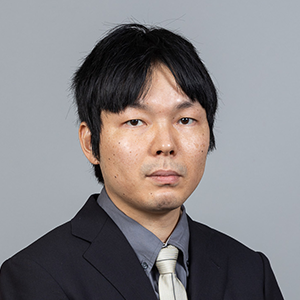 Kenji Kawaguchi合作论文数Department of Computer Science, School of Computing, National University of Singapore;Deep Learning Lab, National University of Singapore;Institute of Data Science, National University of Singapore3
 Wynne Hsu合作论文数Department of Computer Science, School of Computing, National University of Singapore;Institute of Data Science, National University of Singapore3
 Yingnan Liu (柳颖楠)合作论文数School of Computing, National University of Singapore2
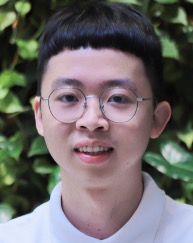 Fusheng Liu合作论文数Institute of Data Science, National University of Singapore2
 Vikas Verma合作论文数UOB2
 Mong Li Lee (Janice)合作论文数Department of Computer Science, School of Computing, National University of Singapore2
 Hieu Pham合作论文数Augment2
 Yichi Zhang合作论文数1Chongyao Chen合作论文数1Yilei Wu合作论文数1
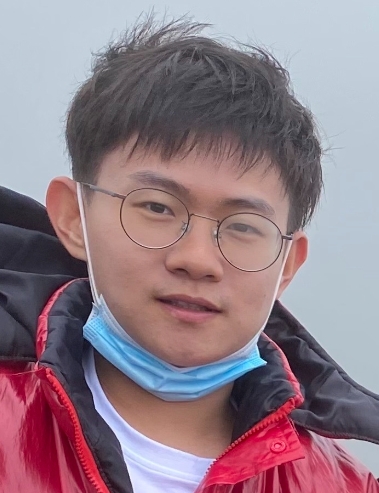 Zijian Dong合作论文数Multimodal Neuroimaging Lab, Yong Loo Lin School of Medicine, National University of Singapore;Department of Electrical and Computer Engineering, College of Design and Engineering, National University of Singapore1
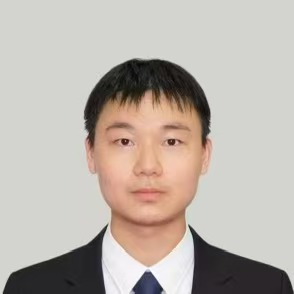 Daquan Zhou (周大权)合作论文数School of Electronic and Computer Engineering, Peking University;Bytedance Inc.1
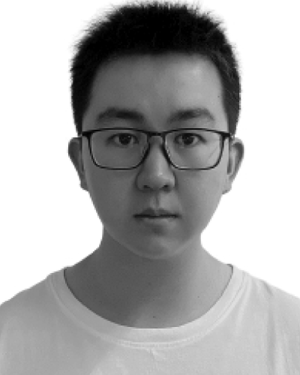 Yiming Hu合作论文数1
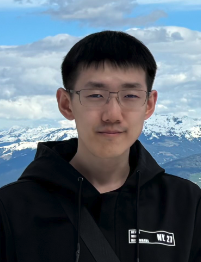 Rui Qiao (乔锐)合作论文数School of Computing, National University of Singapore1
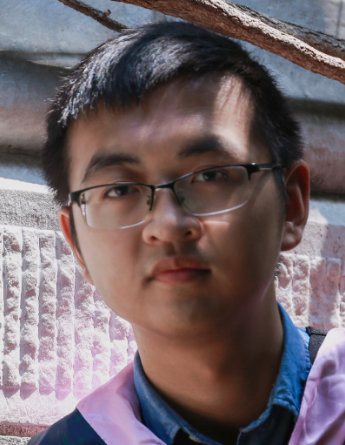 Kaixin Wang合作论文数Technion - Israel Institute of Technology1
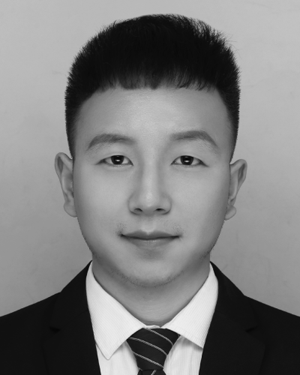 Wenjie Ai合作论文数1Wai Hoh Tang合作论文数Department of Statistics and Data Science, NUS1
 Amanda Yun Rui Lam合作论文数Singapore General Hospital1
 Xinxing Su合作论文数1Guohao Ying合作论文数1
 Sarthak Mittal合作论文数Mila - Quebec Artificial Intelligence Institute;Meta1
 Juan Helen Zhou合作论文数Department of Electrical and Computer Engineering, College of Design and Engineering, National University of Singapore;Centre for Sleep and Cognition, Yong Loo Lin School of Medicine, National University of Singapore;Duke-NUS Medical School1
 Mong Li Lee合作论文数Department of Computer Science, School of Computing, National University of Singapore1
 Zhifeng Li (李志锋)合作论文数Tencent AI Lab1
 Qianxiao Li (李千骁)合作论文数Department of Mathematics, National University of Singapore;Institute of Functional Intelligent Materials, National University of Singapore1
 Yuan Hu合作论文数University of Chinese Academy of Sciences, Beijing 100049, China1
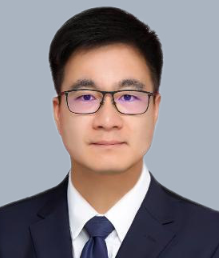 Jian Zhao (赵健)合作论文数School of Artificial Intelligence, Optics and Electronics, Northwestern Polytechnical University;Evolutionary Visione+x Oriented Learning Lab, TeleAI of China Telecom1
 Steven Hoi (许主洪)合作论文数1
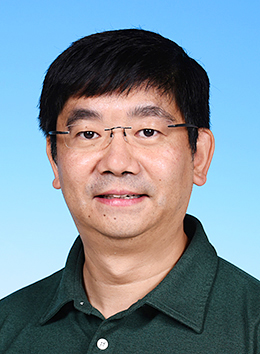 Yuan Yao (姚遠)合作论文数Department of Mathematics, School of Science, Hong Kong University of Science and Technology1
 David Carmody合作论文数1
 Shuangjie Xu合作论文数Deeproute.ai1
 Yu Cheng (成宇)合作论文数The Chinese University of Hong Kong;Skywork AI1
 Zhikang Wang合作论文数1
 Mo Yu (于墨)合作论文数Pattern Recognition Center, WeChat AI1
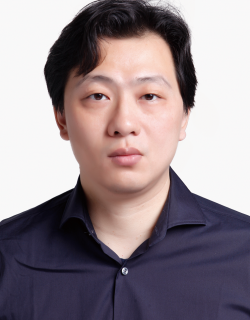 Wei Liu (刘威)合作论文数Video Rebirth1
 Xiao-Tong Yuan (袁晓彤)合作论文数School of Intelligence Science and Technology, Nanjing University1
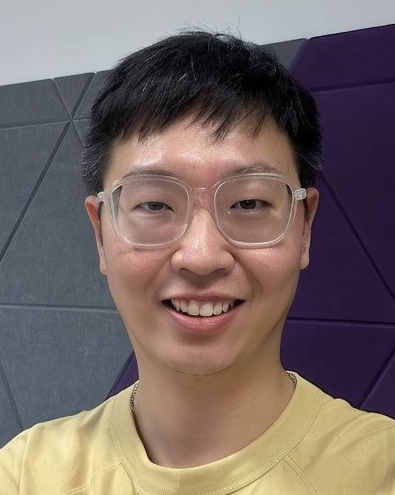 Jun Hao Liew合作论文数ByteDance Research;TikTok1
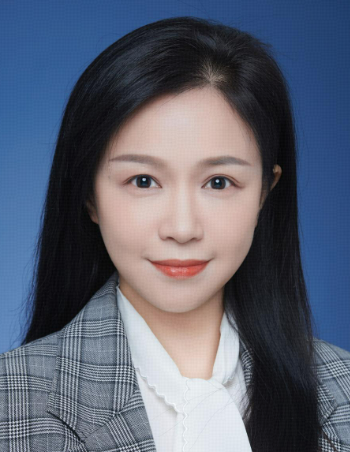 Lin Wan (万琳)合作论文数School of Software Engineering, Huazhong University of Science and Technology1
 Marcus Eng Hock Ong (王英福)合作论文数Department Of Emergency Medicine, Singapore General Hospital1
 Yoshua Bengio (约书亚·本希奥)合作论文数Departement d'informatique et de Recherche Operationnelle, Faculte des Arts et des Sciences, Universite de Montreal;Mila - Quebec Artificial Intelligence Institute;LawZero1
 Guodong Guo合作论文数Department of Computer Science and Electrical Engineering, Benjamin M. Statler College of Engineering and Mineral Resources, West Virginia University;Computer Vision Laboratory, Center for Identification Technology Research, West Virginia University1
 Pan Zhou (周潘)合作论文数School of Electronic Information and Communications, Huazhong University and Science and Technology;School of Cyber Science and Engineering, Huazhong University and Science and Technology1
 Jian Dong合作论文数College of Systems Engineering, National University of Defense Technology1
 Juho Kannala合作论文数Department of Computer Science, School of Science, Aalto University1
 Arno Solin合作论文数Aalto University1
 Caiming Xiong合作论文数Stealth Mode Startup Company1
 Xiaoguang Tu合作论文数1




