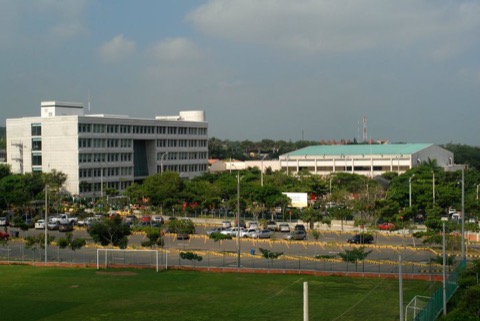
A private, non-affiliated institution, the University of the North (Spanish: Universidad del Norte), also nicknamed Uninorte, is the main academic center for higher education in northern Colombia. It is located in Barranquilla, Atlántico, the largest city and second largest port in the country's Caribbean region. It was founded in 1966 by a business group led by American entrepreneur Karl C. Parrish. It started academic operation on July 11, 1966, with 58 students and 10 teachers in core courses of business administration and engineering.According to a recent ranking by Colombian consulting firm BOT SAS, Universidad del Norte is listed among the five best universities in the country.The university has ten academic divisions, including Engineering, Administrative Sciences, Humanities and Social Sciences, Health Sciences, Legal Sciences, and Basic Sciences. It offers degrees in industrial, mechanical, systems, civil, electrical and electronic engineering. Other degrees include medicine, business administration, law, psychology, international relations, international business, Math, Industrial design, graphic design and architecture. In total, Uninorte offers 28 undergraduate programs, 62 professional specialization programs, 50 master's programs, and 15 doctoral programs. The university also offers some specialization programs in the nearby ports of Santa Marta and Cartagena.All engineering programs are accredited by the ABET, which is one of the most important international accreditation agencies, located in Baltimore, Maryland, United States.Uninorte is one of the most important cultural and technological centers in the Caribbean region of Colombia.

The Comprehensive Policy for the Prevention and Care of Psychoactive Substance Use in Colombia aims to improve the care provided to people, families, and communities at risk or struggling with psychoactive substance use through prevention and mitigation programs. The effectiveness of these programs depends on both population participation and access to intervention centers. This study proposes a bi-objective integer programming model within a location-allocation framework to support policy decisions under budget constraints. To estimate drug-related risk, we integrate sentiment analysis from social media data (X, formerly Twitter) as a key input into the optimization model. Specifically, negative sentiment derived from posts is used to inform the spatial distribution of risk between locations. The model simultaneously minimizes population-level risk and distance to services, while ensuring equitable coverage based on multidimensional poverty and rurality. The proposed approach was applied to real-world data from Atlántico. The results demonstrated that the bi-objective model achieved an average coverage of 24.67
Planning on-street parking for cars and trucks in urban areas with limited curbside space poses significant challenges for decision-makers. This paper proposes a flexible, multi-criteria planning tool for allocating onstreet parking that accounts for heterogeneous user needs. The problem is formulated as a Mixed-Integer Programming (MIP) model, suitable for applications where real-time information is unavailable, during initial planning stages, or when curbside space must be reallocated. The allocation criteria aim to maximize the level of service within the planning area, defined in terms of the number of users served, infrastructure utilization, and parking search impacts. Results show that explicitly modeling cars and trucks separately substantially alters optimal allocation outcomes, increasing truck service by up to 50%, reducing truck parking search time by 75%, and increasing the parking search component of the objective function by 8%. Sensitivity analyses further indicate that prioritizing user types yields moderate changes in performance (-3% to +9%), whereas shifting the planning emphasis between service and utilization versus minimizing parking search externalities leads to the largest improvements, increasing the overall level of service by up to 153%. These findings highlight the importance of accounting for user heterogeneity in curbside planning and demonstrate the usefulness of the proposed tool in supporting objective-driven parking allocation decisions.
Altermagnetism -a magnetic state characterized by spin-polarized electronic bands at zero net magnetization- offers a promising route for next-generation spintronic devices. In two-dimensional (2D) magnets, twist engineering enables its realization by breaking the combined inversion and time-reversal symmetry (PT) while preserving crystal symmetries that ensure the altermagnetic order. Here, by means of first-principles calculations and symmetry analysis, we demonstrate that twist engineering applied to the recently synthesized metallic van der Waals antiferromagnet Co-doped bilayer Fe$_3$GaTe$_2$ (Fe$_2$CoGaTe$_2$) provides a robust platform for altermagnetism. By twisting two layers of Fe$_2$CoGaTe$_2$, the PT symmetry between opposite spin sublattices is broken, resulting in a non-relativistic $i$-wave altermagnetic state with spin splitting up to 138 meV. In the absence of spin-orbit coupling (SOC), the electronic states are spin-degenerate along six high-symmetry directions, while the inclusion of SOC preserves this degeneracy along the three directions protected by twofold rotation axes. Furthermore, we unveil the microscopic mechanisms governing the magnetic behavior in twisted Fe$_2$CoGaTe$_2$. Our results establish twist engineering and metallic Fe-based van der Waals antiferromagnets as versatile platforms to realize 2D van der Waals altermagnetism, with potential for designing high-efficiency ultrathin nanodevices.
Physical and side-channel attacks often expose noisy or partial information about cryptographic secrets rather than exact key values. As the deployment of post-quantum cryptography (PQC) progresses, this risk is amplified by the widespread use of compact secret seeds that are deterministically expanded into large key material. Even probabilistic, bitwise leakage about such seeds may therefore reduce the effective security of deployed PQC implementations. This work adopts the bitwise Bayesian leakage model (BBLM) as a practical abstraction for leakage scenarios in which adversaries obtain per-bit posterior information about a secret, as commonly occurs in cold-boot attacks, partial key exposure, and classifier-based side-channel analysis. Within this model, we study a posterior-guided seed-recovery framework that ranks candidates using likelihood-based scores and validates them through a deterministic public-key oracle under explicit time and memory constraints. We instantiate the framework in the context of cold-boot leakage and evaluate its behavior for abstract seed lengths up to 256 bits. The results indicate that posterior-guided enumeration combined with oracle-based validation can substantially improve recovery efficiency compared to uninformed search, even for algebraically structureless seeds. To illustrate practical applicability, we describe how deterministic validation oracles arise naturally in representative post-quantum schemes, including RYDE, UOV, and FAEST. While the experimental evaluation focuses on cold-boot attacks, the framework applies more broadly to other probabilistic leakage sources, providing a resource-aware methodology for assessing key-recovery risks in deployed and emerging PQC systems.
Within the family of altermagnets, CrSb is a metallic, collinearly ordered material that exhibits particularly strong symmetry-induced spin splitting in its band structure. In this study, we combine electrical magnetotransport measurements up to 68 T on microfabricated single-crystalline CrSb with first-principles calculations to investigate its Fermi surface. Notably, we study the temperature and field-orientation dependence of magnetic quantum oscillations observed in the magnetoresistance. The observed frequency spectrum agrees well with results from density-functional-theory calculations. Our results confirm the predicted electronic band structure of altermagnetic CrSb and highlight the importance of high magnetic fields for accurately mapping the Fermi surfaces of unconventional emergent materials.





