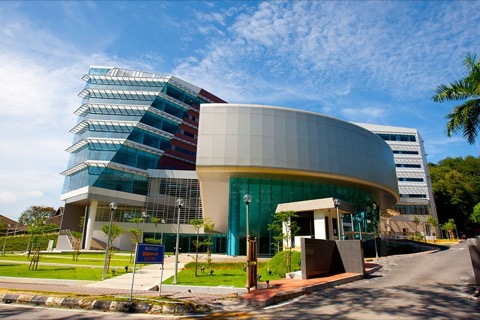
The University of Malaya (Malay: Universiti Malaya; abbreviated as UM) is a public research university located in Kuala Lumpur, Malaysia. It is the oldest and highest ranking Malaysian institution of higher education according to two international ranking agencies, and also the only university in the post-independent Malaya. The university has graduated four prime ministers of Malaysia, and other political, business, and cultural figures of national prominence.The predecessor of the university, King Edward VII College of Medicine, was established on 28 September 1905 in Singapore, then a territory of the British Empire. In October 1949, the merger of the King Edward VII College of Medicine and Raffles College created the university. Rapid growth during its first decade caused the university to organize as two autonomous divisions on 15 January 1959, one located in Singapore and the other in Kuala Lumpur. In 1960, the government of Malaysia indicated that these two divisions should become autonomous and separate national universities. One branch was located in Singapore, later becoming the National University of Singapore after the independence of Singapore from Malaysia, and the other branch was located in Kuala Lumpur, retaining the name University of Malaya. Legislation was passed in 1961 and the University of Malaya was established on 1 January 1962. In 2012, UM was granted autonomy by the Ministry of Higher Education.Today, UM has more than 2,500 faculty members[citation needed] and is divided into thirteen faculties, two academies, five institutes and six academic centres. In the latest QS World University Rankings, UM is currently ranked 65th in the world, 9th in Asia, 3rd in Southeast Asia and the highest ranked learning institution in Malaysia.The Faculty of Languages and Linguistics, Japanese Language and Linguistic Course was awarded the Japanese Foreign Minister’s Commendation for their contributions to promotion of Japanese language education in Malaysia on 1 December 2020. The University of Malaya also has its own radio station, UMalaya Radio which is under the auspices of its Student & Alumni Affairs Division.

This research introduces and optimizes a novel multi-generation power system integrating a steam Rankine cycle (SRC), a gas turbine (GT), an absorption refrigeration cycle (ARC), a proton exchange membrane (PEM) electrolyzer, and a CO2 separation unit. This system is designed to improve energy efficiency while simultaneously capturing CO2 and producing hydrogen through electrolysis. Two configurations-with and without ARC-are evaluated using a genetic algorithm-based multi-objective optimization framework, which considers exergetic efficiency, CO2 emission reduction, and total cost rate. The findings demonstrate that the proposed system improves exergetic efficiency by up to 71% and reduces CO2 emissions by up to 3.9% compared to a standalone GT system. Furthermore, the system without ARC achieves higher hydrogen production, while the system with ARC provides valuable cooling. These findings demonstrate the feasibility and environmental advantages of integrated power, CO2 capture, and H 2 blending systems for sustainable energy generation.
Partial shading fragments the power–voltage characteristic of series-connected photovoltaic (PV) arrays into multiple local peaks, rendering conventional trackers ineffective and exposing the reliance of metaheuristic global maximum power point tracking (GMPPT) methods on random initialization and empirical tuning coefficients. This paper proposes TSB-GMPPT, a deterministic tanh-surrogate branch-and-bound GMPPT algorithm that eliminates both dependencies. A control-oriented hyperbolic-tangent surrogate of the PV I–V characteristic admits a non-iterative Lambert W asymptotic approximation for the maximum power point voltage. During discovery, a single saturation-region measurement per candidate is sufficient to construct a calibrated optimistic bound, safely pruning the search space before final peak localization. An offline polynomial calibration recovers the remaining parameters from short-circuit current. During discovery, an optimistic branch-and-bound rule maintains an upper power bound for each unconfirmed layer and permanently discards candidates that cannot exceed the incumbent confirmed power, contracting the admissible search space without exhaustive probing. A five-state finite-state machine governs initialization, shading-topology detection, discovery, winner refitting, convergence, and adaptive reinitialization. Experimental validation using a Chroma 62150H solar array simulator and a dSPACE DS1104 platform on five-module benchmark cases and additional eight-module complex multi-peak shading cases demonstrates average tracking efficiencies of 99.94% under partial shading and 99.98% under uniform irradiance, with corresponding average convergence times of 0.25 s and 0.21 s, respectively, for the five-module test set. Further validation under eight-module complex multi-peak shading cases and dynamic irradiance transitions confirms rapid re-tracking, accurate GMPP identification, and robust operation under realistic operating conditions.
Smart-building load forecasters are often trained offline on dense, multivariate, high-frequency data, but deployment may provide only hourly, feature-limited inputs. Missing features must then be reconstructed, and their errors can propagate through the model. If this input uncertainty is not reflected, prediction intervals may become miscalibrated, affecting demand-response scheduling. Our work examines where uncertainty should be placed once inference inputs are reconstructed. We develop a unified one-day-ahead probabilistic forecasting framework that aligns temporal resolution, reconstructs the unavailable inputs, and derives causal features, and we compare a modular post-hoc residual-quantile scheme with an integrated in-model quantile-learning scheme. The comparison uses three mid-scale Deep Learning (DL) backbones: recurrent, hybrid recurrent, and attention-based Temporal Fusion Transformer (TFT) models, under identical inputs, forecasting horizon, preprocessing rules, and training budgets. Results show that uncertainty placement is backbone-dependent. Integrated quantile learning is most reliable with the TFT, yielding 2.2–3.6% MAPE and 28–83 W RMSE on the labeled test window, while producing intervals about 5 × narrower than the modular intervals at the closest-to-nominal coverage level. Diebold-Mariano tests support the TFT ranking and the mixed behavior of the recurrent backbones. A reconstruction-sensitivity test shows that reconstructed inputs increase the Quantile Score (QS) by 106% while interval width remains nearly unchanged, indicating that the model does not automatically absorb reconstruction-induced uncertainty. Robustness checks against non-DL baselines and seasonal hold-out weeks support this ranking. Our results expose the limits of post-hoc residual quantiles when inference depends on reconstructed inputs.
Time series clustering is critical for analyzing noisy and non-stationary signals such as electroencephalogram (EEG), where conventional methods assume equal credibility across all trials, often degrading cluster quality in artifact-prone data. This paper proposes the Rough Set-based Credibility Adjusted Data-Conscious Clustering Method (RCADCCM), which incorporates trial-wise credibility into the clustering process. Employing fuzzy membership and rough-set lower/upper approximations concepts, RCADCCM emphasizes credible trials during centroid updates while selectively pruning ambiguous trials, thereby improving robustness without requiring labels or deep representation learning. The method is evaluated on three motor imagery EEG datasets (BCI Competition IV Datasets 1, 2a, and 2b) using CSP, OvR-CSP and FBCSP, and further validated on the non-EEG Cylinder-Bell-Funnel (CBF) time series benchmark to provide representative evidence of applicability beyond EEG data. RCADCCM is compared with classical clustering baselines and a lightweight deep clustering approach (autoencoder-based K-means). Across all evaluated datasets, RCADCCM consistently demonstrates superior clustering accuracy and structural compactness. Parameter sensitivity analysis reveals stable performance for moderate retention ratios, confirming an effective balance between data credibility and utilization. Runtime analysis indicates only modest overhead relative to classical clustering, while remaining substantially more efficient than deep clustering approaches. UMAP visualizations further illustrate improved cluster separability and the removal of ambiguous trials near overlap regions. RCADCCM achieves performance comparable to supervised EEG classifiers while operating in a fully unsupervised setting, highlighting its robustness, interpretability, and computational efficiency for noisy time series analysis beyond EEG.
Green diesel, a renewable fuel from organic waste and plant materials, offers an environmentally friendly alternative to traditional fossil fuels by significantly reducing greenhouse gas emissions and promoting sustainability. Consequently, the current investigation emphasizes the new studies on production of green diesel from fat, oil, and grease (FOG), colloquially known as sewer grease, through the hydrodeoxygenation (HDO) reaction utilizing a bimetallic modified iron foam catalyst identified as NixCey/Fe-Foam. This catalyst was synthesized using a series of cerium loadings with a fixed amount of nickel (Ni0.34Ce0.30/Fe-Foam, Ni0.34Ce0.36/ Fe-Foam, Ni0.34Ce0.42/Fe-Foam) via an electrodeposition method followed by H2 annealing. Comprehensive characterization of the catalysts was conducted, revealing that most exhibited a surface area ranging from 0.35 to 45.13 m2/g, with an acid site density of 12 to 246 & micro;mol/g. Notably, the presence of cerium species enhances the number of acid sites, facilitating the elimination of oxygen functionalities. Furthermore, the catalyst exhibited a distinct rosette-like morphology. In the context of the catalytic HDO screening conducted at 400 degrees C for 6 h, the Ni0.34Ce0.42/Fe-Foam (H2) catalyst, enriched with cerium vacancy species, outperformed the other catalysts, achieving a HDO-derived liquid products yield of 87% and selectivity of 74% towards C15 + C17 and C16 + C18. This superior performance can be attributed to weak to medium acidity sites within the catalyst, which enhance its catalytic efficacy in the HDO process rather than being related to surface area characteristics.





