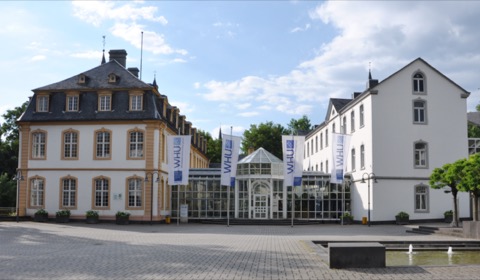
The WHU – Otto Beisheim School of Management is a German business school with campuses in Vallendar and Düsseldorf, Germany. WHU was founded in 1984 by the Koblenz Chamber of Commerce as the Wissenschaftliche Hochschule für Unternehmensführung; the name was modified in 1993 to honour WHU's benefactor, the businessman Otto Beisheim. As of September 2021, there are 1,880 students (including doctoral students) at WHU, about 230 employees and 59 professors (including assistant professors). WHU is widely regarded as one of the most prestigious business schools in the German-speaking world (DACH).WHU is known for its master's program in management, which has been favourably ranked by numerous publications. It maintains a global network of more than 200 partner universities, while also offering numerous double degree programs. The school is also well known for its entrepreneurship programs and has the fourth highest number of unicorn-founding alumni in the world.
Sitting posture is closely related to our health. Poor sitting posture can cause various diseases and jeopardize our health. Among the current methods for detecting sitting posture, computer vision solutions suffer from privacy leakage and wearable sensor solutions suffer from inconvenience and cost of wearing. In this study, we introduce 3D-Sitpose, which leverages millimeter-wave radar to detect human sitting posture. 3D-Sitpose utilizes wireless signal transmission for non-contact detection, ensuring privacy protection and cost reduction. Firstly, we analyze the impact of variations in human sitting posture on millimeter-wave radar signals, and design sophisticated signal processing methods to refine the collected radar data, yielding clearer point cloud information for volunteers in various sitting postures. Secondly, we develop a two-channel neural network to extract fine-grained features related to volunteers from the point cloud data. Finally, we obtain coordinates for 25 human skeletal points. 3D-Sitpose can instruct users to maintain correct sitting posture based on a set of six key angles. We recruit 20 volunteers from our institute to conduct comprehensive evaluations of 3D-Sitpose. Experiments are conducted in two indoor environments to estimate sitting posture. The results reveal the mean Euclidean distance error for all skeletal point locations is 6.65 cm. This demonstrates that our method is able to estimate various sitting changes in volunteers.
Multimodal large language models (MLLMs), which integrate language and visual cues for problem-solving, are crucial for advancing artificial general intelligence (AGI). However, current benchmarks for measuring the intelligence of MLLMs suffer from limited scale, narrow coverage, and unstructured knowledge, offering only static and undifferentiated evaluations. To bridge this gap, we introduce MDK12-Bench, a large-scale multidisciplinary benchmark built from real-world K–12 exams spanning six disciplines with 141K instances and 6,225 knowledge points organized in a six-layer taxonomy. Covering five question formats with difficulty and year annotations, it enables comprehensive evaluation to capture the extent to which MLLMs perform over four dimensions: 1) difficulty levels, 2) temporal (cross-year) shifts, 3) contextual shifts, and 4) knowledge-driven reasoning. We propose a novel dynamic evaluation framework that introduces unfamiliar visual, textual, and question form shifts to challenge model generalization while improving benchmark objectivity and longevity by mitigating data contamination. We further evaluate knowledge-point reference-augmented generation (KP-RAG) to examine the role of knowledge in reasoning. Key findings reveal limitations in current MLLMs in multiple aspects and provide guidance for enhancing model reasoning, robustness, and AI-assisted education.
Video multimodal large language models achieve strong results on existing benchmarks, but answer accuracy alone does not establish whether they can locate the evidence needed to answer a question. We introduce VideoZeroBench, a challenging long-video benchmark with manually annotated question-answer pairs spanning 13 video domains. Questions target fine-grained cues, fleeting events, and evidence distributed across multiple segments. Temporal intervals and key-frame boxes are annotated where applicable. All questions undergo two rounds of cross-verification for answer validity and evidence quality. Our five-level diagnostic protocol compares answering with and without evidence hints, then combines answer correctness with independently evaluated temporal and spatial grounding. Across 19 evaluated models, the best standard QA accuracy is 24.8
Multimodal agents are making rapid progress on general computer-use tasks, yet existing benchmarks remain largely confined to browsers and basic desktop applications, falling short in professional software workflows that dominate real-world scientific and industrial practice. To close this gap, we introduce ProSoftArena, a benchmark and platform specifically for evaluating multimodal agents in professional software environments. We establish the first capability hierarchy tailored to agent use of professional software and construct a benchmark of 436 realistic work and research tasks spanning 6 disciplines and 13 core professional applications. To ensure reliable and reproducible assessment, we build an executable real-computer environment with an execution-based evaluation framework and uniquely incorporate a human-in-the-loop evaluation paradigm. Extensive experiments show that even the best-performing agent attains only a 24.4% success rate on L2 tasks and completely fails on L3 multi-software workflow. In-depth analysis further provides valuable insights for addressing current agent limitations and more effective design principles, paving the way to build more capable agents in professional software settings. This project is available at: https://prosoftarena.github.io.
Action-conditioned surgical video generation is a critical yet highly challenging problem for robotic surgery. The core difficulty is that low-dimensional control vectors must precisely govern complex image-space evolution. In this work, we propose a kinematic-to-visual lifting paradigm that converts articulated kinematics into a unified set of five image-aligned control modalities. Building on this representation, we introduce a hierarchically routed visual control framework that selectively activates the most relevant control modalities and motion scales. Instead of uniformly applying all control signals, our model performs hierarchical routing to dynamically allocate conditioning capacity. We further design kinematic-prior-guided routing loss functions to ensure physically meaningful, temporally stable, and efficient expert utilization. To improve efficiency, we propose a budgeted training and inference scheme that leverages routing-induced sparsity. By selectively discarding low-significance control pathways during training and execution, our approach enables adaptive computation that is complementary to standard distillation. We additionally construct a new benchmark with curated articulated annotations, obtained through human-in-the-loop semantic labeling and differentiable pose tracking, providing realistic supervision for action-conditioned surgical video generation. Extensive experiments demonstrate that our method consistently improves action faithfulness, visual fidelity, and cross-domain generalization over diverse baselines. Moreover, our efficient variant achieves substantial reductions in latency while maintaining strong control accuracy.




