Arrays of optically trapped neutral atoms are a promising architecture for the realization of quantum computers. In order to run increasingly complex algorithms, it is advantageous to demonstrate high-fidelity and flexible gates between long-lived and highly coherent qubit states. In this work, we demonstrate a universal high-fidelity gate set with individually controlled and parallel application of single-qubit gates and two-qubit gates operating on the ground-state nuclear-spin qubit in arrays of tweezer-trapped ^{171}Yb atoms. We utilize the long lifetime, flexible control, and high gate fidelity of our system to characterize native gates using single- and two-qubit Clifford and symmetric subspace randomized-benchmarking circuits with more than 200 controlled-Z (cz) gates applied to one or two pairs of atoms. We measure our two-qubit entangling gate fidelity to be 99.72(3)% (99.40(3)%) with (without) postselection. In addition, we introduce a simple and optimized method for calibration of multiparameter quantum gates. These results represent important milestones toward executing complex and general quantum computation with neutral atoms.
Quantum information processing with neutral atoms relies on Rydberg excitation for entanglement generation. While the use of heavy divalent or open-shell elements, such as strontium or ytterbium, has benefits due to their optically active core and a variety of possible qubit encodings, their Rydberg structure is generally complex. For some isotopes in particular, hyperfine interactions are relevant even for highly excited electronic states. We employ multichannel quantum defect theory to infer the Rydberg structure of isotopes with nonzero nuclear spin and perform nonperturbative Rydberg-pair interaction calculations. We find that due to the high level density and sensitivities to external fields, experimental parameters must be precisely controlled. Specifically in 87Sr, we study an intrinsic F & ouml;rster resonance, unique to divalent atoms with hyperfine-split thresholds, which simultaneously provides line stability with respect to external field fluctuations and enhanced long-range interactions. Additionally, we provide parameters for pair states that can be effectively described by single-channel Rydberg series. The explored pair states provide exciting opportunities for applications in the blockade regime, as well as for more exotic long-range interactions such as largely flat, distance-independent potentials.
A drastic resurgence of interest in Neutral Atom Quantum Computing has ushered in a new era of fascinating demonstrations of key enabling technologies for Fault-Tolerant Quantum Computing. Here I will give an overview of recent demonstrations enabled by Atom Computing's systems built around alkaline-earth(-like) elements including: long coherence times, high-fidelity-scalable-low-loss readout, individually driven 1Q gates, 2Q gates at high fidelity, mid-circuit measurement, and large array refilling.
Assembling and maintaining large arrays of individually addressable atoms is a key requirement for continued scaling of neutral-atom-based quantum computers and simulators. In this work, we demonstrate a new paradigm for assembly of atomic arrays, based on a synergistic combination of optical tweezers and cavity-enhanced optical lattices, and the incremental filling of a target array from a repetitively filled reservoir. In this protocol, the tweezers provide microscopic rearrangement of atoms, while the cavity-enhanced lattices enable the creation of large numbers of optical traps with sufficient depth for rapid low-loss imaging of atoms. We apply this protocol to demonstrate near-deterministic filling (99% per-site occupancy) of 1225-site arrays of optical traps. Because the reservoir is repeatedly filled with fresh atoms, the array can be maintained in a filled state indefinitely. We anticipate that this protocol will be compatible with mid-circuit reloading of atoms into a quantum processor, which will be a key capability for running large-scale error-corrected quantum computations whose durations exceed the lifetime of a single atom in the system.
Measurement-based quantum error correction relies on the ability to determine the state of a subset of qubits (ancillae) within a processor without revealing or disturbing the state of the remaining qubits. Among neutral-atom based platforms, a scalable, high-fidelity approach to mid-circuit measurement that retains the ancilla qubits in a state suitable for future operations has not yet been demonstrated. In this work, we perform imaging using a narrow-linewidth transition in an array of tweezer-confined $^{171}$Yb atoms to demonstrate nondestructive state-selective and site-selective detection. By applying site-specific light shifts, selected atoms within the array can be hidden from imaging light, which allows a subset of qubits to be measured while causing only percent-level errors on the remaining qubits. As a proof-of-principle demonstration of conditional operations based on the results of the mid-circuit measurements, and of our ability to reuse ancilla qubits, we perform conditional refilling of ancilla sites to correct for occasional atom loss, while maintaining the coherence of data qubits. Looking towards true continuous operation, we demonstrate loading of a magneto-optical trap with a minimal degree of qubit decoherence.
The generation of a register of highly coherent, but independent, qubits is a prerequisite to performing universal quantum computation. Here we introduce a qubit encoded in two nuclear spin states of a single 87Sr atom and demonstrate coherence approaching the minute-scale within an assembled register of individually-controlled qubits. While other systems have shown impressive coherence times through some combination of shielding, careful trapping, global operations, and dynamical decoupling, we achieve comparable coherence times while individually driving multiple qubits in parallel. We highlight that even with simultaneous manipulation of multiple qubits within the register, we observe coherence in excess of 105 times the current length of the operations, with [Formula: see text] seconds. We anticipate that nuclear spin qubits will combine readily with the technical advances that have led to larger arrays of individually trapped neutral atoms and high-fidelity entangling operations, thus accelerating the realization of intermediate-scale quantum information processors.
Participants attempted to center a cursor on a video display of a winding roadway with a rate control system. Fourier analysis of their steering movements in response to sinusoidal perturbations of the roadway revealed how much attention they allocated to different roadway preview locations. We compared a full 1.0 s of preview with preview restricted to a narrow slit around 0.3 s or 0.6 s. Participants were able to flexibly shift their attention to either slit. However, they performed better in terms of root-mean-squared error, velocity error, and acceleration error with the fuller view. They concentrated their attention over a range from 0.1 s to 0.3 s of preview in a manner qualitatively consistent with Miller's optimal control model.
We present a fully operational ultra-stable-laser system for cooling, trapping and manipulating Rydberg states in optical tweezer arrays of neutral Sr-atoms. Some CW-lasers are phase-coherently disciplined by an ultra-low-noise comb referenced to a sub-Hz ultra-stable-laser.
The spatiotemporal distribution of drivers' attention to preview was inferred from their steering movements while tracking a winding roadway in a laboratory setting. For most subjects, the average driving attentional distribution over six daily sessions was relatively stable and generalized across different control devices. However, there was considerable day-to-day variability in the attentional distributions. This variability was modeled as a strong interaction between two dynamic processes, the attentional emphasis of selected regions and inhibition of surrounding regions. The model combines a novel application of a reaction-diffusion model of biological pattern formation with an optimal control model of attention to preview. The combined model treats attentional dynamics as an example of the biological spacing of a limited cognitive resource, which is also shaped by the demands of action.
We describe and implement a family of entangling gates activated by radio-frequency flux modulation applied to a tunable transmon that is statically coupled to a neighboring transmon. The effect of this modulation is the resonant exchange of photons directly between levels of the two-transmon system, obviating the need for mediating qubits or resonator modes and allowing for the full utilization of all qubits in a scalable architecture. The resonance condition is selective in both the frequency and amplitude of modulation and thus alleviates frequency crowding. We demonstrate the use of three such resonances to produce entangling gates that enable universal quantum computation: one iSWAP gate and two distinct controlled Z gates. We report interleaved randomized benchmarking results indicating gate error rates of 6% for the iSWAP (duration 135ns) and 9% for the controlled Z gates (durations 175 ns and 270 ns), limited largely by qubit coherence.
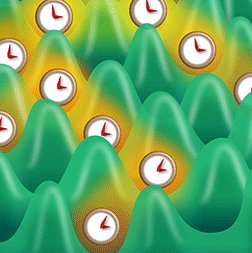
We present the first atomic clock based on quantum degenerate matter, overcoming atomic collisions, reaching a record spectroscopic quality factor of Q = 5.2 ⨉ 1015, and measuring a frequency difference to 3 ⨉ 10-19 in 2 hours.
We show that parametric coupling techniques can be used to generate selective entangling interactions for multi-qubit processors. By inducing coherent population exchange between adjacent qubits under frequency modulation, we implement a universal gate set for a linear array of four superconducting qubits. An average process fidelity of ℱ = 93% is estimated for three two-qubit gates via quantum process tomography. We establish the suitability of these techniques for computation by preparing a four-qubit maximally entangled state and comparing the estimated state fidelity with the expected performance of the individual entangling gates. In addition, we prepare an eight-qubit register in all possible bitstring permutations and monitor the fidelity of a two-qubit gate across one pair of these qubits. Across all these permutations, an average fidelity of ℱ = 91.6 ± 2.6% is observed. These results thus offer a path to a scalable architecture with high selectivity and low cross-talk.
Machine learning techniques have led to broad adoption of a statistical model of computing. The statistical distributions natively available on quantum processors are a superset of those available classically. Harnessing this attribute has the potential to accelerate or otherwise improve machine learning relative to purely classical performance. A key challenge toward that goal is learning to hybridize classical computing resources and traditional learning techniques with the emerging capabilities of general purpose quantum processors. Here, we demonstrate such hybridization by training a 19-qubit gate model processor to solve a clustering problem, a foundational challenge in unsupervised learning. We use the quantum approximate optimization algorithm in conjunction with a gradient-free Bayesian optimization to train the quantum machine. This quantum/classical hybrid algorithm shows robustness to realistic noise, and we find evidence that classical optimization can be used to train around both coherent and incoherent imperfections.
 Jun Ye (叶军)合作论文数Department of Physics, College of Arts and Sciences, University of Colorado Boulder;Joint Institute for Laboratory Astrophysics, University of Colorado Boulder;National Institute of Standards and Technology, U.S. Dept. of Commerce21
 Travis Lee Nicholson合作论文数Department of Physics, Faculty of Science, National University of Singapore20
 Jason Williams合作论文数California Institute of Technology14
 Michael Bishof合作论文数Neuroradiology, University of Bern12Alexander Papageorge合作论文数E.L. Ginzton Lab., Stanford Univ.;c10
 Sebastian Blatt合作论文数JILA UCB, University of Colorado10
 Mickey Mcdonald合作论文数Department of Physics, Columbia University9Swallows Matthew合作论文数8Sara Campbell合作论文数Quantinuum7
 Jonathan King合作论文数Dept Geosci, Univ Arizona7
 Remy Notermans合作论文数7
 Stanimir Kondov合作论文数7krish kotru合作论文数6Robin Coxe合作论文数6
 Prasahnt Sivarajah合作论文数6Matthew Reagor合作论文数6
 Chad Rigetti合作论文数Departments of Physics and Applied Physics;Yale University6
 Brian Lester合作论文数Counterpoint Needle Exchange, AIDS Committee of London6Colm A. Ryan合作论文数5a s caldwell合作论文数School of Materials Engineering, Purdue University5
 Ross B. Hutson合作论文数JILA, NIST5
 Sabrina Hong合作论文数Google Quantum AI, Santa Barbara, CA 93105 USA5
 Michael Scheer合作论文数Dept Phys, Princeton Univ5Wei Zhang合作论文数5
 W. J. Zeng合作论文数Quantonation;Unitary Foundation5Alexa Staley合作论文数4J. Lauigan合作论文数4P. Battaglino合作论文数4Smith Robert S.合作论文数4
 Diego Scarabelli合作论文数Columbia Univ, Dept Appl Phys & Appl Math, New York, NY 10027 USA4
 Michael Selvanayagam合作论文数4
 Prawiroatmodjo G E D K合作论文数4
 Sarah Bromley合作论文数JILA, National Institute of Standards and Technology and University of Colorado;Department of Physics, University of Colorado;National Institute of Standards and Technology and University of Colorado, University of Colorado4
 Nasser Alidoust合作论文数Center for Quantum Computing, Amazon Web Services4
 Nikolas Tezak合作论文数OpenAI4
 Paul S. Julienne合作论文数Department of Physics, College of Computer, Mathematical, & Natural Sciences, University of Maryland;National Institute of Standards and Technology4
 Mehrnoosh Vahidpour合作论文数4G. Edward Marti合作论文数4J. W. Thomsen合作论文数L.C.A.M. (URA du C.N.R.S. 281), Université Paris-Sud4C.-A. Chen合作论文数3T.-y. Wu合作论文数3R. Coxe合作论文数3X. Xie合作论文数3T. Wilkason合作论文数3Z. Vendeiro合作论文数3R. van de Veerdonk合作论文数3M. Urbanek合作论文数3M. Stone合作论文数3A. Smull合作论文数3




