The isolation of two proteinases in crystalline form from extracts of beef pancreas has been described by Kunitz and Northrop (1). These enzymes have been named trypsin and chymotrypsin. Previous publications (2) from this laboratory have reported the finding of a series of synthetic peptide derivatives which were readily hydrolyzed by crystalline chymotrypsin. In this communication a synthetic substrate for crystalline trypsin is described. or-Benzoyl-Larginineamide hydrochloride (I) is hydrolyzed extremely rapidly by crystalline trypsin (recrystallized three times) to yield benzoyl-Z-arginine and ammonia (cf. Table I). This hydrolysis proceeds optimally at about pH 7.8 (Fig. 1).
Annals of the New York Academy of SciencesVolume 45, Issue 9 p. 409-423 THE SIGNIFICANCE OF COUPLED REACTIONS FOR THE ENZYMATIC HYDROLYSIS AND SYNTHESIS OF PROTEINS Max Bergmann, Max Bergmann Rockeleller Institute for Medical Research, New York, N. Y.Search for more papers by this authorJoseph S. Fruton, Joseph S. Fruton Rockeleller Institute for Medical Research, New York, N. Y.Search for more papers by this author Max Bergmann, Max Bergmann Rockeleller Institute for Medical Research, New York, N. Y.Search for more papers by this authorJoseph S. Fruton, Joseph S. Fruton Rockeleller Institute for Medical Research, New York, N. Y.Search for more papers by this author First published: November 1944 https://doi.org/10.1111/j.1749-6632.1944.tb47960.xCitations: 42AboutPDF ToolsRequest permissionExport citationAdd to favoritesTrack citation ShareShare Give accessShare full text accessShare full-text accessPlease review our Terms and Conditions of Use and check box below to share full-text version of article.I have read and accept the Wiley Online Library Terms and Conditions of UseShareable LinkUse the link below to share a full-text version of this article with your friends and colleagues. Learn more.Copy URL Share a linkShare onFacebookTwitterLinkedInRedditWechat Citing Literature Volume45, Issue9Energy Relationships in Enzyme ReactionsNovember 1944Pages 409-423 RelatedInformation
The use of p-hydroxybenzaldehyde in place of benzaldehyde makes accessible .peptidescontaining the dehydrogenated tyrosine residue.
Papain contains a cysteine-activatable proteinase that hydrolyzes benzoyll-arginlneamide (1). This enzyme has been shown to have a specificity similar to that of crystalline pancreatic trypsin (2) and therefore has been designated papain trypsinase (3). Previous experiments have shown that papain trypsinase exists in two inactive forms which can be designated papain-a-trypsinase and papain-13-trypsinase (4). Only the 13-trypsinase can be activated by HCN. However, a-trypsinase can be transformed into the 13-form by minute amounts of sulfhydryl compounds such as H~S or cysteine. The activation of the 0-form by an excess of HCN or H~S is completely reversed when the activator is removed in vacuo. These results have been interpreted to indicate that the reversible activation of papain-fl-trypsinase consists in the formation of dissociable activator-13-trypsinase compounds, as represented below.
 Leonidas Zervas合作论文数33Arthur Miekeley合作论文数17Joseph S. Fruton合作论文数14Hans Schleich合作论文数8Carl Niemann合作论文数7George W. Irving合作论文数7
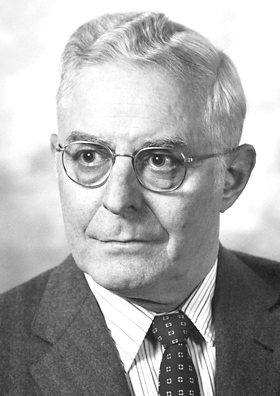 William H. Stein合作论文数The Rockefeller Institute for Medical Research,New York6Hellmut Enßlin合作论文数5Erwin Brand合作论文数5David G. Doherty合作论文数5Fritz Stather合作论文数5josephine e tietzman合作论文数4William F Ross合作论文数4Fritz Radt合作论文数4Werner Freudenberg合作论文数4Erich Kann合作论文数4Klaus Hofmann合作论文数4Fritz Weinmann合作论文数3karl grafe合作论文数3Hans Machemer合作论文数3H. Pollok合作论文数3
 Stanford Moore (斯坦福·摩尔)合作论文数Rockefeller University3Otto K. Behrens合作论文数3Leo Salzmann合作论文数3Ferdinand Stern合作论文数3
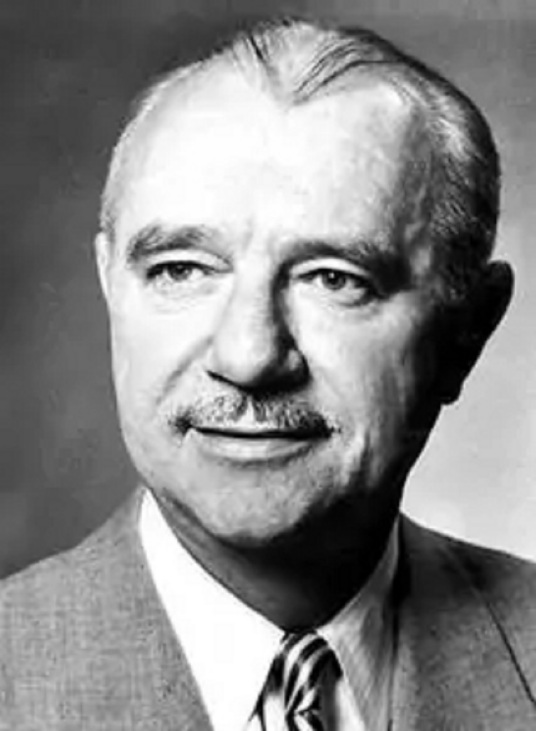 Vincent Du Vigneaud (文森特·迪维尼奥)合作论文数康奈尔大学3Stephan Ludewig合作论文数3Reinhold Ulpts合作论文数3Ewald Knehe合作论文数3Wh Stein合作论文数2Artur Miekeley合作论文数2heinz rinke合作论文数2Ferdinand Dreyer合作论文数2
 Heinz Ludwig Fraenkel Conrat合作论文数Université de Californie à Berkeley2Ernst Von Lippmann合作论文数2F. K. V. Koch合作论文数2Herbert Schotte合作论文数2Wilhelm Breuers合作论文数2Efim Silberkweit合作论文数2Charlotte Witte合作论文数2H Schleich合作论文数1K Grafe合作论文数1Georgios Michalis合作论文数1Gi Lavin合作论文数1Wolfgang Lechinsky合作论文数1martin gierth合作论文数1fritz leinert合作论文数1




