The deployment of deep neural networks on embedded systems remains a challenging task due to stringent constraints in computational resources, memory bandwidth, and energy efficiency. In this work, we present QYOLOv10, a quantization-aware acceleration framework designed to enable efficient object detection using low-precision variants of the YOLOv10 model-namely nano (n), small (s), and medium (m). The proposed method integrates advanced post-training quantization techniques for weights, activations, and inputs, with adaptive precision strategies aligned to hardware-specific constraints. These optimizations strike a favorable trade-off between computational efficiency and detection accuracy. To demonstrate real-world viability, we deploy QYOLOv10 on the Xilinx Kria KV260 platform using a customized Deep Processing Unit (DPU) overlay synthesized in Vivado and executed via the Vitis AI runtime. Experimental results show that QYOLOv10 achieves up to 4.8x improvement in inference speed, over 40% memory footprint reduction, and maintains accuracy within 1.2% of the original full-precision models. Inference latency is reduced to below 25 ms per image, enabling robust real-time performance. These results highlight the suitability of QYOLOv10 for edge-centric applications such as autonomous navigation, intelligent surveillance, and IoT-based visual analytics. By addressing the practical challenges of deep model deployment under resource-constrained conditions, this work contributes a scalable and hardware-aware solution for embedded object detection systems.
In today's interconnected world, securing digital image transmissions is crucial to protect sensitive information against modern cyber threats. This paper presents a hardware implementation of a novel chaos-based symmetric cryptosystem for secure grayscale image transmission. The proposed method integrates a 4D Rossler hyperchaotic system as a key generator with a lightweight 128-bit block cipher comprising whitening, pixel-bit permutation, block-pixel permutation, and chaos-based S-box substitution. Both the key generator and the encryption engine are implemented on a Xilinx Virtex UltraScale VCU108 FPGA using VHDL. The proposed chaotic PRNG successfully passes the NIST SP 800-22 statistical tests, demonstrating strong randomness properties. Experimental results show that the cryptosystem achieves high security and robust resistance to statistical and differential attacks, with entropy values up to 7.9997, NPCR average of 99.62 %, and UACI equal to 33.4 %. The hardware implementation achieves a throughput of 3.49 Gbps with low power consumption of 0.098 W, confirming its suitability for real-time embedded image encryption applications. These results validate the effectiveness of the proposed design in meeting high-speed, low-power, and high-security requirements for modern image transmission systems.
Semantic segmentation is a fundamental component of autonomous driving systems, enabling accurate scene understanding and object-level perception. However, achieving precise instance-level delineation while maintaining real-time performance on resource-constrained platforms remains a significant challenge, particularly for edge deployment scenarios. This paper proposes a lightweight dual-YOLOv8 fusion framework for instance-aware semantic segmentation in autonomous driving applications. The proposed approach integrates YOLOv8n-seg and YOLOv8s-seg through a multi-scale fusion strategy that exploits their complementary feature representations to improve the segmentation of road-relevant objects, including cars, buses, trucks, and motorcycles. The framework is evaluated on the Reetiquetado de Vehiculos dataset using standard instance-level segmentation metrics. Experimental results demonstrate strong performance, achieving an overall mAP@0.5 of 92.9% and mAP@0.5:0.95 of 80.8%, while maintaining real-time inference with an average processing time of 7.9 ms per image (126 FPS) on an NVIDIA RTX 3050 GPU. Class-wise and confidence-based analyses confirm consistent segmentation accuracy across vehicle categories, highlighting the robustness of the proposed fusion strategy in handling scale variation, occlusions, and object diversity. In addition, an embedded deployment analysis provides insight into the feasibility and practical constraints of deploying the proposed framework on representative edge platforms. Overall, the proposed dual-YOLOv8 fusion framework achieves an effective balance between segmentation accuracy and computational efficiency, making it suitable for real-time autonomous driving perception on edge ARM/GPU platforms and Advanced Driver Assistance Systems (ADAS).
Emotion recognition systems based on computational intelligence are emerging as powerful tools for modeling and interpreting complex emotional responses, particularly in clinical populations such as individuals with Autism Spectrum Disorder (ASD). ASD is associated with atypical patterns of emotional perception and expression, which significantly impact social functioning and quality of life. This systematic review examines recent advancements in biomedical signal-based emotion recognition systems tailored to ASD, with a focus on methods that utilize computational intelligence to analyze physiological (e.g., EEG, ECG, galvanic skin response, eye tracking) and behavioral (e.g., facial expressions, vocal cues) signals. Following PRISMA guidelines, 68 peerreviewed studies were analyzed to assess modeling strategies, signal acquisition techniques, and simulation frameworks aimed at supporting diagnosis, monitoring, and therapeutic intervention. Key challenges identified include limited model generalizability due to reliance on neurotypical datasets, a lack of ASD-specific multimodal signal resources, and difficulties in real-time clinical deployment. The review highlights promising directions such as adaptive multimodal fusion, human-in-the-loop learning, and integration of computational simulations into clinical workflows. By bridging engineering and clinical science, this work supports the development of intelligent emotion recognition systems for real-world applications in ASD diagnosis, behavior monitoring, and personalized intervention.
Autonomous driving technologies are rapidly advancing, driven by the need for safer, more efficient, and intelligent transportation systems. A fundamental component of these systems is the perception module, which enables vehicles to understand and react to their surrounding environment. Object detection, in particular, is essential for identifying dynamic and static elements on the road, such as pedestrians, vehicles, traffic signs, and obstacles. In this work, we explore and enhance the capabilities of state-of-the-art deep learning-based object detectors within the YOLO (You Only Look Once) family, focusing on the latest versions: YOLOv10 and YOLOv11. We fine-tuned and optimized multiple variants of each model—namely, nano (n), small (s), medium (m), and large (l)—to improve detection accuracy and computational efficiency for real-time autonomous driving applications. The models were trained and evaluated on a diverse road object, and performance was measured using key metrics including precision, mean Average Precision (mAP), and Precision-Recall curves. Experimental results reveal that the fine-tuned YOLOv10n achieved a peak class-level precision of 1.00 at a specific confidence threshold (0.997), indicating that perfect precision was observed for certain classes under high-confidence conditions, while the overall mean precision and mAP metrics reflect more balanced model performance, while YOLOv11s attained the best result within its group with a precision of 0.91 at a threshold of 0.972. These findings demonstrate the potential of tailored YOLO architectures to meet the demanding requirements of real-world autonomous navigation systems.
Accurate instance segmentation of urban scenes from UAV imagery is a critical task for applications such as urban planning, traffic monitoring, and autonomous navigation. In this study, we present a comprehensive evaluation of YOLOv11mISeg, a state-of-the-art instance segmentation model, on the Modified UAVid dataset, which provides high-resolution annotated aerial imagery of complex urban environments. Our approach leverages the model’s lightweight architecture to achieve both high precision and real-time inference, making it suitable for embedded and UAV-based applications. Extensive experiments demonstrate that YOLOv11m-ISeg effectively distinguishes individual objects, including vehicles, pedestrians, and urban structures, while maintaining computational efficiency. Quantitative results show substantial improvements in mask accuracy and mean Average Precision (mAP) compared to baseline segmentation models, highlighting the model’s robustness in challenging urban scenarios. This work establishes YOLOv11m-ISeg as a promising solution for UAV-based instance segmentation and provides valuable insights for future aerial scene understanding research.
Detecting objects such as vehicles, buildings, pedestrians, and road signs is indispensable to advancing the concept of autonomous and self-driving cars. Furthermore, an autonomous vehicle (AV) must accurately detect its surrounding environment to operate reliably. Most object detection (OD) techniques perform adequately under typical weather conditions, including cloudy or sunny days. However, their efficiency decreases significantly when exposed to Adverse Weather Conditions (AWCs), including days with sandstorm, rain, fog or snow. Complex and computationally costly models are required to achieve high accuracy rates. In this study, we present an improved OD system in AWCs for autonomous vehicles (AVs) using the single-stage deep learning (DL) algorithm YOLO (You Only Look Once) version 10. To evaluate our system, Vehicle Detection in Adverse Weather Nature (DAWN) dataset is used. It comprises real-world images captured under various types of AWCs. The experimental findings confirm that the suggested method is effective and surpasses state-of-the-art OD approaches under AWCs.
Recent years have seen a rapid development in Machine Learning, which has profoundly influenced many areas of science and engineering. Among them, computer vision takes the leading place, where important tasks are image classifications powered by CNNs. Despite the great performance of CNNs in complicated scenarios, they remain sensitive to so-called adversarial attacks, and deliberate perturbations leading them to incorrect predictions. Besides more innocuous consequences, this has serious security implications for critical applications, in-cluding medical diagnostics, where misclassifications might result in disastrous outcomes. This research work discusses adversarial attacks on CNNs and other DNNs in computer vision, studying a full range of the generation and detection methods with details while discussing intrinsic vulnerability and robustness. It also proposes a learning framework that will enhance the robustness and security of DNNs and CNNs against such adversarial perils. The ultimate goal is directed to an improvement in the reliability of such models in absolutely critical scenarios for safe deployment into applications where accuracy is crucial.
The widespread success of Convolutional Neural Networks (CNNs) in computer vision has been accompanied by soaring computational demands, often requiring high-performance GPUs for real-time inference. However, such hardware is impractical in embedded and resource-constrained environment. To address this, we propose a post-training quantization (PTQ) framework that converts CNN models from FP32 to INT8 without retraining, optimized for FPGA deployment. Using asymmetric quantization and TensorFlow Lite, we implemented VGG16 and ResNet50 on a PYNQ-Z1 Field-Programmable Gate Arrays (FPGA). The quantized VGG16 achieved a 67% increase in throughput (from 150 FPS to 250 FPS), a 68% reduction in latency, and a 52% improvement in Power-Delay Product. ResNet50 saw over 420% gain in DSP efficiency, a 3100% increase in LUT efficiency, and a 94% PDP reduction. Despite a marginal accuracy loss, both models showed significantly improved energy efficiency and performance-per-resource utilization. Our results confirm that PTQ enables scalable, low-power AI inference suitable for real-time applications on edge and embedded systems.
Accurate object segmentation is a critical component for ensuring safe and reliable operation in autonomous vehicles. This paper explores the application of YOLOv8nseg, a lightweight deep learning model, to the task of realtime vehicle segmentation in dynamic driving environments. Building upon the architectural strengths of previous YOLO versions, YOLOv8n-seg introduces modular improvements aimed at balancing inference speed with segmentation precision. Our proposed framework leverages this architecture to segment five vehicle categories-car, bus, motorcycle, truck, and truck3-with a focus on robustness in complex urban scenarios. The methodology includes training on a curated vehicle re-annotation dataset representative of diverse driving conditions, followed by extensive evaluation of classification accuracy, precision-recall trade-offs, and qualitative segmentation results. The experimental results demonstrate that YOLOv8n-seg achieves a mean Average Precision (mAP${\$}$0.5) of 0.936 across all categories, with particularly strong performance for cars $(0.973)$ and buses $(0.952)$. The model further maintains high stability in training and validation losses, confirming robust convergence and generalization capabilities.
Traffic sign detection systems are vital for improving road safety and supporting autonomous navigation in urban environments. This paper presents a fine-tuned traffic sign detection system based on the You Only Learn One Representation (YOLOR) architecture. The model was trained and evaluated on a dataset comprising 15 traffic sign classes: Green Light, Red Light, Speed Limit 10, Speed Limit 100, Speed Limit 110, Speed Limit 120, Speed Limit 20, Speed Limit 30, Speed Limit 40, Speed Limit 50, Speed Limit 60, Speed Limit 70, Speed Limit 80, Speed Limit 90, and Stop. To enhance detection performance across diverse classes, the model was fine-tuned to accurately detect and classify these elements under varying conditions. The experimental results demonstrate strong detection capabilities, achieving a precision of 87.5%, a recall of 87.8%, a mean Average Precision at IoU 0.5 (mAP@0.5) of 88.5%, and a mAP across IoU thresholds from 0.5 to 0.95 (mAP@0.5:0.95) of 77.7%. These results highlight the effectiveness of the YOLOR-based approach for real-world traffic sign recognition tasks, offering a promising solution for intelligent transportation and autonomous driving applications. Furthermore, the model's competitive performance compared to recent methods reinforces its relevance in current state-of-the-art benchmarks.
indoor objects detection and recognition present an active research axis in computer vision and artificial intelligence fields. Various deep learning-based techniques can be applied to solve the objects detection problems. With the apperance of deep convolutional neural networks (DCNN) a great breakthrough for various applications was achieved. Indoor objects detection present a primary task that can assist blind and visually impaired persons (BVI) during their navigation. However, building a reliable indoor objects detection system used for edge devices implementations still presents a serious challenge. To address this problem, we propose in this work to build an indoor objects detection system based on DCNN network. Cross-stage partial network (CSPNet) has been used for the detection process and a lightweight backbone based on EfficientNet v2was used as a network backbone. In order to ensure a lightweight implementation of the proposed work on FPGA devices, various optimizations techniques have been applied to compress the model size and reduce its computation complexity. The proposed indoor objects detection system was implemented on a Xilinx ZCU 102 board. Training and testing experiments have been conducted on the proposed indoor objects dataset that count 11000 images containing 25 landmark classes. The proposed work achieved very competitive results in terms of detection accuracy and processing time for the original CSP-EfficientNet v2 network as well as for the proposed compressed version.
The rapid growth of autonomous driving and intelligent transportation systems has increased the need for accurate and efficient traffic sign detection. Recognizing traffic signs in real time plays a crucial role in enabling vehicles to understand and respond to dynamic road conditions, ensuring both safety and regulatory compliance. This study investigates the performance of three lightweight YOLOv11 variants, YOLOv11n, YOLOv11s, and YOLOv11m, for road sign detection, aiming to balance accuracy with computational efficiency for real-time deployment in resource-constrained environments. Each model was trained and evaluated using a consistent traffic sign dataset, with performance metrics including precision, recall, mean Average Precision (mAP), and F1 score. The YOLOv11n model demonstrated stable training behavior and achieved a peak mAP@0.5 of 0.52, with a mean F1 score of 0.47, indicating efficient detection of dominant classes but limited performance for underrepresented ones. The YOLOv11s showed improved generalization and localization abilities with a higher mAP@0.5 of 0.55 and a mean F1 score of 0.64, suggesting a balanced trade-off between speed and accuracy. The most advanced variant, YOLOv11m, achieved the highest mAP@0.5 of 0.70 and an F1 score of 0.63, demonstrating robust detection and convergence properties. However, all models exhibited difficulty in detecting rarely represented classes, such as "crosswalk," emphasizing the importance of dataset balancing. These findings confirm the suitability of these YOLOv11 variants for embedded traffic monitoring systems and highlight avenues for further improvement through data augmentation and fine-tuning.
Sign language recognition and translation remain pivotal for facilitating communication among the deaf and hearing communities. However, end-to-end sign language translation (SLT) faces major challenges, including weak temporal correspondence between sign language (SL) video frames and gloss annotations and the complexity of sequence alignment between long SL videos and natural language sentences. In this paper, we propose an Adaptive Transformer (ADTR)-based deep learning framework that enhances SL video processing for robust and efficient SLT. The proposed model incorporates three novel modules: Adaptive Masking (AM), Local Clip Self-Attention (LCSA), and Adaptive Fusion (AF) to optimize feature representation. The AM module dynamically removes redundant video frame representations, improving temporal alignment, while the LCSA module learns hierarchical representations at both local clip and full-video levels using a refined self-attention mechanism. Additionally, the AF module fuses multi-scale temporal and spatial features to enhance model robustness. Unlike conventional SLT models, our framework eliminates the reliance on gloss annotations, enabling direct translation from SL video sequences to spoken language text. The proposed method was evaluated using the ArabSign dataset, demonstrating state-of-the-art performance in translation accuracy, processing efficiency, and real-time applicability. The achieved results confirm that ADTR is a highly effective and scalable deep learning solution for continuous sign language recognition, positioning it as a promising AI-driven approach for real-world assistive applications.
Accurate and timely detection of potholes is a critical task for ensuring road safety and minimizing maintenance costs. Traditional methods for pothole detection are often laborintensive, costly, and prone to human error. In this paper, we propose a novel approach to pothole detection using a fine-tuned YOLOv10s model. By leveraging the power of state-of-the-art convolutional neural networks, we adapt YOLOv10s to detect and classify potholes with high precision, even under challenging road conditions and diverse environmental settings. Our approach significantly improves detection speed and accuracy compared to conventional techniques, making it highly suitable for realtime road monitoring systems. The fine-tuning process involves training the model on a custom dataset of pothole images, allowing it to learn specific road surface characteristics and adapt to various scales and lighting conditions. Experimental results show that our fine-tuned YOLOv10s model outperforms existing pothole detection methods, achieving superior detection rates while maintaining low false positive and negative rates. We also discuss the potential of this method for integration into automated road monitoring systems, offering scalable solutions for infrastructure maintenance and enhancing public safety. Our work presents a significant advancement in intelligent transportation systems (ITS), contributing to the broader application of AI in road condition monitoring and maintenance.
Ensuring the integrity and confidentiality of patient medical information is a critical priority in the healthcare sector. In the context of security, this paper proposes a novel encryption algorithm that integrates Blockchain technology, aiming to improve the security and privacy of transmitted data. The proposed encryption algorithm is a block-cipher image encryption scheme based on different chaotic maps: The logistic Map, the Tent Map, and the Henon Map used to generate three encryption keys. The proposed block-cipher system employs the Hilbert curve to perform permutation while a generated chaos-based S-Box is used to perform substitution. Furthermore, the integration of a Blockchain-based solution for securing data transmission and communication between nodes and authenticating the encrypted medical image's authenticity adds a layer of security to our proposed method. Our proposed cryptosystem is divided into two principal modules presented as a pseudo-random number generator (PRNG) used for key generation and an encryption and decryption system based on the properties of confusion and diffusion. The security analysis and experimental tests for the proposed algorithm show that the average value of the information entropy of the encrypted images is 7.9993, the Number of Pixels Change Rate (NPCR) values are over 99.5% and the Unified Average Changing Intensity (UACI) values are greater than 33%. These results prove the strength of our proposed approach, demonstrating that it can significantly enhance the security of encrypted images.
You Only Look Once (YOLO) object detection network has gained significant adoption in the field of plant leaf disease detection due to its strong detection capabilities. However, deploying YOLO models on resource-constrained devices remains challenging, as they require substantial computational power. The complexity and size of these models pose significant obstacles for edge platforms, which are often limited in processing and memory resources. To address these limitations and accelerate inference, we propose a quantized version of YOLOv5x, called Quant-YOLOv5x. This quantization reduces the size and complexity of the model, making it more suitable for edge deployment while maintaining competitive detection accuracy. The experiments were carried out using a self-generated dataset focused on detecting tomato and pepper leaf diseases. Our quantization method reduces the bitwidth of the entire YOLO network to 8 bits, resulting in only a 2.8% decrease in mean Average Precision (mAP), a 50% reduction in model size, and an increase of 4.7 FPS compared to the standard YOLOv5 model.
Recently, convolutional neural networks (CNNs) have shown remarkable performance in a variety of computer vision tasks. However, as CNNs become more complex, there is a higher demand for computational power, which typically necessitates the use of advanced hardware, limiting their scalability and broader applicability. This drives the need for optimization techniques to reduce these computational costs. We propose a uniform approach that enables the deployment of neural networks on FPGA platforms that cannot handle highprecision values. A common strategy to address this challenge is to perform low-precision computations through neural network quantization. The goal of this paper is to evaluate post-training integer quantization across different networks and criteria. We introduce an efficient framework designed to accelerate computations while simultaneously reducing both latency and memory overhead. This approach involves asymmetric quantization of the weight and activation matrices with the goal of minimizing these costs. Our experiments demonstrate a model size reduction of up to $75 \%$, with minimal accuracy degradation of less than $1 \%$ on benchmark datasets. Furthermore, we observe latency improvements of up to $3 \times$ compared to full-precision models. We believe that the proposed method will provide new insights into the interpretation of the quantization of neural networks.
Night vision perception is a critical component in advancing the safety and reliability of autonomous driving (AD) systems. Traditional vision-based detection models often struggle under low-light conditions due to limited illumination and increased noise, which can lead to missed detections or false positives. In this work, we present a real-time detection framework based on the Detection Transformer (DETR) architecture, optimized for night vision applications in autonomous vehicles. The proposed approach leverages the rmsw_5k_night dataset to train and evaluate the detection performance under challenging nighttime scenarios. Experimental results demonstrate that the DETR-based model achieves a high precision confidence of 0.91 with an overall confidence score of 0.983 across all classes, highlighting its robustness and reliability in dark environments. These findings validate the effectiveness of transformer-based detection models in real-time night vision tasks and open pathways for further integration into AD pipelines.
Deep convolutional neural networks (DCNNs) have been mainly powerful and important artificial intelligence techniques, which are exploited in various computer vision applications, such as facial point detection (FPD), owing their versatility and high performance. The role of DCNNs in this area is pivotal due to their ability to learn hierarchical features, which are essential for recognizing complex patterns. On the other hand, DCNNs have considerable computational complexity due to their topology nature. An FPGA-based SoC design is needed for CNN acceleration due to the rapid development, energy efficiency, low latency and high reconfigurability of FPGAs. Despite their performance benefits, FPGA-based SoCs also come with several limitations like complexity of design. This paper proposes a dynamic partial reconfiguration (DPR) and hybrid architecture for DCNN accelerators. We propose (i) a GPU-based software implementation for DCNN-based FPD, (ii) a CNN-based acceleration and optimization method using the high-level synthesis technique, (iii) a DPR-based hybrid architecture to improve the performance of the suggested approach. To validate our design, four scenarios are put forward. The experimental results prove that the proposed work achieves a better performance in terms of reconfigurability and execution time, hardware cost, and power consumption.
 Yahia Said合作论文数Faculty of Sciences, Laboratory of Electronics and Microelectronics E?E, Monastir 5000, Tunisia54
 Rached Tourki合作论文数39
 Fatma Ezahra Sayadi合作论文数36Mouna Afif合作论文数Laboratory of Electronics and Microelectronics (EμE), Faculty of Sciences of Monastir, University of Monastir, Monastir, Tunisia29
 Wajdi Elhamzi合作论文数27
 Riadh Ayachi合作论文数Laboratory of Electronics and Microelectronics (EμE), Faculty of Sciences of Monastir, University of Monastir, Monastir, Tunisia26
 Messaoud Seifeddine合作论文数University of Monastir, Laboratory of Electronics and Microelectronics, Sciences Faculty of Monastir, Monastir, Tunisia21
 Taoufik Saidani合作论文数EμE Laboratory, FSMonatir20
 Haythem Bahri合作论文数Lab. of Eμ, Fac. of Sci.;E, Monastir, Tunisia;c;Fac. of Sci., Lab. of EμE, Monastir, Tunisia|c|19Randa Khemiri合作论文数19
 Chouchene Marwa合作论文数19
 Mohamed Ali Hajjaji合作论文数LE2I Lab., Burgundy Univ.;c;LE2I Lab., Burgundy Univ.18Fethi Smach合作论文数Laboratoire Le;Université de Bourgogne15
 Yassin Kortli合作论文数AI-ED Lab., Yncrea ouest14
 Johel Miteran合作论文数Laboratoire Le;Université de Bourgogne;Laboratoire Le, Université de Bourgogne14
 Abdellatif Mtibaa合作论文数university of monastir13
 Julien Dubois合作论文数Laboratoire Electronique, Informatique et Image, Université de Bourgogne13
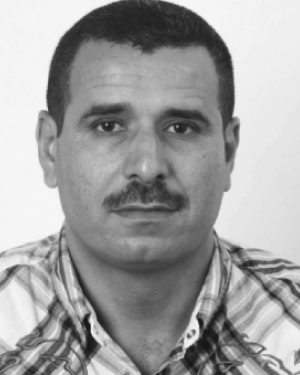 Mehrez Marzougui合作论文数Aff1 Aff212
 Abbas Bradai合作论文数XLIM Institute, University of Poitiers10Edwige Pissaloux合作论文数10
 Maher Jridi合作论文数Vision Department, ISEN-Brest10Wadhah Ayadi合作论文数9
 Layla Horrigue合作论文数9Saidani, T.合作论文数8
 Hallek Mohamed合作论文数8
 Imen Charfi合作论文数8
 Hamdi Boukamcha合作论文数Faculty of Sciences of Monastir7Amel Ben Mahjoub合作论文数7
 Soulef Bouaafia合作论文数Laboratory of EμFSM, University of Monastir;Laboratory of EμE, University of Monastir6
 Belgacem Bouallegue合作论文数Laboratoire d'électronique et de micro-électronique6
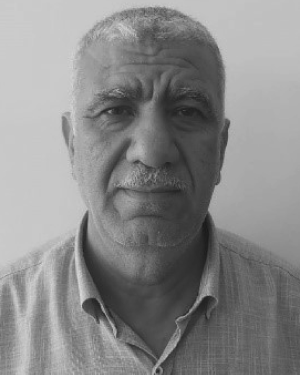 Mohsen Machhout合作论文数Electronic and Micro-Electronic Laboratory, Faculty of Sciences of Monastir, 5000, Tunisia. e-mail:6
 Nouri Masmoudi合作论文数university of sfax6
 Ahmed Ben Atitallah合作论文数High Institute of Electronics and Communication, BP University of Sfax6Dhaha Dia合作论文数6
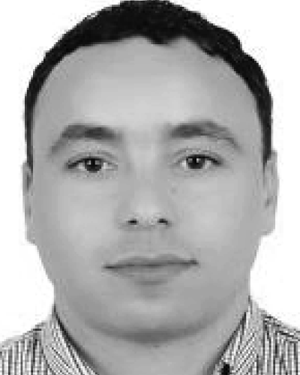 Faouzi Nasri合作论文数5Ayoub Mhaouch合作论文数5
 Imen Bouazzi合作论文数Elect & Microelect Lab, Univ Monastir5
 Ayman Alfalou合作论文数EMAT Laboratory;University of Moncton;EMAT Laboratory, University of Moncton5
 Mohamed S. Abid合作论文数5
 N. Liouane合作论文数Ensi Enim5Jamila Bhar合作论文数5
 Souhir Gabsi合作论文数Faculty of Sciences of Monastir, University of Monastir4Nassima Medimegh合作论文数4Khelifi, F.合作论文数4
 Nejmeddine Bahri合作论文数University of Sfax4
 Abdessalem Ben Abdelali合作论文数4
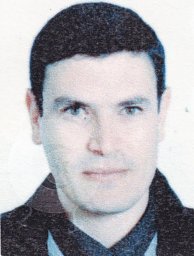 Samir Belaid合作论文数4
 Refka Ghodhbane合作论文数4
 Kholdoun Torki合作论文数Circuits Multi-Project, 46, Avenue Félix VIALLET, 38031 GRENOBLE Cedex, France4




