We present the first side-channel attack on full-fledged smartphones that recovers the elliptic curve secret scalar from the electromagnetic signal that corresponds to a single scalar-by-point multiplication in current versions of Libgcrypt, OpenSSL, HACL* and curve25519-donna. To avoid leaking information via side channels, these implementations follow the recommendations of RFC 7748 and use a constant-time conditional swap operation. Our attack targets signal differences created by systematic changes in operand values during this conditional swap operation. We deploy the attack, using low-cost equipment (<$800), against two Android-based mobile phones and against a Linux-based IoT development board. We repeat the attack 100 times, each time with a different scalar, on each device. In all of the implementations considered in this work, our attack successfully recovers the full secret key within seconds. To mitigate the attack we suggest randomizing the exclusive-or mask in the conditional swap operation. We show that this countermeasure is effective in preventing this and similar attacks.
Cyber-physical systems (CPS) are controlling many critical and sensitive aspects of our physical world while being continuously exposed to potential cyber-attacks. These systems typically have limited performance, memory, and energy reserves, which limits their ability to run existing advanced malware protection, and that, in turn, makes securing them very challenging. To tackle these problems, this paper proposes, Remote, a new robust framework to detect malware by externally observing Electromagnetic (EM) signals emitted by an electronic computing device (e.g., a microprocessor) while running a known application, in real-time and with a low detection latency, and without any a priori knowledge of the malware. Remote does not require any resources or infrastructure on, or any modifications to, the monitored system itself, which makes Remote especially suitable for malware detection on resource-constrained devices such as embedded devices, CPSs, and Internet of Things (IoT) devices where hardware and energy resources may be limited. To demonstrate the usability of Remote in real-world scenarios, we port two real-world programs (an embedded medical device and an industrial PID controller), each with a meaningful attack (a code-reuse and a code-injection attack), to four different hardware platforms. We also port shellcode-based DDoS and Ransomware attacks to five different standard applications on an embedded system. To further demonstrate the applicability of Remote to commercial CPS, we use Remote to monitor a Robotic Arm. Our results on all these different hardware platforms show that, for all attacks on each of the platforms, Remote successfully detects each instance of an attack and has $<$<0.1 percent false positives. We also systematically evaluate the robustness of Remote to interrupts and other system activity, to signal variation among different physical instances of the same device design, to changes over time, and to plastic enclosures and nearby electronic devices. This evaluation includes hundreds of measurements and shows that Remote achieves excellent accuracy ($<$<0.1 percent false positive and $>$>99.9 percent true positive rates) under all these conditions. We also compare Remote to prior work EDDIE [1] and SYNDROME [2], and demonstrate that these prior work are unable to achieve high accuracy under these variations.
Side-channel signals have long been used in cryptanalysis, and recently they have also been utilized as a way to monitor program execution without involving the monitored system in its own monitoring. Both of these use-cases for side-channel analysis have seen steady improvement, allowing ever-smaller deviations in program behavior to be monitored (to track program behavior and/or identify anomalies) or exploited (to steal sensitive information). However, there is still very little intuition about where the limits for this are, e.g. whether a single-instruction or a single-bit difference can realistically be recovered from the signal. In this paper, we use a popular open-source cryptographic software package as a test subject to demonstrate that, with enough training data, enough signal bandwidth, and enough signal-to-noise ratio, the decision of branch instructions that cause even single-instruction-differences in program execution can be recovered from the electromagnetic (EM) emanations of an IoT/embedded system. We additionally show that, in cryptographic implementations where branch decisions contain information about the secret key, nearly all such information can be extracted from the signal that corresponds to only a single cryptographic operation (e.g. encryption). Finally, we analyze how the received signal bandwidth, the amount of training, and the signal-to-noise ratio (SNR) affect the accuracy of side-channel-based reconstruction of individual branch decisions that occur during program execution.
This paper presents the first side channel attack approach that, without relying on the cache organization and/or timing, retrieves the secret exponent from a single decryption on arbitrary ciphertext in a modern (current version of OpenSSL) fixed-window constant-time implementation of RSA. Specifically, the attack recovers the exponent's bits during modular exponentiation from analog signals that are unintentionally produced by the processor as it executes the constant-time code that constructs the value of each "window" in the exponent, rather than the signals that correspond to squaring/multiplication operations and/or cache behavior during multiplicand table lookup operations. The approach is demonstrated using electromagnetic (EM) emanations on two mobile phones and an embedded system, and after only one decryption in a fixed-window RSA implementation it recovers enough bits of the secret exponents to enable very efficient (within seconds) reconstruction of the full private RSA key. Since the value of the ciphertext is irrelevant to our attack, the attack succeeds even when the ciphertext is unknown and/or when message randomization (blinding) is used. Our evaluation uses signals obtained by demodulating the signal from a relatively narrow band (40 MHz) around the processor's clock frequency (around 1GHz), which is within the capabilities of compact sub-$1,000 software-defined radio (SDR) receivers. Finally, we propose a mitigation where the bits of the exponent are only obtained from an exponent in integersized groups (tens of bits) rather than obtaining them one bit at a time. This mitigation is effective because it forces the attacker to attempt recovery of tens of bits from a single brief snippet of signal, rather than having a separate signal snippet for each individual bit. This mitigation has been submitted to OpenSSL and was merged into its master source code branch prior to the publication of this paper.
Technical Support Scams (TSS), which combine online abuse with social engineering over the phone channel, have persisted despite several law enforcement actions. Although recent research has provided important insights into TSS, these scams have now evolved to exploit ubiquitously used online services such as search and sponsored advertisements served in response to search queries. We use a data-driven approach to understand search-and-ad abuse by TSS to gain visibility into the online infrastructure that facilitates it. By carefully formulating tech support queries with multiple search engines, we collect data about both the support infrastructure and the websites to which TSS victims are directed when they search online for tech support resources. We augment this with a DNS-based amplification technique to further enhance visibility into this abuse infrastructure. By analyzing the collected data, we provide new insights into search-and-ad abuse by TSS and reinforce some of the findings of earlier research. Further, we demonstrate that tech support scammers are (1) successful in getting major as well as custom search engines to return links to websites controlled by them, and (2) they are able to get ad networks to serve malicious advertisements that lead to scam pages. Our study period of approximately eight months uncovered over 9,000 TSS domains, of both passive and aggressive types, with minimal overlap between sets that are reached via organic search results and sponsored ads. Also, we found over 2,400 support domains which aid the TSS domains in manipulating organic search results. Moreover, to our surprise, we found very little overlap with domains that are reached via abuse of domain parking and URL-shortening services which was investigated previously. Thus, investigation of search-and-ad abuse provides new insights into TSS tactics and helps detect previously unknown abuse infrastructure that facilitates these scams.
Technical Support Scams (TSS), which combine online abuse with social engineering over the phone channel, have persisted despite several law enforcement actions. The tactics used by these scammers have evolved over time and they have targeted an ever increasing number of technology brands. Although recent research has provided insights into TSS, these scams have now evolved to exploit ubiquitously used online services such as search and sponsored advertisements served in response to search queries. We use a data-driven approach to understand search-and-ad abuse by TSS to gain visibility into the online infrastructure that facilitates it. By carefully formulating tech support queries with multiple search engines, we collect data about both the support infrastructure and the websites to which TSS victims are directed when they search online for tech support resources. We augment this with a DNS-based amplification technique to further enhance visibility into this abuse infrastructure. By analyzing the collected data, we demonstrate that tech support scammers are (1) successful in getting major as well as custom search engines to return links to websites controlled by them, and (2) they are able to get ad networks to serve malicious advertisements that lead to scam pages. Our study period of 8 months uncovered over 9,000 TSS domains, of both passive and aggressive types, with minimal overlap between sets that are reached via organic search results and sponsored ads. Also, we found over 2,400 support domains which aid the TSS domains in manipulating organic search results. Moreover, we found little overlap with domains that are reached via abuse of domain parking and URL-shortening services which was investigated previously. Thus, investigation of search-and-ad abuse provides new insights into TSS tactics and helps detect previously unknown abuse infrastructure that facilitates these scams.
This paper describes EM-Based Detection of Deviations in Program Execution (EDDIE), a new method for detecting anomalies in program execution, such as malware and other code injections, without introducing any overheads, adding any hardware support, changing any software, or using any resources on the monitored system itself. Monitoring with EDDIE involves receiving electromagnetic (EM) emanations that are emitted as a side effect of execution on the monitored system, and it relies on spikes in the EM spectrum that are produced as a result of periodic (e.g. loop) activity in the monitored execution. During training, EDDIE characterizes normal execution behavior in terms of peaks in the EM spectrum that are observed at various points in the program execution, but it does not need any characterization of the malware or other code that might later be injected. During monitoring, EDDIE identifies peaks in the observed EM spectrum, and compares these peaks to those learned during training. Since EDDIE requires no resources on the monitored machine and no changes to the monitored software, it is especially well suited for security monitoring of embedded and IoT devices. We evaluate EDDIE on a real IoT system and in a cycle-accurate simulator, and find that even relatively brief injected bursts of activity (a few milliseconds) are detected by EDDIE with high accuracy, and that it also accurately detects when even a few instructions are injected into an existing loop within the application.
Memory corruption vulnerabilities are the root cause of many modern attacks. Existing defense mechanisms are inadequate; in general, the software-based approaches are not efficient and the hardware-based approaches are not flexible. In this paper, we present hardware-assisted data-flow isolation, or, HDFI, a new fine-grained data isolation mechanism that is broadly applicable and very efficient. HDFI enforces isolation at the machine word granularity by virtually extending each memory unit with an additional tag that is defined by dataflow. This capability allows HDFI to enforce a variety of security models such as the Biba Integrity Model and the Bell -- LaPadula Model. We implemented HDFI by extending the RISC-V instruction set architecture (ISA) and instantiating it on the Xilinx Zynq ZC706 evaluation board. We ran several benchmarks including the SPEC CINT 2000 benchmark suite. Evaluation results show that the performance overhead caused by our modification to the hardware is low (<; 2%). We also developed or ported several security mechanisms to leverage HDFI, including stack protection, standard library enhancement, virtual function table protection, code pointer protection, kernel data protection, and information leak prevention. Our results show that HDFI is easy to use, imposes low performance overhead, and allows us to create more elegant and more secure solutions.
It is a great challenge in human health clinic to find parsimonious set of genes responsible for depression disease. Many prioritization approaches have been developed for depression candidate genes. However, most of the methods primarily rank depression candidate genes based on the similarities with known depression genes. Those approaches do not effectively consider relativeness of depression candidate genes with non-disease genes for precise ranking. In this paper, we propose a Biomarker Ensemble Ranking Framework (BERF) for depression candidate gene prioritization, which applies 2-ranking models scheme by considering both candidate genes and non-disease genes. We first clusterize training genes which consists of both known depression and non-disease genes. Then, we introduce a global loss function in the 2-ranking learning model. Finally, we propose a modified SVM-based learning strategy with minimizing the global loss. An ensemble technique is applied to generate the ranking results for depression candidate genes. The experimental results show that our BERF outperforms existing approach in terms of ROC and AUC.
Differential Power Analysis (DPA) attack for smart card, ASIC or micro controller based on crypto-systems have been demonstrated by several authors. Masking is a very well known approach as a DPA countermeasure. Due to cascading architecture of masked multiplier, the existing masking schemes increase timing and area complexity. Balanced masked architecture brings poor security guaranty. In this paper, we propose a masked multiplier which reduces path delay as compared to the existing ones in the literature. The proposed masked S-box has two level of area optimization. One is avoiding transformation cost and other is using masked bits in sharing mode. We explore security issues in the context of first-order and second-order DPA attacks. We have demonstrated that our approach indeed prevents the first order DPA attack of the Rijndael circuit implemented on FPGA. The proposed masked AES S-box is the most compact one (in terms of area and path delay) as well as secure in the context of first order DPA attack.
The paper puts forward the design of an intelligent SHA-1 based crypto system. For a given 512-bit message stream the intelligence of the system lies in its power of predicting the probable-colluders. Along with the conventional SHA-1 architecture, our scheme employs a predictor control block which takes the message stream from the user, and provides the log-list of the equal length bit-streams that are most likely to produce collisions with the message stream. The predictor controller uses Canonical Particle Swarm optimization (CPSO) algorithm. Besides proposing the algorithm itself, the paper also surveys the performance of the predictor when employed with difierent hardware platforms.
This paper puts forward an efficient and optimized method to determine the probable-colluders in a MD5 based cryptosystem. Along with the conventional MD5 implementing architecture, our scheme employs a predictor control block which takes the message stream from the user, and provides the log-list of the equal length bit-streams that are most likely to produce collisions with the message stream in a real time system. The predictor controller uses Time varying Acceleration Coefficient Particle Swarm optimization (TVACPSO) algorithm. Besides proposing the algorithm itself, the paper also surveys the performance of the predictor when employed with different hardware platforms.
All elliptic curve cryptographic schemes are based on scalar multiplication of points, and hence its faster computation signifies faster operation. This paper proposes two different parallelization techniques to speedup the GF(p) elliptic curve multiplication in affine coordinates and the corresponding architectures. The proposed implementations are capable of resisting different side channel attacks based on time and power analysis. The 160, 192, 224 and 256 bits implementations of both the architectures have been synthesized and simulated for both FPGA and 0.13μ CMOS ASIC. The final designs have been prototyped on a Xilinx Virtex-4 xc4vlx200-12ff1513 FPGA board and performance analyzes carried out. The experimental result and performance comparison show better throughput of the proposed implementations as compared to existing reported architectures.
Masking of gates is one of the most popular techniques to prevent differential power analysis (DPA) of AES algorithm. It has been shown that the logic circuits used in the implementation of cryptographic algorithms leak side-channel information inspite of masking, which can be exploited, in differential power attacks. The phenomenon in CMOS circuits responsible for the leakage of masked circuits is known as glitching. Motivated by this fact, the authors analyse the effect of glitches in CMOS circuits against masked implementation of the AES S-box. The authors explicitly demonstrate that glitches do not affect always. There exists a relation between combinational path delay of the circuit and timing difference of input vectors to the circuit, which has a bearance on the amount of information leaked by the masked gates. A balanced masked S-box circuit is proposed where the inputs are synchronised by sequential components. Detailed SPICE results are shown to support the claim that the modifications indeed reduce the vulnerability of the masked AES S-box against DPA attacks.
This paper presents a single chip encryp- tor/decryptor core implementation of Advanced Encryption Standard (AES-Rijndael) cryptosystem. The suggested architecture is capable of handling all possible combinations of standard bit lengths (128,192,256) of data and key. The fully rolled inner- pipelined architecture ensures lesser hardware complexity. The architecture does reutilize precomputed blocks, in the sense that the same hardware is shared during encryption and decryption as much as possible. The design has been implemented on Xilinx XCVe1000-8bg560 device. The performance of the architecture has been compared with existing results in the literature and has been found to be the most efficient (throughput/area) implementation of the AES algorithm.
This paper deals with FPGA and ASIC implementations of side-channel attack resistant elliptic curve cryptosystems defined over GF(p). The elegance of the design lies in the fact that all operations are performed in binary number system, thus reducing conversion overheads of existing architectures. In our implementation, point addition and point doubling operations are performed in affine coordinates. They are performed using same amount of computation, which provides a secure design against timing and power analysis attacks. Implementation and side-channel analysis results are compared with related existing designs.
 Santosh Ghosh合作论文数Department of Computer Science and Engineering, Indian Institute of Technology, Kharagpur, India8
 Alenka G. Zajic (Alenka Zajic)合作论文数School of Electrical and Computer Engineering, College of Engineering, Georgia Institute of Technology5
 Milos Prvulovic合作论文数School of Computer Science, College of Computing, Georgia Institute of Technology5
 Dipanwita Roy Chowdhury合作论文数Department of Computer Science and Engineering, Indian Institute of Technology, Kharagpur, India5Sonai Ray合作论文数4
 I. Sengupta合作论文数Department of Computer Science and Engineering, Indian Institute of Technology4Indranil Sen Gupta合作论文数3Athanasios Kountouras合作论文数Georgia Institute of Technology, Atlanta, GA, USA2
 Frank T. Werner合作论文数School of Electrical and Computer Engineering, Georgia Institute of Technology2Najmeh Miramirkhani合作论文数Stony Brook University2
 Nader Sehatbakhsh合作论文数Electrical and Computer Engineering Department, School of Engineering, University of California, Los Angeles2
 Alireza Nazari合作论文数2
 Mustaque Ahamad合作论文数Center for Experimental Research in Computer Systems, College of Computing, Georgia Institute of Technology;School of Computer Science, College of Computing, Georgia Institute of Technology;Institute for Information Security and Privacy, College of Computing, Georgia Institute of Technology;School of Cybersecurity and Privacy, College of Computing, Georgia Institute of Technology2
 Manos Antonakakis合作论文数School of Electrical and Computer Engineering, College of Engineering, Georgia Institute of Technology2Bharat R. Srinivasan合作论文数Salesforce com San Francisco2
 Nick Nikiforakis合作论文数Department of Computer Science, College of Engineering and Applied Sciences, Stony Brook University2
 Haider Khan合作论文数University of Denver2Nishith Sinha合作论文数Georgia Tech, Atlanta, GA 30332 USA1
 Yuanda Zhu合作论文数Department of Electrical and Computer Engineering, Georgia Institute of Technology1
 Moumita Dey合作论文数Georgia Tech, Atlanta, GA 30332 USA1
 Abu Sayed Chowdhury合作论文数Sch Elect Engn & Comp Sci, Washington State Univ1Niels Samwel合作论文数Radboud Univ Nijmegen, Digital Secur Grp, Nijmegen, Netherlands1
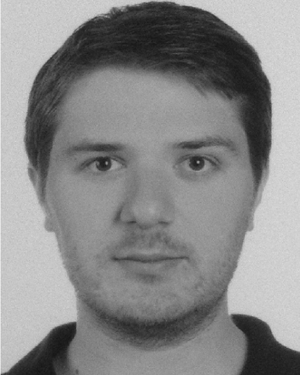 Baki Berkay Yilmaz合作论文数Georgia Institute of Technology1
 Robert Callan合作论文数Georgia Institute of Technology1
 Debdeep Mukhopadhyay合作论文数Department of Computer Science and Engineering, Indian Institute of Technology Kharagpur;New York University1
 Insu Yun合作论文数School of Electrical Engineering, Korea Advanced Institute of Science and Technology1
 Taesoo Kim合作论文数School of Cybersecurity and Privacy, College of Computing, Georgia Institute of Technology;School of Computer Science, College of Computing, Georgia Institute of Technology;Samsung Electronics1
 Yanqing Zhang合作论文数Department of Computer Sciences, College of Arts & Sciences, Georgia State University1
 Wenke Lee合作论文数School of Computer Science, College of Computing, Georgia Institute of Technology1
 Yuval Yarom合作论文数Faculty of Computer Science, Ruhr University Bochum1
 Byoungyoung Lee合作论文数CompSec Lab, Department of Electrical and Computer Engineering, Seoul National University1
 Dipanwita Roychowdhury合作论文数Department of Computer Science and Engineering, Indian Institute of Technology, Kharagpur, India
1
Dipanwita Roychowdhury合作论文数Department of Computer Science and Engineering, Indian Institute of Technology, Kharagpur, India
1 Ayatullah Faruk Mollah合作论文数1
 Hyungon Moon合作论文数Department of Polymer Science and Engineering, Kumoh National Institute of Technology1
 Yunheung Paek合作论文数School of Electrical Engineering1D. Roy Chowdhury合作论文数Department of Computer Science and Engineering, Indian Institute of Technology, Kharagpur, India1
 Daniel Genkin合作论文数School of Computer Science, College of Computing, Georgia Institute of Technology;School of Cybersecurity and Privacy, College of Computing, Georgia Institute of Technology1
 Chengyu Song合作论文数Department of Computer Science and Engineering, Marlan and Rosemary Bourns College of Engineering, University of California, Riverside1




