This work presents a generalized actuator modeling approach that enhances simulation accuracy, with applications extending beyond Mars exploration. Actuators are integral components in space robotics, where precision and reliability are paramount. The circa-2023 Sample Retrieval Lander (SRL) design exemplifies this, relying on a robotic arm to retrieve Mars sample tubes for return to Earth. With Earth-Mars round-trip communication delays on the order of minutes, direct human teleoperation is unsafe and impractical, necessitating autonomous execution through onboard kinematic controllers. Because the robotic arm represents a single point of failure in such a critical mission, we develop an exceptionally high-fidelity simulation environment to validate the controller design. Unlike many system simulations that idealize actuator performance to simplify computations, our model captures key dynamics often overlooked in traditional approaches. Its accuracy is validated through comparisons with real-world actuator tests, demonstrating both mission relevance for SRL and potential applicability to future space robotics systems.
Flybys of the Saturn’s moon Enceladus by instruments onboard the Cassini spacecraft have revealed extensive water jets with macromolecular organics signatures emanating from the cracks at the south polar surface. The National Academies Planetary Science and Astrobiology Decadal Survey, covering mission priorities for the next decade, recently identified an Enceladus mission which collects plume material as a high priority both as a flagship mission and for a New Frontiers program mission. A primary objective of an Enceladus mission would be to analyze plume material to detect evidence of life in the subsurface ocean if it exists there. The Supercritical CO2 and Subcritical H2O Analysis instrument (SCHAN) is a candidate instrument to perform the life detection analysis. In this paper we will present the development of a sample handling system for the SCHAN instrument for Enceladus mission applications and preliminary testing results of the sample handling system. The sample handling system would receive a sample from a separate sample acquisition and transfer system in cryogenic vacuum conditions, transform the samples to liquid form and deliver the liquid to the SCHAN instrument. The sample handling and SCHAN instrument would reside on the spacecraft in a thermally controlled vacuum environment.
Sampling autonomy for icy moon lander missions requires understanding of topographic and photometric properties of the sampling terrain. Unavailability of high resolution visual datasets (either bird-eye view or point-of-view from a lander) is an obstacle for selection, verification or development of perception systems. We attempt to alleviate this problem by: 1) proposing Graphical Utility for Icy moon Surface Simulations (GUISS) framework, for versatile stereo dataset generation that spans the spectrum of bulk photometric properties, and 2) focusing on a stereo-based visual perception system and evaluating both traditional and deep learning-based algorithms for depth estimation from stereo matching. The surface reflectance properties of icy moon terrains (Enceladus and Europa) are inferred from multispectral datasets of previous missions. With procedural terrain generation and physically valid illumination sources, our framework can fit a wide range of hypotheses with respect to visual representations of icy moon terrains. This is followed by a study over the performance of stereo matching algorithms under different visual hypotheses. Finally, we emphasize the standing challenges to be addressed for simulating perception data assets for icy moons such as Enceladus and Europa. Our code can be found here: https://github.com/nasa-jpl/guiss.
Granular materials are of critical interest to many robotic tasks in planetary science, construction, and manufacturing. However, the dynamics of granular materials are complex and often computationally very expensive to simulate. We propose a set of methodologies and a system for the fast simulation of granular materials on Graphics Processing Units (GPUs), and show that this simulation is fast enough for basic training with Reinforcement Learning algorithms, which currently require many dynamics samples to achieve acceptable performance. Our method models granular material dynamics using implicit timestepping methods for multibody rigid contacts, as well as algorithmic techniques for efficient parallel collision detection between pairs of particles and between particle and arbitrarily shaped rigid bodies, and programming techniques for minimizing warp divergence on Single-Instruction, Multiple-Thread (SIMT) chip architectures. We showcase our simulation system on several environments targeted toward robotic tasks, and release our simulator as an open-source tool.
Europa is a premier target for advancing both planetary science and astrobiology, as well as for opening a new window into the burgeoning field of comparative oceanography. The potentially habitable subsurface ocean of Europa may harbor life, and the globally young and comparatively thin ice shell of Europa may contain biosignatures that are readily accessible to a surface lander. Europa's icy shell also offers the opportunity to study tectonics and geologic cycles across a range of mechanisms and compositions. Here we detail the goals and mission architecture of the Europa Lander mission concept, as developed from 2015 through 2020. The science was developed by the 2016 Europa Lander Science Definition Team (SDT), and the mission architecture was developed by the preproject engineering team, in close collaboration with the SDT. In 2017 and 2018, the mission concept passed its mission concept review and delta-mission concept review, respectively. Since that time, the preproject has been advancing the technologies, and developing the hardware and software, needed to retire risks associated with technology, science, cost, and schedule.
Dwarf planet Ceres is a compelling target for future exploration because it hosts at least regional brine reservoirs and potentially ongoing geological activity. As the most water-rich body in the inner solar system, it is a representative of a population of planetesimals that were likely a significant source of volatiles and organics to the inner solar system. Here we describe possible medium-class (around $1 billion) mission concepts that would determine both Ceres’ origin and its current habitability potential. Habitability is addressed through a combination of geological, geophysical, and compositional investigations by (i) searching for evidence from orbit of past and ongoing geological activity near landforms interpreted as brine-driven volcanic structures and (ii) probing the brine distribution below one of these regions with electromagnetic sounding (in situ). Two approaches were considered for compositional measurements, which address both habitability and origins: (1) in situ exploration at two sites and (2) sample return from a single site. Both concepts targeted material at Occator crater, which is one of the youngest features on Ceres (∼20 Ma) and a site rich in evaporites evolved from recently erupted brine sourced from a region >35 km deep. We conclude that a sample return architecture from these young evaporite deposits offers greater science return by enabling high-resolution analysis of organic matter (trapped in salt minerals) and isotopes of refractory elements for a similar cost and less science risk than in situ analyses. This manuscript describes the six science objectives and the two implementation concepts considered to achieve those objectives.
Plume deposit regions on the surface of Enceladus likely reflect and preserve the composition of the internal ocean and could contain potential traces of life and biosignatures.The novel Dual-Rasp sampling system is designed to acquire large amounts of plume deposits on the surface of Enceladus.It is under development to achieve TRL 5 in 2021.
The development of autonomous actions aboard surface systems is of great value to the exploration of ocean worlds, and the in situ exploration of much of our solar system.The ability of landers to operate with more autonomy than current landers and rovers will enable more and better science, with an overall reduction in cost for comparable missions.In this paper we identify the array of challenges that confront in situ exploration on an ocean world and how many of these challenges are, and have been, addressed (and in some cases resolved) in the early development work for NASA's Europa Lander mission concept.We identify the pathway for constructing a highly autonomous surface system that enables ocean worlds exploration across an array of targets.Our key developments include:• A system-wide architecture effort to identify the mission activities, and the onboard decisions, that will be required for time-and resource-efficient missions.This activity identifies the onboard autonomous behaviors and the necessary supporting architecture, such as the sensing required.A holistic approach to autonomy overall is the intent, including identifying computation needs, strategies for the judicious use of energy, applicability of multiple methods for sample acquisition, fault and failure reaction strategies, learning options from surface interactions, and self-calibration and assessment techniques.• A focused investigation of the autonomy related to sample acquisition, including mechanism and end-effector tool development, the development of representative algorithms for workspace assessment, sample/excavation target identification, dynamic tool use/control, and sensing needed to ascertain acquisition success.This investigation also includes adaptation based on surface interactions.• The construction of both a hardware-in-the-loop (HITL) testbed and a software-plus-simulation ("SoftSim") testbed environment to enable the implementation of multiple "prototype" "systems".The testbed environments will have both the fidelity and flexibility to represent the trade space for the most challenging tasks related to autonomous functionality.• The exploration of onboard versus ground operator responsibility for mission activities.The uncertainties of the surface environment, and the influence of operators/scientists in the execution of the specific activities, deserves consideration and experimentation.The proper mix will vary with the mission target, but all are likely to need to balance the amount of science and engineering data for a given uplink or downlink opportunity to maintain a compelling operational tempo.(Europa allows a relatively low direct-to-Earth communications link for about 50% of a 86 hour europan day.) • An exploration of autonomy enabling architectural and design choices for the surface spacecraft.A surface mission with significant autonomy goals will require expanded resiliency by design, spanning from sensing and perception to alternative strategies to accomplish the required mission activities.Less visible, but still critical to autonomous behaviors, will be sufficient computation, sufficient memory and storage, and effective fault/interruption detection.Designing a system with fewer resource limitations may be the right trade to reduce the overall complexity of implementation.
Mobility System Concepts Venus variable altitude balloon Tethered descent of lunar pit or any steep slopeMars rotorcraft 4-wheel drive/steer roverThe mission concepts described in this document are pre-decisional and are provide for planning and discussion only.1 IntroductionRobotic in situ mobility systems enable science by providing wide-ranging access to planetary surfaces and subsurface voids (pits, caves, and crevasses), while robotic instrument deployment and sampling systems enable science operations in diverse, poorly known conditions with very limited communication with Earth.The past decade saw major progress in surface rover capability, breakthroughs in rotary-wing aerial mobility, promising innovations in variablealtitude balloon technology, a viable mission concept to descend a pit on the Moon, and many innovations in sampling systems.This white paper synthesizes a cross-cutting view of how recent progress in robotics can contribute to missions in the 2023-2032 decade and where further key technology development can impact the 2033-2042 decade, with cross-references to science white papers (WP) and Planetary Mission Concept Studies (PMCS) that motivate the robotics capabilities.The discussion is organized in subtopics covering surface mobility, subsurface void mobility, aerial mobility, instrument placement and sampling, and cross-cutting component technologies.Several closely related or complementary topics are covered in other white papers, including advanced EDL, system-level autonomy, and deep subsurface access [Carson WP, Day WP, Edwards WP, Schmidt WP]. Significant cross-cutting benefits exist in promising new robotics technologies that can enable or enhance mission concepts for very long range rovers for the Moon and Mars, rovers for high latitudes on the Moon and Mars, descending pits and crevasses on the Moon, Mars, and Enceladus, and variable altitude balloons and rotary wing aerial mobility for Venus, Mars, and Titan. Needs and promising solutions exist for robot arms that do not require preheating, rock and ice penetration and analysis on the Moon, Mars, and Ocean Worlds, science operations with much less ground-in-the-loop interaction, and avionics miniaturization, performance enhancement, and cost reduction. Funding for maturation of cross-cutting robotics technology is needed to maximize these benefits.
A potential future mission landing on the surface of Saturn's moon Enceladus would represent a unique opportunity to probe the content of an extra-terrestrial ocean potentially hosting life beyond Earth. The content of the subsurface ocean is continuously ejected by plumes, and some of that material settles on the surface, as observed by the Cassini mission. The goal of a potential landing mission would be of collecting and analyzing samples from the upper 1 cm of the surface, made of most recently deposited material from plume fallback. However, the low surface gravity of Enceladus (1% of Earth's) represents a unique challenge for sample handling. This study focuses on the analysis of the novel Dual-Rasp sampling system enabling rapid sampling and collection of surface material into receptacles via momentum transfer. A numerical model based on the discrete element method (DEM) was developed to investigate the tool-soil interaction and the resulting granular material flow while performing surface sample acquisition. A systematic process for validating the DEM simulation model is presented, including an experimental test campaign expected to be conducted in a vacuum chamber in both lg and low-g environment.
Enceladus is unique as an astrobiology target in that it hosts an active plume sourced directly from its habitable subsurface ocean. Ice particles from the plume contain geochemical constituents that are diagnostic of the ocean conditions, and may hold traces of life and/or biosignatures, if they exist. Up to 93% of the plume particles fall back onto the surface of Enceladus. The low radiation environment and present-day activity are favorable to the preservation of any complex organics and putative biosignatures contained within these particles. Laboratory experiments and modeling suggest that plume deposits would likely be weakly consolidated and relatively easy to sample. Sampling systems like a dual rasp, under development to achieve technology readiness level (TRL) 5 in 2021, would enable a landed mission on Enceladus' surface to acquire large amounts of surface materials, a requirement for analysis of trace constituents. A landed mission on Enceladus could greatly enhance our understanding of the chemical makeup of plume particles and the subsurface ocean, and seek traces of life and/or biosignatures.
The novel Dual-Rasp sampling system has been developed for landed missions to low gravity planetary bodies and is particularly well suited for the unique environment of Saturn's moon Enceladus. The Dual-Rasp sampling system has two counter-rotating rasp cutters that remove material from the surface and direct it into a guide. The cuttings follow the guide into a sample collection cup. When the sampling collection completes, the tool reconfigures by rotating the guide to create a closed circuit for pneumatic sample transfer from the collection cup to science instruments on the lander. A valve opens a gas tank and the gas flows from that tank into the sample collection cup and down rigid tubing to the science instruments chamber on the lander. A two degree of freedom arm with base actuators is used to deploy the sampler and control its sampling location.
The Dual-Rasp sampling system has been developed for the unique sampling environment of a lander mission to the surface of Saturn's moon Enceladus. Plume material from the subsurface ocean that has fallen to the surface is desired resulting in an objective to sample the topmost layer of icy material. The low gravity and potential large range of surface properties are challenges for the sampling system. The Dual-Rasp sampling system has two counter-rotating rasp cutters with teeth that remove material that is thrown up between the cutters. Two prototypes of the Dual-Rasp sampling system were built and tested, one with a carousel and one that uses pneumatics for sample transfer.
The analysis of robotic systems (e.g. landers and rovers) involved in sampling operations on planetary bodies is crucial to ensure mission success, since those operations generate forces that could affect the stability of the robotic system. This paper presents MISTRAL (MultIdisciplinary deSign Tool for Robotic sAmpLing), a novel tool conceived for trade space exploration during early conceptual and preliminary design phases, where a rapid and broad evaluation is required for a very high number of configurations and boundary conditions. The tool rapidly determines the preliminary design envelope of a sampling apparatus to guarantee the stability condition of the whole robotic system. The tool implements a three-dimensional analytical model capable to reproduce several scenarios, being able to accept various input parameters, including the physical and geometrical characteristics of the robotic system, the properties related to the environment and the characteristics related to the sampling system. This feature can be exploited to infer multidisciplinary high-level requirements concerning several other elements of the investigated system, such as robotic arms and footpads. The presented research focuses on the application of MISTRAL to landers. The structure of the tool and the analysis model are presented. Results from the application of the tool to real mission data from NASA’s Phoenix Mars lander are included. Moreover, the tool was adopted for the definition of the high-level requirements of the lander for a potential future mission to the surface of Saturn’s moon Enceladus, currently under investigation at NASA Jet Propulsion Laboratory. This case study was included to demonstrate the tool’s capabilities. MISTRAL represents a comprehensive, versatile, and powerful tool providing guidelines for cognizant decisions in the early and most crucial stages of the design of robotic systems involved in sampling operations on planetary bodies.
Enceladus and possibly Europa spew materials from their internal ocean into their exosphere, some of which are deposited back onto the surface of those Ocean Worlds. This setting provides a unique opportunity to seek traces of past or extant life in ice plume deposits on their surfaces. However, the design of lander missions and surface sampling techniques and the choice of sampling locations rely heavily on strength expectations. Here we present an experimental investigation of the evolution in strength of ice plume deposit analogs at several temperatures, as well as a model that predicts first‐order estimates of the strength of evolved ice plume deposits under geologic timescales relevant to Enceladus and Europa. These results suggest that plume deposits remain weak and poorly consolidated on Enceladus, while they may develop substantial strength (comparable to solid ice) within <100 Myr on Europa.
Since the end of the Apollo missions to the lunar surface in December 1972, humanity has exclusively conducted scientific studies on distant planetary surfaces using teleprogrammed robots. Operations and science return for all of these missions are constrained by two issues related to the great distances between terrestrial scientists and their exploration targets: high communication latencies and limited data bandwidth. Despite the proven successes of in-situ science being conducted using teleprogrammed robotic assets such as Spirit, Opportunity, and Curiosity rovers on the surface of Mars, future planetary field research may substantially overcome latency and bandwidth constraints by employing a variety of alternative strategies that could involve: 1) placing scientists/astronauts directly on planetary surfaces, as was done in the Apollo era; 2) developing fully autonomous robotic systems capable of conducting in-situ field science research; or 3) teleoperation of robotic assets by humans sufficiently proximal to the exploration targets to drastically reduce latencies and significantly increase bandwidth, thereby achieving effective human telepresence. This third strategy has been the focus of experts in telerobotics, telepresence, planetary science, and human spaceflight during two workshops held from October 3–7, 2016, and July 7–13, 2017, at the Keck Institute for Space Studies (KISS). Based on findings from these workshops, this document describes the conceptual and practical foundations of low-latency telepresence (LLT), opportunities for using derivative approaches for scientific exploration of planetary surfaces, and circumstances under which employing telepresence would be especially productive for planetary science. An important finding of these workshops is the conclusion that there has been limited study of the advantages of planetary science via LLT. A major recommendation from these workshops is that space agencies such as NASA should substantially increase science return with greater investments in this promising strategy for human conduct at distant exploration sites.
To investigate the viability and benefits of in-Space Assembly, Dr. Paul Hertz, Director of NASA’s Astrophysics Division, chartered a study, asking “When is it worth assembling space telescopes in space rather than building them on the Earth and deploying them autonomously from a single launch vehicle?” This whitepaper summarizes the response.
The following topics are dealt with: space vehicles; artificial satellites; aerospace computing; Mars; mobile robots; planetary rovers; aerospace instrumentation; autonomous aerial vehicles; space research; and aerospace robotics.
 Scott Moreland合作论文数Jet Prop Lab, CALTECH20
 Kam S. Tso合作论文数IA Tech, Inc.19
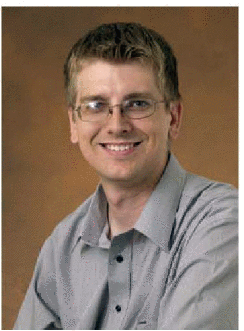 Jeffrey S. Norris合作论文数18
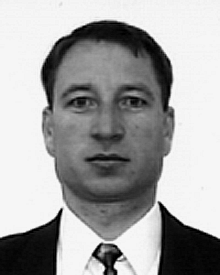 Mircea Badescu合作论文数Jet Propulsion Laboratory;California Institute of Technology;Jet Propulsion Laboratory, California Institute of Technology17
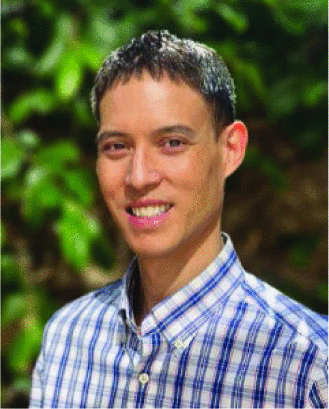 Paulo Younse合作论文数11
 Mark W. Powell合作论文数11
 Dario Riccobono合作论文数10
 Mark K. Long合作论文数10
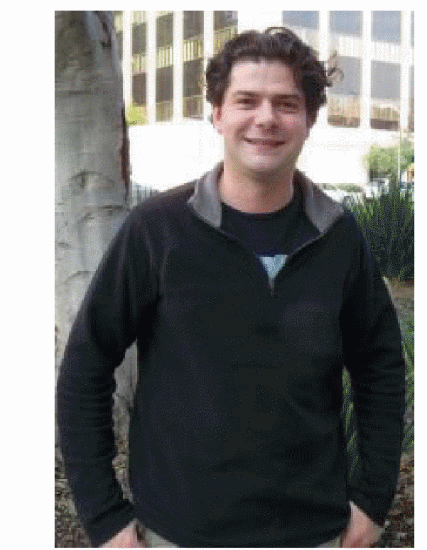 Mathieu Choukroun合作论文数9
 Max Bajracharya合作论文数Toyota Research Institute8
 Wayne Zimmerman合作论文数8
 Samad Hayati合作论文数Jet Propulsion Laboratory, California Institute of Technology7
 Marsette Vona合作论文数Northeastern University College of Computer and Information Science
Geometric and Physical Computing research group 7
Marsette Vona合作论文数Northeastern University College of Computer and Information Science
Geometric and Physical Computing research group 7 Kris Zacny合作论文数Honeybee Robotics Spacecraft Mechanisms Corporation7
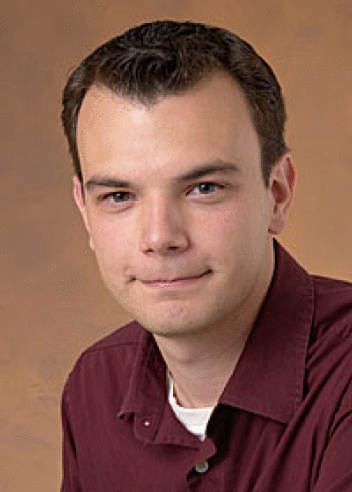 Matthew Dicicco合作论文数Mechanical engineering field and space robotics laboratory, massachusetts institute of technology7Brett Kennedy合作论文数Education (more>>) 9;97 Stanford University - M.S., Mechanical Engineering;96 - 67
 Joel W. Burdick合作论文数Division of Engineering and Applied Science, California Institute of Technology6Anthony Ganino合作论文数6
 Tyler Okamoto合作论文数5
 Elizabeth Carey合作论文数Jet Propulsion Laboratory, California Institute of Technology5
 Eloise Marteau合作论文数Jet Propulsion Laboratory, California Institute of Technology5
 Curtis Collins合作论文数5
 Yoseph Bar Cohen合作论文数Advanced Technologies Group, Jet Propulsion Laboratory, California Institute of Technology;Nondestructive Evaluation and Advanced Actuators Technologies Lab, Jet Propulsion Laboratory, California Institute of Technology5
 Lori Shiraishi合作论文数5
 Robert Hodyss合作论文数Jet Propulsion Laboratory, 4800 Oak Grove Dr., Pasadena Ca, 91109-8099, USA5Bruce Bon合作论文数Jet Propulsion Laboratory, California Institute of Technology, Pasadena, California 91109, USA5
 Nicolas Hudson合作论文数Jet Propulsion Laboratory, Pasadena, USA 91109-80995
 Daniel M. Helmick合作论文数Jet Propulsion Laboratory;University of Minnesota;Dept . of Computer Science and Engineering;Jet Propulsion Laboratory, University of Minnesota5
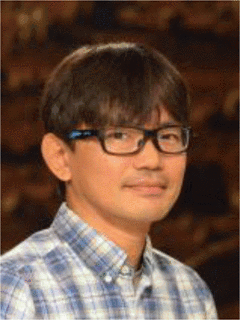 Risaku Toda合作论文数5j beahan合作论文数4
 Joseph Bowkett合作论文数Jet Prop Lab, CALTECH4
 Alex Brinkman合作论文数4
 Vieira, P.合作论文数4
 Harish Manohara合作论文数4
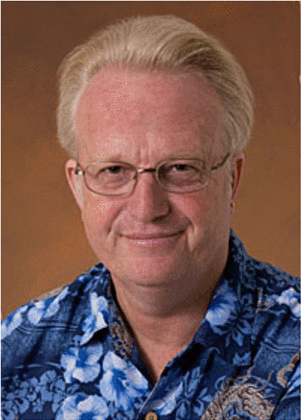 Robert D. Steele合作论文数4
 Larry Matthies合作论文数Jet Propulsion Laboratory, California Institute of Technology4
 Gregory K. Tharp合作论文数4
 Jamie L. Molaro合作论文数4
 Greg Peters合作论文数4
 Jeremy Ma合作论文数4Leonard I. Dorsky合作论文数3Lara Panossian合作论文数3
 Tom Nordheim合作论文数Jet Propulsion Laboratory, California Institute of Technology3J. L. Molaro合作论文数3
 Stephen Peters合作论文数3
 Sherrit Stewart合作论文数NASA Jet Propulsion Laboratory3Paul Hebert合作论文数3
 Green, J.R.合作论文数3
 Raymond E. Arvidson合作论文数Department of Earth, Environmental, and Planetary Sciences, College of Arts & Sciences, Washington University in St. Louis;NASA3




