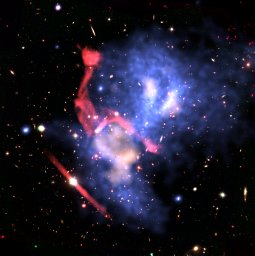
We present the results of Chandra and XMM-Newton X-ray imaging and spatially resolved spectroscopy, along with new MUSTANG2 90 GHz observations of the thermal Sunyaev-Zeldovich (SZ) effect on MACS J0717.5+3745. This exceptionally massive (3.5 +/- 0.6 x 10(15 )M(circle dot)) Frontier Fields cluster located at intermediate redshift (z = 0.5458) is experiencing multiple mergers and hosting an apparent X-ray bright large-scale structure filament. We produced thermodynamical maps from Chandra, XMM-Newton, and ROSAT data using a new method to model the astrophysical and instrumental backgrounds. The temperature peak of 24 +/- 4 keV is also the pressure peak of the cluster and it is spatially closely correlated with the SZ peak from the MUSTANG2 data. We characterised a potential shock candidate at the cluster centre, based on the sharp temperature and pressure gradient. We also quantified its temperature-derived Mach number in various directions to span a range of & Mscr; = (1.7 - 2.0)+/- 0.3. We used Bayesian X-ray analysis methods to disentangle different projected spectral signatures for the filament structure, with the Akaike and Bayes information criteria (AIC and BIC) used to select the most appropriate model to describe the various temperature components. We report an X-ray filament temperature of 3.1(-0.3)(+0.6)keV and a density (3.78 +/- 0.05)x10(-4) cm(-3), corresponding to an overdensity of similar to 400 relative to the critical density of the Universe. We estimate the hot gas mass of the filament to be similar to 6.1 x 10(12) M-circle dot, while its total projected weak-lensing measured mass is similar to(6.8 +/- 2.7)x10(13 )M(circle dot), indicating a hot baryon fraction of 4-10%.
Submillimeter single-dish telescopes offer two key advantages compared to interferometers: they can efficiently map larger portions of the sky and recover larger spatial scales. Nonetheless, fluctuations in the atmosphere limit the accurate retrieval of signals from astronomical sources. Therefore, we introduce a user-friendly simulator named _maria_ to optimize scanning strategies and instrument designs to efficiently reduce atmospheric noise and filtering effects. We further use this tool to produce synthetic time streams and maps from hydrodynamical simulations, enabling a fair comparison between theory and reality. _maria_ has implemented a suite of telescope and instrument designs intended to mimic current and future facilities. To generate synthetic time-ordered data, each mock observatory scans through the atmosphere in a configurable pattern over the celestial object. We generate evolving and location-and-time-specific weather for each of the fiducial sites using a combination of satellite and ground-based measurements. While _maria_ is a generic virtual telescope, this study specifically focuses on mimicking broadband bolometers observing at 100 GHz. To validate our virtual telescope, we compare the mock time streams with real MUSTANG-2 observations and find that they are quantitatively similar by conducting a k-sample Anderson-Darling test resulting in p<0.001. Subsequently, we image the time-ordered data to create noise maps and mock observations of clusters of galaxies for both MUSTANG-2 and an instrument concept for the 50m Atacama Large Aperture Submillimeter Telescope (AtLAST). Furthermore, using _maria_, we find that a 50m dish provides the highest levels of correlation of atmospheric signals across adjacent detectors compared to smaller apertures (e.g., 42-cm and 6-m survey experiments), facilitating removal of atmospheric signal on large scales.
Context. HCN, HNC, and their isotopologues are ubiquitous molecules that can serve as chemical thermometers and evolutionary tracers to characterize star-forming regions. Despite their importance in carrying information that is vital to studies of the chemistry and evolution of star-forming regions, the collision rates of some of these molecules have not been available for rigorous studies in the past. Aims. Our goal is to perform an up-to-date gas and dust chemical characterization of two different star-forming regions, TMC 1-C and NGC 1333-C7, using new collisional rates of HCN, HNC, and their isotopologues. We investigated the possible effects of the environment and stellar feedback in their chemistry and their evolution. Methods. We used updated collisional rates of HCN, HNC, and their isotopologues in our analysis of the chemistry of TMC 1-C (Taurus) and NGC 1333-C7 (Perseus). With millimeter observations, we derived their column densities, the C and N isotopic fractions, the isomeric ratios, and the deuterium fractionation. The continuum data at 3 mm and 850 mu m allowed us to compute the emissivity spectral index and look for grain growth as an evolutionary tracer. Results. The (HCN)-C-13/(HNC)-C-13 ratio is anticorrelated with the deuterium fraction of HCN, thus it can readily serve as a proxy for the temperature. The spectral index (beta similar to 1.34-2.09) shows a tentative anticorrelation with the (HCN)-C-13/(HNC)-C-13 ratio, suggesting grain growth in the evolved, hotter, and less deuterated sources. Unlike TMC 1-C, the south-to-north gradient in dust temperature and spectral index observed in NGC 1333-C7 suggests feedback from the main NGC 1333 cloud. Conclusions. With this up-to-date characterization of two star-forming regions, we found that the chemistry and the physical properties are tightly related. The dust temperature, deuterium fraction, and the spectral index are complementary evolutionary tracers. The large-scale environmental factors may dominate the chemistry and evolution in clustered star-forming regions.
Context. HCN, HNC, and their isotopologues are ubiquitous molecules that can serve as chemical thermometers and evolutionary tracers to characterize star-forming regions. Despite their importance in carrying information that is vital to studies of the chemistry and evolution of star-forming regions, the collision rates of some of these molecules have not been available for rigorous studies in the past. Aims. Our goal is to perform an up-to-date gas and dust chemical characterization of two different star-forming regions, TMC 1-C and NGC 1333-C7, using new collisional rates of HCN, HNC, and their isotopologues. We investigated the possible effects of the environment and stellar feedback in their chemistry and their evolution. Methods. We used updated collisional rates of HCN, HNC, and their isotopologues in our analysis of the chemistry of TMC 1-C (Taurus) and NGC 1333-C7 (Perseus). With millimeter observations, we derived their column densities, the C and N isotopic fractions, the isomeric ratios, and the deuterium fractionation. The continuum data at 3 mm and 850 µm allowed us to compute the emissivity spectral index and look for grain growth as an evolutionary tracer. Results. The H 13 CN/HN 13 C ratio is anticorrelated with the deuterium fraction of HCN, thus it can readily serve as a proxy for the temperature. The spectral index ( β ~ 1.34–2.09) shows a tentative anticorrelation with the H 13 CN/HN 13 C ratio, suggesting grain growth in the evolved, hotter, and less deuterated sources. Unlike TMC 1-C, the south-to-north gradient in dust temperature and spectral index observed in NGC 1333-C7 suggests feedback from the main NGC 1333 cloud. Conclusions. With this up-to-date characterization of two star-forming regions, we found that the chemistry and the physical properties are tightly related. The dust temperature, deuterium fraction, and the spectral index are complementary evolutionary tracers. The large-scale environmental factors may dominate the chemistry and evolution in clustered star-forming regions.
In this work we study the intracluster medium of a galaxy cluster at the cosmic noon: JKCS041 at z=1.803. A 28h long Sunyaev-Zel'dovich (SZ) observation using MUSTANG-2 allows us to detect JKCS041, even if intrinsically extremely faint compared to other SZ-detected clusters. We found that the SZ peak is offset from the X-ray center by about 220 kpc in the direction of the brightest cluster galaxy, which we interpret as due to the cluster being observed just after first passage of a major merger. JKCS041 has a low central pressure and a low Compton Y compared to local clusters selected by their intracluster medium (ICM), likely because the cluster is still in the process of assembly but also in part because of a hard-to-quantify bias in current local ICM-selected samples. JKCS041 has a 0.5 dex fainter Y signal than another less massive z 1.8 cluster, exemplifying how much different weak-lensing mass and SZ mass can be at high redshift. The observations we present provide us with the measurement of the most distant resolved pressure profile of a galaxy cluster. Comparison with a library of plausibly descendants shows that JKCS041 pressure profile will likely increase by about 0.7 dex in the next 10 Gyr at all radii.
ABSTRACT We present resolved thermodynamic profiles out to 500 kpc, about r500, of the z = 1.75 galaxy cluster IDCS J1426.5+3508 with 40 kpc resolution. Thanks to the combination of Sunyaev–Zel’dovich and X-ray data sets, IDCS J1426.5+3508 becomes the most distant cluster with resolved thermodynamic profiles. These are derived assuming a non-parametric pressure profile and a very flexible model for the electron density profile. The shape of the pressure profile is flatter than the universal pressure profile. The IDCS J1426.5+3508 temperature profile is increasing radially out to 500 kpc. To identify the possible future evolution of IDCS J1426.5+3508 , we compared it with its local descendants that numerical simulations show to be 0.65 ± 0.12 dex more massive. We found no evolution at 30 kpc, indicating a fine tuning between cooling and heating at small radii. At 30 < r < 300 kpc, our observations show that entropy and heat must be deposited with little net gas transfer, while at 500 kpc the gas need to be replaced by a large amount of cold, lower entropy gas, consistent with theoretical expectation of a filamentary gas stream, which brings low entropy gas to 500 kpc and energy at even smaller radii. At r ≳ 400 kpc the polytropic index takes a low value, which indicates the presence of a large amount of non-thermal pressure. Our work also introduces a new definition of the evolutionary rate that uses unscaled radii, unscaled thermodynamic quantities, and different masses at different redshifts to compare ancestors and descendants. It has the advantage of separating cluster evolution, dependence on mass, pseudo-evolution, and returns a number with unique interpretation, unlike other definitions used in literature.
Modeling the submillimeter to centimeter emission of stars is challenging due to a lack of sensitive observations at these long wavelengths. We launched an ongoing campaign to obtain new observations entitled Measuring the Emission of Stellar Atmospheres at Submillimeter/millimeter wavelengths (MESAS). Here we present ALMA, GBT, and VLA observations of Sirius A, the closest main-sequence A-type star, that span from 1.4 to 9.0 millimeters. These observations complement our previous millimeter data on Sirius A and are entirely consistent with the PHOENIX stellar atmosphere models constructed to explain them. We note that accurate models of long wavelength emission from stars are essential not only to understand fundamental stellar processes, but also to determine the presence of dusty debris in spatially unresolved observations of circumstellar disks.
CCAT-prime will be a 6-meter aperture telescope operating from sub-mm to mm wavelengths, located at 5600 meters elevation on Cerro Chajnantor in the Atacama Desert in Chile. Its novel crossed-Dragone optical design will deliver a high throughput, wide field of view capable of illuminating much larger arrays of sub-mm and mm detectors than can existing telescopes. We present an overview of the motivation and design of Prime-Cam, a first-light instrument for CCAT-prime. Prime-Cam will house seven instrument modules in a 1.8 meter diameter cryostat, cooled by a dilution refrigerator. The optical elements will consist of silicon lenses, and the instrument modules can be individually optimized for particular science goals. The current design enables both broad- band, dual-polarization measurements and narrow-band, Fabry-Perot spectroscopic imaging using multichroic transition-edge sensor (TES) bolometers operating between 190 and 450 GHz. It also includes broadband kinetic induction detectors (KIDs) operating at 860 GHz. This wide range of frequencies will allow excellent characterization and removal of galactic foregrounds, which will enable precision measurements of the sub-mm and mm sky. Prime-Cam will be used to constrain cosmology via the Sunyaev-Zeldovich effects, map the intensity of [CII] 158 μm emission from the Epoch of Reionization, measure Cosmic Microwave Background polarization and foregrounds, and characterize the star formation history over a wide range of redshifts. More information about CCAT-prime can be found at www.ccatobservatory.org.
We use new large area far infrared maps ranging from 65 to 500 μm obtained with the AKARI and the Balloon-borne Large Aperture Submillimeter Telescope missions to characterize the dust emission toward the Cassiopeia A supernova remnant (SNR). Using the AKARI high-resolution data we find a new “tepid” dust grain population at a temperature of ∼35 K and with an estimated mass of 0.06 M☉. This component is confined to the central area of the SNR and may represent newly formed dust in the unshocked supernova ejecta. While the mass of tepid dust that we measure is insufficient by itself to account for the dust observed at high redshift, it does constitute an additional dust population to contribute to those previously reported. We fit our maps at 65, 90, 140, 250, 350, and 500 μm to obtain maps of the column density and temperature of “cold” dust (near 16 K) distributed throughout the region. The large column density of cold dust associated with clouds seen in molecular emission extends continuously from the surrounding interstellar medium to project on the SNR, where the foreground component of the clouds is also detectable through optical, X-ray, and molecular extinction. At the resolution available here, there is no morphological signature to isolate any cold dust associated only with the SNR from this confusing interstellar emission. Our fit also recovers the previously detected “hot” dust in the remnant, with characteristic temperature 100 K.
The Balloon-borne Large-Aperture Submillimeter Telescope (BLAST) is, until the regular operation of Herschel satellite, the most powerful submillimeter mapping telescope in the world. By operating above most of the atmosphere, BLAST provides a sensitivity (and therefore mapping speed) approximately an order–of–magnitude faster than any other existing submillimeter facilities in terms of detecting compact cores and even a greater improvement in terms of measuring diffuse structures in the interstellar medium (ISM). Using its three-band photometry at 250, 350, and 500 μm, BLAST samples the peak of the spectral energy distribution of the coldest starless cores, providing the critical coverage needed to constrain masses, luminosities, and temperatures. In this contribution we present a general description of the telescope and summarize the observations performed during the 2005 and 2006 Long Duration Balloon flights. In addition, we describe the Vela Molecular Ridge, a region extensively observed by BLAST, and discuss some of our preliminary results.
The six-meter Atacama Cosmology Telescope (ACT) in Chile was built to measure the cosmic microwave background (CMB) at arcminute angular scales. We are building a new polarization sensitive receiver for ACT (ACTPol). ACTPol will characterize the gravitational lensing of the CMB and aims to constrain the sum of the neutrino masses with ~ 0.05 eV precision, the running of the spectral index of inflation-induced fluctuations, and the primordial helium abundance to better than 1 %. Our observing fields will overlap with the SDSS BOSS survey at optical wavelengths, enabling a variety of cross-correlation science, including studies of the growth of cosmic structure from Sunyaev-Zel'dovich observations of clusters of galaxies as well as independent constraints on the sum of the neutrino masses. We describe the science objectives and the initial receiver design.
Modern cosmology has sharpened questions posed for millennia about the origin of our cosmic habitat. The age-old questions have been transformed into two pressing issues primed for attack in the coming decade: How did the Universe begin? and What physical laws govern the Universe at the highest energies? The clearest window onto these questions is the pattern of polarization in the Cosmic Microwave Background (CMB), which is uniquely sensitive to primordial gravity waves. A detection of the special pattern produced by gravity waves would be not only an unprecedented discovery, but also a direct probe of physics at the earliest observable instants of our Universe. Experiments which map CMB polarization over the coming decade will lead us on our first steps towards answering these age-old questions.
The Balloon-borne Large Aperture Submillimeter Telescope (BLAST) operated successfully during a 100 hr flight from northern Sweden in 2005 June (BLAST05). As part of the calibration and pointing procedures, several compact sources were mapped, including solar system, Galactic, and extragalactic targets, specifically Pallas, CRL 2688, LDN 1014, IRAS 20126+4104, IRAS 21078+5211, IRAS 21307+5049, IRAS 22134+5834, IRAS 23011+6126, K3-50, W75N, and Mrk 231. One additional source, Arp 220, was observed and used as our primary calibrator. Details of the overall BLAST05 calibration procedure are discussed here. The BLAST observations of each compact source are described, flux densities and spectral energy distributions are reported, and these are compared with previous measurements at other wavelengths. The 250, 350, and 500 μm BLAST data can provide useful constraints to the amplitude and slope of the submillimeter continuum, which in turn may be useful for the improved calibration of other submillimeter instruments.
We present the first results from a new 250, 350, and 500 mu m Galactic plane survey taken with the Balloon-borne Large-Aperture Submillimeter Telescope (BLAST) in 2005. This survey's primary goal is to identify and characterize high-mass protostellar objects (HMPOs). The region studied here covers 4 deg(2) near the open cluster NGC 6823 in the constellation Vulpecula (l = 59 degrees). We find 60 compact sources (< 60'' diameter) detected simultaneously in all three bands. Their SEDs are constrained through BLAST, IRAS, Spitzer MIPS, and MSX photometry, with inferred dust temperatures spanning similar to 12-40 K assuming a dust emissivity index beta = 1.5. The luminosity-to-mass ratio, a distance-independent quantity, spans similar to 0.2-130 L-circle dot M-circle dot(-1). Distances are estimated from coincident (CO)-C-13(1 -> 0) velocities combined with a variety of other velocity and morphological data in the literature. In total, 49 sources are associated with a molecular cloud complex encompassing NGC 6823 (distance similar to 2.3 kpc), 10 objects with the Perseus arm (similar to 8.5 kpc), and one object is probably in the outer Galaxy (similar to 14 kpc). Near NGC 6823, the inferred luminosities and masses of BLASTsources span similar to 40-10(4) L-circle dot and similar to 15-700M(circle dot), respectively. The mass spectrum is compatible with molecular gas masses in other high- mass star- forming regions. Several luminous sources appear to be ultracompact H ii regions powered by early B stars. However, many of the objects are cool, massive gravitationally bound clumps with no obvious internal radiation from a protostar, and hence excellent HMPO candidates.
We describe a mapmaking method that we have developed for the Balloon-borne Large Aperture Submillimeter Telescope (BLAST) experiment, but which should have general application to data from other submillimeter arrays. Our method uses a maximum likelihood-based approach, with several approximations, which allows images to be constructed using large amounts of data with fairly modest computer memory and processing requirements. This new approach, Signal and Noise Estimation Procedure Including Correlations (SANEPIC), builds on several previous methods but focuses specifically on the regime where there are a large number of detectors sampling the same map of the sky, and explicitly allowing for the possibility of strong correlations between the detector time streams. We provide real and simulated examples of how well this method performs compared with more simplistic mapmakers based on filtering. We discuss two separate implementations of SANEPIC: a brute-force approach, in which the inverse pixel-pixel covariance matrix is computed, and an iterative approach, which is much more efficient for large maps. SANEPIC has been successfully used to produce maps using data from the 2005 BLAST flight.
Closed cycle 4He sorption refrigerators are an increasingly popular choice for remote cryogenic operations. The presence of a superfluid film on the inner walls of the evaporation pot limits their performance. We present a simple model of the gas, film, and heat flow in a 4He sorption refrigerator, taking into account the effects of an orifice to limit superfluid film flow. The model serves as a useful guideline for optimizing cryogenic performance. We also present a diagram of hold time vs. steady state temperature as a function of the radius of the orifice and compare the model to measurements.
PAPPA is a balloon-based experiment designed to measure the polarization of the Cosmic Microwave Background using candidate technology for an eventual Einstein Inflation Probe mission. It will survey a 20 degrees x 20 degrees patch of sky with 0.5 degrees angular resolution covering 3 passbands centered at 89, 212 and 302 GHz. Detection will be accomplished via antenna-coupled transition edge sensors (TESs) with SQUID-based readouts. In the eventual flight package, band defining filters and MEMS-based polarization modulators will be incorporated into the superconducting microstrip transmission lines that terminate in resistors that are thermally coupled to the TESs. The MEMS switches will allow on-chip polarization modulation that is faster than significant detector gain variations. The initial configuration will incorporate a simplified focal plane augmented by quasioptical polarization modulation. We describe the overall instrument design and present a summary of the current progress.
The primordial anisotropy polarization pathfinder array (PAPPA) is a balloon-based instrument to measure the polarization of the cosmic microwave background and search for the signal from gravity waves excited during an inflationary epoch in the early universe. PAPPA will survey a 20° × 20° patch at the North Celestial Pole using 32 pixels in 3 passbands centered at 89, 212, and 302 GHz. Each pixel uses MEMS switches in a superconducting microstrip transmission line to combine the phase modulation techniques used in radio astronomy with the sensitivity of transition-edge superconducting bolometers. Each switched circuit modulates the incident polarization on a single detector, allowing nearly instantaneous characterization of the Stokes I, Q, and U parameters. We describe the instrument design and status.
 Mark Devlin合作论文数Department of Physics and Astronomy, School of Arts & Sciences, University of Pennsylvania20
 Peter Ade合作论文数9
 Mark Halpern合作论文数Department of Physics & Astronomy, Faculty of Science, The University of British Columbia9
 P. C. Hargrave合作论文数Dept Phys & Astron, Cardiff Univ8
 P. Mauskopf合作论文数Sch Earth & Space Explorat, Arizona State Univ8
 Douglas Scott合作论文数Department of Physics & Astronomy, The University of British Columbia8
 C. Semisch合作论文数7
 Tony Mroczkowski合作论文数Department of Astronomy;Columbia University;Department of Astronomy, Columbia University7Gaelen Marsden合作论文数7
 Luca Olmi合作论文数Istituto di Radioastronomia;Sezione di Firenze;Istituto di Radioastronomia, Sezione di Firenze7
 Brian S. Mason合作论文数National Radio Astronomy Observatory7
 Kent Irwin合作论文数Physics Department, School of Humanities and Sciences, Stanford University;Hansen Experimental Physics Laboratory, Stanford University7E. L. Chapin合作论文数6M. Rex合作论文数6
 Jochen Klein合作论文数CERN6
 Matt Griffin合作论文数Cardiff Hub for Astrophysics Research and Technology, School of Physics and Astronomy, Cardiff University6
 David H. Hughes合作论文数Department of Astrophysics, Mexican National Institute of Astrophysics, Optics and Electronics6
 C. Tucker合作论文数School of Physics and Astronomy;Cardiff University;School of Physics and Astronomy, Cardiff University6
 Marco Viero合作论文数University of Pennsylvania6
 James J. (Jamie) Bock合作论文数The Division of Physics, Mathematics and Astronomy, California Institute of Technology;Jet Propulsion Laboratory, California Institute of Technology6
 Joshua O. Gundersen合作论文数Department of Physics;University of Miami;Department of Physics, University of Miami6C. B. Netterfield合作论文数5G. S. Tucker合作论文数5D. V. Wiebe合作论文数5
 Jonathan Sievers合作论文数Department of Physics, Faculty of Science, McGill University5Matthew D. P. Truch合作论文数5
 Ertus Pascale合作论文数5
 Peter G. Martin合作论文数Canadian Institute for Theoretical Astrophysics, University of Toronto5
 Guillaume Patanchon合作论文数5Tanay Bhandarkar合作论文数University of Pennsylvania4
 Edward J Wollack合作论文数Goddard Space Flight Center, National Aeronautics and Space Administration4
 Craig L. Sarazin合作论文数Department of Astronomy, College of Arts and Sciences, University of Virginia4Ra Watson合作论文数3John Orlowski-Scherer合作论文数Dept Phys & Astron, Univ Penn3Jeff McMahon合作论文数Dept Phys, Univ Chicago3Ian Lowe合作论文数Dept Phys & Astron, Univ Penn3
 Gary Hinshaw合作论文数Department of Physics & Astronomy, The University of British Columbia3
 Rod Davies合作论文数University of Manchester3
 David T. Chuss合作论文数Department of Physics, College of Liberal Arts and Sciences, Villanova University3
 Johannes Hubmayr合作论文数Quantum Electromagnetics Division, National Institute of Standards and Technology3
 Gene Hilton合作论文数Zanvyl Krieger School of Arts & Sciences, Johns Hopkins University;National Institute of Standards and Technology3
 Dominic Benford合作论文数Astrophysics Division, National Aeronautics and Space Administration;Montgomery County Public Schools3Simon J. Melhuish合作论文数School of Physics and Astronomy;Cardiff University;School of Physics and Astronomy, Cardiff University3R. J. Davis合作论文数3Carlos M Gutierrez合作论文数3
 Michael D. Niemack合作论文数Department of Physics, The College of Arts & Sciences, Cornell University/Astronomy Department, Cornell University3
 Michele Limon合作论文数Goddard Space Flight Center3
 Rafael Rebolo合作论文数Institute of Astrophysics of the Canary Islands3D. Navarro-Almaida合作论文数2




