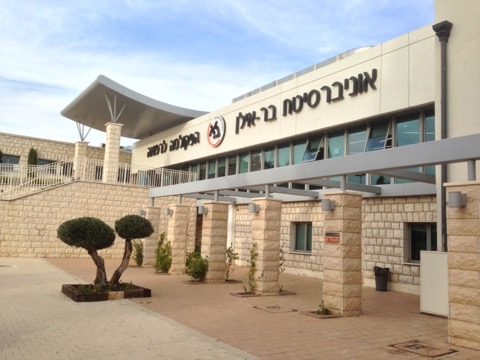

Some gifted students may have symptoms of attention-deficit/hyperactivity disorder (ADHD), which are associated with academic challenges. Self-efficacy for mathematics is typically lower in students with ADHD symptoms compared with their peers. This study explored how gifted students' sources of self-efficacy may mediate the relationship between their ADHD symptoms and mathematics self-efficacy. The study was conducted within the Israeli education system, which in recent years has promoted academic excellence alongside the inclusion of diverse student populations, in line with national inclusion policies. A quantitative longitudinal study collected self-report questionnaires from 88 gifted students at the beginning and end of seventh grade, to trace changes across the challenging transition year to middle school. Participants were identified as gifted students, while ADHD symptom levels were assessed as a continuous self-report variable and were not used to define twice-exceptionality. Results revealed that while higher inattention and/or hyperactivity-impulsivity levels correlated with lower mathematics self-efficacy, the effect was indirect, mediated by specific sources of self-efficacy, with the pattern and strength of the mediating relationships differing between the beginning and end of seventh grade. These findings highlight the importance of targeting self-efficacy sources to promote positive mathematical achievement for gifted students with high levels of ADHD symptoms.
This study investigated predictors of vowelized and unvowelized word reading efficiency among third-grade Hebrew-speaking students with reading difficulties (RD). First, it examined the contribution of rapid automatization naming (RAN), working memory (WM), phonological awareness (PA), morphological awareness (MA), and orthographic processing (OP) in explaining vowelized and unvowelized word reading efficiency among third-grade students with RD. It further explored how RAN interacts with WM, PA, MA, and OP in explaining word reading efficiency in the two scripts, and whether the contribution of RAN differs in strength between vowelized and unvowelized word reading. 270 children were assessed on the abovementioned explanatory variables as well as word reading efficiency. While RAN, WM, PA, and OP explained both vowelized and unvowelized word reading, MA contributed only to unvowelized word reading. Moreover, a significant interaction between RAN and PA was found for vowelized word reading, indicating a skill-enhancement (protective) pattern, whereby the association between RAN and reading efficiency varied as a function of phonological awareness. For unvowelized words, RAN and WM showed a significant interaction indicating a skill-enhancement pattern, in which stronger abilities in both lead to better word reading efficiency. Finally, RAN was found to play a more pronounced role in word reading efficiency of unvowelized words. These findings provide evidence that in a dual-script language, the dynamics of RAN and other cognitive-linguistic reading predictors can vary across scripts, highlighting the need for script-dependent targeted support for children with RD.
Arabic-speaking children grow up in diglossia where different language varieties serve complementary functions; They use Spoken Arabic (SpA) for everyday communication but acquire literacy in Standard Arabic (StA), the only variety with a conventional orthography. Research shows that while the linguistic distance between SpA and StA challenges StA language and literacy acquisition with an advantage for linguistic structures that are identical in the two varieties, skills in SpA and StA are interdependent. Furthermore, Executive Functions (EF) predict StA comprehension reflecting the need to manage the competition between SpA and StA. The study investigated the effectiveness of Arabic Diglossia-centered Multi-domain Intervention (ADMIN) in promoting Palestinian-Arabic-speaking kindergarten children’s language and literacy skills in SpA and in StA, as well as their EF skills. ADMIN is diglossia-centered; It trains SpA-identical structures before gradually transitioning to StA structures while fostering diglossic awareness. ADMIN is also multi-domain; It trains language, literacy and EFs. 403 children (Mean age = 64.4, SD = 3.1 months) were randomly assigned to an experimental group (n = 250) or a control (n = 153) group. The experimental group received three 20-min ADMIN sessions a week for 15 weeks, whereas the control group received business-as-usual instruction. Multi-level modeling for nested data showed greater gains in the experimental group in SpA and StA language (receptive and expressive vocabulary, lexico-phonological representations) and metalinguistic skills (phonological and morphological awareness), and in EF and letter knowledge, compared to the control group. The findings have implications for early literacy education in Arabic diglossia and beyond.
Entropic uncertainty relations are universal quantifiers of fundamental uncertainties of quantum measurements and are widely discussed in the quantum metrology literature. Quantum memory is a phenomenon related to the specific type of quantum correlations that allows for reducing fundamental uncertainties of quantum measurements. In the present work, the modified concept of quantum memory for time-dependent problems is proposed. We compare the time-dependent formulation of quantum memory with the out-of-time-ordered correlator (OTOC). Quantum memory is a rigorous mathematical concept that requires demanding calculations. Thus, until now, quantum memory has been discussed mainly for simple model systems and stationary problems. In the present work, we demonstrate that quantum memory can also be studied for realistic and physically relevant systems, e.g., the atomic helical spin chain, as well as the emergence and propagation of quantum correlations in time. We found that quantum memory manifests faster oscillations in time than OTOC and does not equilibrate. Furthermore, an artificial neural network is trained and asked to predict results for OTOC and quantum memory. These results show that quantum memory is more sensitive than OTOC in terms of broken inversion symmetry and the nonreciprocal effect.
We present a highly efficient and robust method for free boundary injective parameterization of disk-like triangle meshes with low isometric distortion. Harmonic function-based approaches, grounded in a strong mathematical framework, are widely employed. In particular, harmonic maps are valuable for guaranteeing injectivity under suitable boundary conditions. They are also computationally efficient, as they operate within a linear subspace [FW22]. However, this restriction to a limited subspace often introduces substantial isometric distortion, especially on highly curved surfaces. In contrast, methods that explore the full space of piecewise linear maps [SPSH*17] achieve much lower isometric distortion, but at the expense of increased computational cost. We propose a hybrid method that combines the speed and robustness of harmonic maps with the generality of full-space methods to produce injective maps with low isometric distortion up to 50 times faster than state-of-the-art methods. The core concept is simple but powerful. Instead of searching for the optimal parameterization over the original mesh via a full-space method, we simplify the input fine mesh and parameterize the coarse mesh. We then prolong the Beltrami coefficients from the coarse mesh parameterization to the fine mesh, resulting in a customized Laplacian matrix that gives rise to a harmonic map in a modified metric [WGS23, FW25]. Our method ensures injectivity, offers great computational efficiency, and produces significantly lower isometric distortion compared to harmonic maps.





