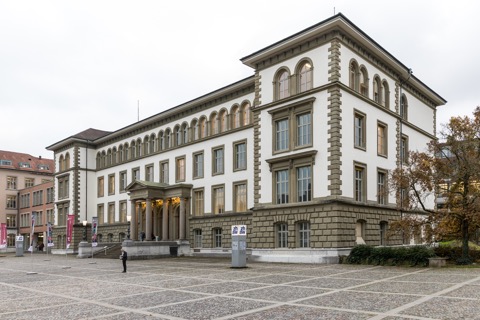
The Zurich University of Applied Sciences (ZHAW; German: Zürcher Hochschule für Angewandte Wissenschaften) located in the city of Winterthur, with facilities in Zurich and Wädenswil, is one of the largest University of Applied Sciences in Switzerland and is part of the Zürcher Fachhochschule.Currently, the university has eight schools, covering architecture and civil engineering, health, linguistics, life sciences and facility management, applied psychology, social work, engineering and management and law.The ZHAW School of Management and Law obtained AACSB accreditation in 2015.

Abstract Background The COVID-19 pandemic accelerated telehealth service adoption in physiotherapy, including telerehabilitation (TR). However, the extent of TR use and factors influencing its implementation in Germany remain unclear. This study aimed to evaluate TR use in physiotherapy (during COVID-19 lockdowns, current use, future intentions, conditions treated, content, setting, and session type) and identify barriers and facilitators from physiotherapists’ (PTs) perspectives. Methods A mixed-methods sequential explanatory design was employed, combining a cross-sectional online survey (n = 152) with two focus group interviews (n = 9). The survey collected data on demographics, TR use, barriers, and facilitators. Focus groups explored themes emerging from the survey in greater depth. Data were analyzed using descriptive statistics and content analysis, integrating quantitative and qualitative findings. Quantitative and qualitative findings were integrated through explanatory linking and joint display in a comparative analysis table. Results TR use peaked during COVID-19 lockdown (32.26%) but decreased to 18.06% by October 2022, with 26.45% intending future use and 43.87% considering it. Among TR users, musculoskeletal conditions were most commonly treated (75%), followed by sports (38%), pulmonology (33%), and neurology (27%). The primary barrier was lack of physical examination (74% agreement). While technical challenges were not reported as a major barrier in the survey, interviews revealed significant concerns about insufficient internet bandwidth and technical infrastructure. Common reasons for using TR included promoting patient self-management (78% agreement) and broadening therapy options (69% agreement). Qualitative data identified additional implementation facilitators, including structured implementation processes, appropriate technical infrastructure, and patient involvement in decision-making. Conclusion While TR implementation in German physiotherapy shows growth potential, several barriers currently limit its adoption. Successful implementation requires addressing PTs capabilities, knowledge gaps, professional identity concerns, and environmental factors. Addressing these issues could enhance patient care quality, increase service accessibility, and advance healthcare delivery models.
Integration of sensing, memory, and computing functionalities within a single device is a key step towards the development of efficient and compact artificial visual systems. Halide perovskite based memristors are promising candidates for such neuromorphic platforms due to their inherent optoelectronic properties and resistive switching capabilities. Using lead free layered double perovskites based on 1,4-phenylenedimethylammonium (PDMA) and benzylammonium (BzA) of (PDMA)2AgBiX8 and (BzA)4AgBiX8 (X = I and Br) compositions, we show that field and light-driven migration of halide ions and lattice incorporated Ag+ governs resistive switching and synaptic processes through an intrinsic mechanism, enabling electrical and optical synaptic responses. Depending on how ionic redistribution is stabilized or allowed to relax under different electrode and architectural boundary conditions, the same material exhibits both non-volatile memory and diffusive (volatile) switching essential for mimicking dynamic synaptic and neuronal processes. In solar cell configurations, the built-in junction field couples photocarrier generation with ionic motion, allowing zero-bias optical synaptic plasticity and self-powered operation for potential in-sensor computing. Electrical and optical synaptic responses emerge from this unified ion-dynamic process. Electrode and temperature dependence studies, transient measurements, polarity-switching analysis, and impedance spectroscopy provide consistent mechanistic signatures across operating modes. These findings position lead-free layered double perovskites as multifunctional and sustainable materials for neuromorphic technologies.
The Epoch of Reionization (EoR), when the first luminous sources ionized the intergalactic medium, represents a new frontier in cosmology. The Square Kilometre Array Observatory (SKAO) will offer unprecedented insights into this era through observations of the redshifted 21-cm signal, enabling constraints on the Universe's reionization history. We inves-tigate the information content of the average neutral hydrogen fraction ((x) over bar (HI)) in several Gaussian (spherical and cylindrical power spectra) and non-Gaussian (Betti numbers and bispectrum) summary statistics of the 21-cm signal. Mock 21-cm observations are generated using the AA* configuration of SKAO's low-frequency telescope, incorporating noise levels for 100 and 1000 h. We employ a state-of-the-art implicit inference framework to learn posterior distributions of (x) over bar (HI) in redshift bins centred at z = 8 7.2, and 6.5, for each statistic and noise scenario, validating the posteriors through calibration tests. Using the figure of merit to assess constraining power, we find that Betti numbers alone are on average more informative than the power spectra, while the bispectrum provides limited constraints. However, combining higher-order statistics with the cylindrical power spectrum improves the mean figure of merit by similar to 0.25 dex (similar to 33 per cent reduction in sigma((x) over bar (HI))). The relative contribution of each statistic varies with the stage of reionization. With SKAO observations approaching, our results show that combining power spectra with higher-order statistics can significantly increase the information retrieved from the FoR, maximizing the scientific return of future 21-cm observations.
Efficient navigation in dynamic environments requires anticipating how motion patterns evolve beyond the robot's immediate perceptual range, enabling preemptive rather than purely reactive planning in crowded scenes. Maps of Dynamics (MoDs) offer a structured representation of motion tendencies in space useful for long-term global planning, but constructing them traditionally requires global environment observations over extended periods of time. We introduce EgoMoD, the first approach that learns to predict future MoDs directly from short egocentric video clips collected during robot operation. Our method learns to infer environment-wide motion tendencies from local dynamic cues using a video- and pose-conditioned architecture trained with MoDs computed from external observations as privileged supervision, allowing local observations to serve as predictive signals of global motion structure. Thanks to this, we offer the capacity to forecast future motion dynamics over the whole environment rather than merely extend past patterns in the robot's field of view. Experiments in large simulated environments show that EgoMoD accurately predicts future MoDs under limited observability, while evaluation with real images showcases its zero-shot transferability to real systems.
Stakeholders from six European pilot sites engaged in participatory mapping and land suitability assessments to co-design climate-smart strategies for sustainable land management. The mixed methodology applied combined GIS based landscape vulnerability analysis, stakeholder knowledge, and assessments of ecosystem services. Key phases included preliminary assessment of environmental pressures, participatory SWOT analysis, and collaborative mapping exercises to identify suitable mixed farming (MF) and agroforestry (AF) practices. This approach empowered local communities, enhanced knowledge exchange, and integrated socio-ecological dimensions into land-use planning. Participatory mapping proved effective in capturing spatial perceptions, guiding context-specific transitions, and building consensus on landscape-scale interventions. Based on environmental pressure indicators, the scaling-up analysis showed that, depending on local conditions, the proportion of areas suitable for MF and AF ranged from 2 to 61





