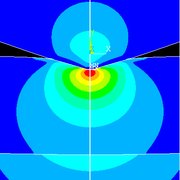
Pile-up distribution around residual imprint of indentation on single crystals is known to be greatly influenced by the indented crystallographic orientation but also by the shape of the indenter [1]. Numerous authors have shown that it is possible to reproduce numerically this pile-up distribution using material’s behaviour law based on crystal plasticity or dislocation dynamics [2, 3]. But the opposite way, i.e to identify the complete material law from the experimental topography, is not so easy. In this way, we report numerical and experimental results of nanoindentation at grain scale in case FCC material. Two polycrystalline nickel samples were studied: an annealed sample and a work-hardened one, both with large grains (characteristic size about 140μm and 168μm, respectively). Piles-up and slip traces were systematically analysed for Berkovich indentations performed along the four crystallographic directions [001], [101], [111] and [123], and with different orientation of the Berkovich indenter in a given indentation plane. Indentation imprints were examined by atomic force microscopy in order to measure piles-up size and geometry and to identify the activated slip systems. The indentation test has been modelled with the FE code Zebulon under the single crystal plasticity framework, using the Meric-Cailletaud model [4]. These results reveal that, pile-up sizes and shapes are strongly dependant of the hardening matrix of the single crystal plasticity model which is related to the interactions between the different slip systems, but also suggest, that a part of the components of this matrix is identifiable from the measure of the residual topography.
This paper presents a method to determine the mechanical properties of piezoelectric thin films. The vibrational behavior of microcantilevers and clamped–clamped beams actuated by aluminum nitride (AlN) piezoelectric films were analyzed in order to investigate the suitability of these devices as characterization tools. Different geometries of resonators composed of a free‐standing structure made up of a TiPt/AlN/TiPt piezoelectric stack were tested. The out‐of‐plane motion of the resonators was assessed by laser Doppler vibrometry. An AlN Young's modulus of about 200 GPa was extracted from resonance‐frequency measurements by means of Comsol software simulations that allow taking into account AlN underetching. This value of Young's modulus was compared to the one measured by a nanoindentation technique. The quality of crystallinity was also assessed using X‐ray diffraction (XRD) measurements. We then estimated the residual stress (about 200 MPa) using an interferometry measurement.
Podosomes are mechanosensitive adhesion cell structures that are capable of applying protrusive forces onto the extracellular environment. We have recently developed a method dedicated to the evaluation of the nanoscale forces that podosomes generate to protrude into the extracellular matrix. It consists in measuring by atomic force microscopy (AFM) the nanometer deformations produced by macrophages on a compliant Formvar membrane and has been called protrusion force microscopy (PFM). Here we perform time-lapse PFM experiments and investigate spatial correlations of force dynamics between podosome pairs. We use an automated procedure based on finite element simulations that extends the analysis of PFM experimental data to take into account podosome architecture and organization. We show that protrusion force varies in a synchronous manner for podosome first neighbors, a result that correlates with phase synchrony of core F-actin temporal oscillations. This dynamic spatial coordination between podosomes suggests a short-range interaction that regulates their mechanical activity.
In this study, a new type of active membrane based on magnetic elastomer composite is manufactured, characterized and integrated into a simple valve. The simple and low-cost fabrication process combined with large displacement capability of the membrane is favorable for use in disposable fluidic devices. Passivated ferromagnetic cobalt nanoparticles (~37 nm) synthesized by the chemical route were embedded in polydimethylsiloxane (PDMS) to fabricate nano-composite flexible membranes. Magneto-mechanical and mechanical properties of the PDMS composite elastomeric membrane loaded with various concentrations of cobalt (Co) nanoparticles (between 15 and 75 % by weight) were studied. Dynamic mechanical analysis (DMA) measurements of the nano-composite membranes were conducted as a function of the applied frequency (between 0.1 and 56 Hz). With higher concentration (50-wt%) of Co nanoparticles in PDMS, the elastic modulus was increased by 3–4 times as compared with that of membranes with lower concentrations of nanoparticles. Shore hardness was maximum for the nano-composite membrane loaded with 50-wt% of Co nanoparticles. A fluidic actuator with 400 μm thick PDMS membrane of 18 mm free diameter loaded with 50-wt% Co nanoparticles was manufactured and tested under external magnetic field. In the region where the magnetic field gradient is highest, high deflection of the membrane could be obtained (0.68 mm for 1 Tesla). However some hysteresis of the membrane deflection could be observed, even at very low frequency. Loading of PDMS with Co nanoparticles allowed a wider range of control of the wetting properties of PDMS surfaces under oxygen plasma treatment, from hydrophobic to hydrophilic to super-hydrophilic. Tunability in hydrophilicity could be achieved by varying the process parameters as verified by contact angles and Fourier transforms infrared (FTIR) spectra before and after plasma treatment. Under certain conditions, 50 % Cobalt-PDMS membrane surfaces exhibited a super-hydrophilic behavior (contact angle ~5°).
Podosomes are adhesion structures formed in monocyte-derived cells. They are F-actin-rich columns perpendicular to the substrate surrounded by a ring of integrins. Here, to measure podosome protrusive forces, we designed an innovative experimental setup named protrusion force microscopy (PFM), which consists in measuring by atomic force microscopy the deformation induced by living cells onto a compliant Formvar sheet. By quantifying the heights of protrusions made by podosomes onto Formvar sheets, we estimate that a single podosome generates a protrusion force that increases with the stiffness of the substratum, which is a hallmark of mechanosensing activity. We show that the protrusive force generated at podosomes oscillates with a constant period and requires combined actomyosin contraction and actin polymerization. Finally, we elaborate a model to explain the mechanical and oscillatory activities of podosomes. Thus, PFM shows that podosomes are mechanosensing cell structures exerting a protrusive force.
The rheological parameters of materials are determined in the industry according to international standards established generally on the basis of widespread techniques and robust methods of estimation. Concerning solid polymers and the determination of Young's modulus in tensile tests, ISO 527-1 or ASTM D638 standards rely on protocols with poor scientific content: the determination of the slope of conventionally defined straight lines fitted to stress-strain curves in a given range of elongations. This paper describes the approach allowing for a correct measurement of the instantaneous elastic modulus of polymers in a tensile test. It is based on the use of an appropriate reduced model to describe the behavior of the material. The model comes a thermodynamical framework and allows to reproduce the behavior of an HDPE Polymer until large strains, covering the elastoviscoplastic and hardening regimes. Well-established principles of parameter estimation in engineering science are used to found the identification procedure. It will be shown that three parameters only are necessary to model experimental tensile signals: the instantaneous ('Young's') modulus, the maximum relaxation time of a linear distribution (described with a universal shape) and a strain hardening modulus to describe the 'relaxed' state. The paper ends with an assessment of the methodology. Our results of instantaneous modulus measurements are compared with those obtained with other physical experiments operating at different temporal and length scales.
In this paper, we present a technique to simultaneously measure Young's modulus E and Poisson's ratio v of an isotropic material at local scale in a single experiment. Using several flexural modes of vibration of the scanning microdeformation microscope, it is possible to decouple the contributions of E and v from the first two resonant frequencies, thereby providing access to both the elastic parameters. The proposed approach is applied to SU8 thin films deposited on silicon substrates and provides values consistent with those from the literature. (C) 2011 Elsevier B.V. All rights reserved.
The aim of this paper consists in the understanding and in the analysis of the indentation modulus values M <hkl> determined by the continuous stiffness method in the case of anisotropic materials and/or SMART materials as ferroelectric or shape memory alloys. Some examples have been studied; Ni, W, Zn, Ni-2 MnGa and PZT where the indentation modulus values are very different to those given by the biaxial modulus (E/1 -gamma 2). A simple analytical formulation which gives results very close to those obtained by 3D finite elements calculations of Berkovich indentation of materials with cubic and hexagonal symmetries has been proposed. An interpretation of the two indentation modulus values of SMART materials under loading or at 90% of unloading has been proposed. These two values are linked to the modification or the reorientation of the ferroelectric domains or of the martensite variants under the pressure of the tip. In conclusion, the indentation modulus is far to be a standard parameter, that is to say the biaxial modulus, when the studied materials present a great anisotropy or behave as SMART materials.
Although previous works have shown the marked influence of thiourea as an organic additive in electrolyte bulk on copper electrodeposition, a variety of mechanisms could be responsible. The present paper concerns the effect of a thiourea layer adsorbed prior to copper electrodeposition. First evidence of a monolayer on platinum substrate was revealed by X-ray photoelectron spectroscopy. Two different times (15h and 1min) for platinum immersion were tested, and it was observed that, even for short times, thiourea is chemisorbed on the surface. Then, effects of thiourea adsorption on copper underpotential deposition (UPD) and overpotential deposition (OPD) processes on polycrystalline platinum were investigated by polarisation curves, atomic force microscopy and X-ray photoelectrons. Thiourea monolayer increases the copper UPD process: in fact the current density of UPD cathodic peak is higher in the presence of thiourea on the platinum surface. However no modifications were observed on the AFM images and on the XPS spectra. For the copper OPD process, the presence of thiourea monolayer inhibits copper deposition: the current density of OPD cathodic peak is lower whatever the immersion time of the platinum substrate in the thiourea solution. Moreover, XPS spectra show that the presence of thiourea modified the oxidation state of the copper coating, as an oxide film is formed more quickly on the surface of the coating.
The morphology of nano-craters drilled in borosilicate glass by single-shot femtosecond laser ablation has been studied by atomic force microscopy and scanning electron microscopy. The influence of polarization, numerical aperture (NA = 0.4 and 0.8) and fluence (3 < F < 18 J cm(-2)) was systematically investigated in the case of a strong geometrical confinement, leading to nanometric scale in all spatial dimensions. Indeed, the structure size is not restricted by the diffraction limit but determined by the laser pulse stability and the material properties.The dimensions of the principal and of the secondary (self-focusing) craters, and of the rim have been studied in detail. Different relationships have been proposed for the evolutions of the depths and of the different diameters of the craters as functions of the position of the specimen surface through the beam-material interaction region, and of the characteristics of the laser. (C) 2009 Elsevier Ltd. All rights reserved.
We have developed an optomechanical methodology, combining interferometric deflection data, the nanoindentation technique and analytical modeling to perform the characterization of piezoelectrically driven microcantilevers operating as MEMS actuators. Here, the association of standard Twyman-Green interferometry (TGI) with time averaged and stroboscopic techniques permits the evaluation of the 3-D out-of-plane deflections of microdevices and provides feedback of measurements that helps us to optimize MEMS structures and improve the reliability and stability of microcantilevers.The goal of the presented study was investigation of high-quality cantilevers composed from silicon beam and a transducer including the aluminum nitride (AlN) layer. It is a material with piezoelectric properties, which can be an alternative for PZT films in micromachining technology. After presenting the fabrication process of the testing devices, the rest of the paper will focus on non-contact measurements of cantilevers deflection by interferometry: static data (e.g., initial shape, deformation, stress) and dynamic parameters of samples (e.g., resonance frequency and amplitude distributions in vibration modes). On the basis of these experimental data, parameters such as piezoelectric coefficient d(31) have been calculated taking into account multiple film stacking. (c) 2008 Elsevier Ltd. All rights reserved.
1.5 mu m-Ni55Mn23Ga22 ferromagnetic thin films were deposited onto silicon substrates and silicon single beam cantilever using radio-frequency magnetron sputtering. As-deposited sample and heat-treated thin films were studied on their silicon substrates and peeled off to determine the influence of the stress. Post-heat treatment process allows at the films to achieve the shape memory effect (SME). Vibrating sample magnetometer (VSM) and deflection measurement of the sample annealed at 873 K during 36 ks exhibit ferromagnetic martensitic structure with a typical SME response to the magnetic field induced strains which match the values of the bulk material.
This paper treats a wide range of subjects related to the use of AlN as actuation layer in MEMS, from its deposition conditions to accurate interferometric device characterization and physical parameters extraction. The case of AlN driven multilayered cantilevers has been considered. Parameters such as Young's modulus associated to the (0 0 2) orientation of the crystallites, residual thin film stresses, thermal expansion coefficient α and piezoelectric coefficient d31 have been calculated using non approximated equations able to take into account multiple film stacking. The well oriented thin films exhibit approximately the same properties as the bulk material.
On etudie avec l'essai de nanoindentation Berkovich instrumente et en utilisant la technique de mesure de la rigidite en continu, les proprietes mecaniques locales du nickel polycristallin recuit et ecroui a gros grains et du nickel electrodepose sur plusieurs substrats et pour differentes densites de courant. On focalise notre analyse sur l'interpretation, en fonction de l'orientation des grains, du degre d'ecrouissage et du diametre des colonies de nanocristaux, des valeurs du module d'indentation M (hkl) , de la durete H (hkl) et des effets d'echelle associes, a savoir l'existence de longueurs internes h* (hkl) ' ainsi que sur les parametres d'identification inverse par Elements Finis des courbes d'indentation.
In this study we use the nanoindentation technique which is a powerful tool to characterise the mechanical properties of a welded bond. The Berkovich indentation has the advantage to test small material volumes compared to the conventional tensile tests. The welded process with electrons beam of hydrogen vessels induces different regions and the aim of this study is to characterize the differences of the mechanical properties of the different zones of the weld. To identify the stress-strain curves of the testedmaterial, F.E. inverse method has been used. After treatment, for one pass, the hardness of the melted zone is greater than those of the base material and for the two passes, the hardness is still lower than those of the base material. The interface zones present a hardness which is always higher than those of the weld. A relation of the Hall-Petch type which correlates the evolution of the hardness with the zinc concentration and the grain size has been proposed. Moreover a relation between the normalized hardness and the hydrogen concentration CH has been found. The parameters of the stress-strain curves of the four regions; base material, interface, one and two passes melted zones, have been deduced. The identified laws are used in a F.E. model of a welded sphere to modelize its radial deformation under internal pressure loading.
This paper treats a wide range of subjects related to the use of AlN as actuation layer in MEMS, from its deposition conditions to accurate interferometric device characterization and physical parameters extraction. The case of AlN driven multilayered cantilevers has been considered. Parameters such as Young's modulus associated to the (002) orientation of the crystallites, residual thin film stresses, thermal expansion coefficient α and piezoelectric coefficient d31 have been calculated using non approximated equations able to take into account multiple film stacking. The well oriented thin films exhibit approximately the same properties as the bulk material.
 Laurent Hirsinger合作论文数Laboratoire de Mécanique et Technologie, E.N.S. de Cachan / C.N.R.S. / Université Paris 69
 Michalina Jozwik合作论文数7
 Christophe Gorecki合作论文数International Center for Translational Eye Research, Institute of Physical Chemistry;Department of Micro Nano Sciences and Systems, Franche-Comté Électronique Mécanique Thermique et Optique - Sciences et Technologies7
 Katarzyna Krupa合作论文数6
 Andrei, A.合作论文数5
 Lukasz Nieradko合作论文数UMR CNRS 6174, University of Franche Comté5
 Cathy Meunier合作论文数4
 Fabrice Richard合作论文数Institut de Biologie du Développement de Marseille Luminy, Aix-Marseille Université;Institut de Biologie du Développement de Marseille Luminy, Aix-Marseille Université3C. Oytana合作论文数3
 P. Vairac合作论文数Department LPMO, FEMTO-ST Institute3Fabien Amiot合作论文数2a mermet合作论文数2Anaïs Bouissou合作论文数2Stéphane André合作论文数2
 Poincloux Renaud合作论文数CNRS, Univ Toulouse2
 Christophe Thibault合作论文数Université Paul Sabatier, Université de Toulouse2Amsha Proag合作论文数2
 Yann Meyer合作论文数IRTES-M3M, UTBM;c;IRTES-M3M, UTBM2Travaillot Thomas合作论文数2A. Sergent合作论文数2
 Manuel Collet合作论文数Institut FEMTO-ST, Université de Franche-Comté – 242Ch Vieu合作论文数2C. Rousselot合作论文数2Mahmood Qasmi合作论文数2L. Bornier合作论文数2
 Laurent Robert合作论文数UMR CNRS 6174, FEMTO-ST Institute2
 Raphael Voituriez合作论文数CNRS2Peggy Robinet合作论文数2Dominique Perreux合作论文数2Florent Bernard合作论文数Jean Monnet University2Isabelle Maridonneau-Parini合作论文数2y meshaka合作论文数1E. Fribourg-Blanc合作论文数1S Brida合作论文数1franck richard合作论文数1
 Guillaume M Charriere合作论文数1
 Akanksha Singh合作论文数1Barbier D.合作论文数1
 Arnaud Blaise合作论文数1j baborowski合作论文数1Laurent Farge合作论文数1Stéphanie Balor合作论文数1
 Jean-Claude Gerbedoen合作论文数LIMMS/CNRS-IIS, The University of Tokyo1P. Martins合作论文数1
 Thomas Mangeat合作论文数RainDance Technologies France;RainDance Technologies France1denis remiens合作论文数1
 Francois Courvoisier合作论文数Optique Department, Femto-st Institute, Centre National de la Recherche Scientifique, Universite de Franche-Comte1Nicolas Defrance合作论文数1
 Burdet Pierre合作论文数Department of Materials Science and Metallurgy, University of Cambridge1




