Multimodal Large Language Models (MLLMs) perform strongly in high-resource languages, yet often produce fluent but culturally "thin" descriptions in low-resource settings. We argue that this failure is not merely a linguistic limitation: culture-specific visual knowledge depends on native visual-textual alignments that translation-centric pipelines rarely provide. We present MELLA, a multimodal dataset across eight low-resource languages, designed to jointly support linguistic fluency and cultural groundedness. MELLA uses a dual-source strategy that combines native web image-alt-text pairs for culture-grounded supervision with generated-and-translated image descriptions for linguistically rich supervision, explicitly separating two learning signals often conflated in multilingual multimodal data. Through controlled diagnostic fine-tuning on multiple MLLM backbones, we show that MELLA mitigates cultural hallucination by helping models recognize and articulate culturally specific entities overlooked by translation-based adaptation. Our findings highlight data alignment, rather than model modification alone, as a key path toward culturally grounded multimodal understanding in low-resource languages.
Retrieving evidence pages from visually rich long documents is a key challenge in document question answering. Existing page-level visual retrievers operate under an independent matching paradigm: each page is scored in isolation based on query-page similarity. This paradigm can under-rank evidence pages whose signals are localized in fine-grained chunks or depend on document-internal associations. We propose EviProp, a retrieval method that recovers such pages via seeded relevance diffusion. EviProp models each document as a multimodal Chunk-Page graph with hierarchical, sequential, and similarity links. Given a query, it combines dense visual page priors with sparse chunk seeds, then runs Personalized PageRank to diffuse relevance over the graph. Experiments on MMLongBench-Doc and LongDocURL show consistent gains in evidence-page retrieval over independent visual retrieval and text-visual fusion baselines. Downstream QA results further show that improved retrieval translates into better answer accuracy, with negligible online retrieval overhead. Our code is released at https://github.com/Flyecnu/EviProp.
Automating industrial CAD design and manufacturing places distinctive demands on multimodal foundation models: the model must see engineering drawings and 3D geometry screenshots, write correct parametric-modelling scripts and Windows COM API code, and cover the full range from single parts to assemblies. General-purpose multimodal models fall short on these tasks, while single-task fine-tuning is too narrow to support the diverse calls that upper-layer agents issue. We build IndustryForge-27B on top of Qwen3.5-VL-27B by curating and integrating six industrial-CAD sub-corpora totalling ∼52k multimodal samples—CAD Visual QA (CAD-VQA), parametric CAD code (text2cadquery), assembly-level CAD code (text2cadquery-assembly), and three COM sub-corpora for Inventor / SolidWorks (com_2d / com_3d / com_assembly)—and training with a unified multi-task SFT recipe. Across four CAD-domain benchmarks IndustryForge-27B lifts the base model by +33.65 pp on average and outperforms the strong closed-source model GPT-5.4 on all four; across eleven general-capability benchmarks it retains, and slightly improves upon, the base model (+1.56 pp mean, no catastrophic forgetting). IndustryForge-27B will serve as the common substrate for downstream industrial-agent projects, providing a unified starting point for a full-stack industrial agent that spans from CAD design to industrial-software operation, from parts to assemblies, and from single-shot generation to closed-loop self-improvement.
Recent advances in large language models and programmatic CAD have significantly improved Text-to-CAD generation for individual parts. However, production-ready mechanical assembly generation remains largely unsolved. Unlike single-part modeling, assemblies require coordinated reasoning over multiple components, functional interfaces, assembly relations, engineering principles, and physical consistency. Consequently, directly generating executable CAD code is insufficient for constructing mechanically valid and reusable assemblies. We present AssemCAD, an axiom-grounded framework for production-ready CAD assembly generation from natural language. Instead of representing an assembly as monolithic CAD code, AssemCAD first constructs an axiomatic Assembly Specification consisting of typed parts, geometry-backed ports, executable mates, and engineering axioms. Each assembly relation is explicitly grounded in one or more engineering principles, making the resulting specification interpretable, reusable, and verifiable. To realize this specification, AssemCAD introduces a port- and mate-based CAD assembly library that executes symbolic assembly relations through deterministic mate transformations and validates declared interfaces using concrete B-Rep geometric evidence. Built on this representation and library, AssemCAD further supports on-demand synthesis of reusable parametric component factories for both standard and open-world geometries. Experiments on AssemBench show that AssemCAD substantially improves assembly preservation and physical validity over code-centric CAD generation baselines, while generalizing across different foundation-model backbones. By combining axiom-grounded assembly reasoning with deterministic geometric execution, AssemCAD extends Text-to-CAD from isolated part generation toward production-ready mechanical assembly design.
Retrieving past experiences has become a common strategy to enhance large language model agents. However, most existing memory-augmented agents treat retrieved experiences as static records to be replayed verbatim, injecting them into the context regardless of whether they align with the agent's current situation. This “replay” paradigm ignores the gap between the abstract, general nature of stored experience and the concrete, ever-changing states encountered at decision time, frequently causing negative transfer. In contrast, humans rarely recall past experiences verbatim; instead, they reorganize and adapt retrieved memories to fit the present context. Inspired by this, we propose MemHarness, a framework that equips LLM agents to actively harness and reconstruct past experiences based on the present context. At each decision step, a unified policy model critiques and reconstructs the retrieved experience conditioned on the current state, producing context-grounded guidance before acting. This reconstructive ability emerges naturally through end-to-end training with GRPO. Experiments on ALFWorld and WebShop show that MemHarness substantially outperforms pure RL and static memory-augmented baselines, demonstrating strong robustness in out-of-distribution (OOD) scenarios. Furthermore, our analyses reveal that this reconstruction objective not only prevents negative transfer but also serves as latent guidance during training, fundamentally improving the agent's intrinsic reasoning capabilities.
Document parsing is a fundamental task in multimodal understanding, supporting a wide range of downstream applications such as information extraction and intelligent document analysis. Benefiting from strong semantic modeling and robust generalization, VLM-based end-to-end approaches have emerged as the mainstream paradigm in recent years. However, these models often suffer from substantial inference latency, as they must autoregressively generate long, full-page sequences when processing long-form documents. While recent hybrid methods mitigate this issue via region-level parallel decoding with VLMs, independent region decoding loses full-page context and might weaken global coherence. To address this issue, we propose Hierarchical Speculative Decoding (HSD), a two-stage local-to-global framework for document parsing. HSD first employs a lightweight pipeline drafter to predict region partitions and generate coarse drafts for each region. The first stage verifies the generated region-level drafts in parallel for efficiency, while the second stage further performs page-level verification on these refined outputs to preserve full-page coherence. Experimental results show that HSD achieves a near-lossless 2.7x speedup with HunyuanOCR on OmniDocBench v1.5 and up to 7.04x speedup on long-document parsing tasks, demonstrating the effectiveness of the proposed method. The code is available at https://github.com/whlscut/HSD.
Retrieval-Augmented Generation (RAG) enhanced by Knowledge Graphs has shown promise in complex multi-hop reasoning tasks. However, existing graph-based retrieval methods typically rely on flat, undirected topologies. During the retrieval process, the probability flow often gets trapped in high-degree abstract concept nodes which we define as “probability black holes”, leading to semantic drift and noise accumulation. To address this, we propose SemFlowRAG, a framework that reconstructs the flat retrieval space into a corpus-adaptive semantic gradient graph. This data-driven self-organization enables a hierarchical structure to emerge naturally from the data distribution, capturing the intrinsic semantic granularity of the corpus to suppress structural noise. By quantifying the semantic abstractness of entities through the embedding variance of their associated passages, we transform static undirected edges into directed semantic constraints. Furthermore, we design an abstractness-guided directed PageRank algorithm that forces the retrieval trajectory to follow a “high-to-low semantic abstractness” gradient. This mechanism ensures layer-by-layer evidence convergence, smoothly guiding the retrieval process from abstract concepts to specific document evidence. Extensive experiments on complex QA datasets demonstrate that SemFlowRAG effectively mitigates the “probability black holes” issue, outperforming existing baselines in both retrieval and downstream reasoning performance.
Post-training for large language models typically couples policy exploration with model optimization, hindering the reuse of high-reward behaviors from policy exploration. While on-policy distillation alleviates this by consolidating independently optimized experts, its reliance on matching absolute expert distributions can yield suboptimal supervision, especially when the target model possesses a different prior or already surpasses the expert's capabilities. To alleviate this, we introduce Proxy OPD (P-OPD), an asynchronous post-training framework that transfers reward-induced policy improvements rather than absolute policy distributions. P-OPD first optimizes a proxy policy via reward feedback. It then extracts the relative distributional changes between the proxy's initial and optimized states, transferring these directional updates through the target model's own on-policy trajectories while retaining the target policy as the reference. This decoupled formulation requires the proxy to provide merely a useful direction of improvement rather than superior absolute capability, enabling update signals from older or weaker proxies to remain highly effective. Systematic experiments on Qwen3-family models across mathematical reasoning and code generation demonstrate that P-OPD consistently enhances already strong target models. Furthermore, transfer intensity can be dynamically modulated through signal scaling, making the extracted update signals seamlessly reusable across diverse model variants and training configurations. These results establish relative policy updates as highly reusable, adjustable assets for scalable, reward-based post-training.
Recent advancements in LVLMs necessitate robust benchmarks for complex, visually grounded reasoning. A critical limitation is identified in many document understanding benchmarks: visual content is often reducible to text, enabling high performance without genuine visual grounding. To address this limitation, OmniMapBench is introduced to foster visual-centric reasoning for map documents. The benchmark comprises 2,096 manually annotated question-answer pairs across 1,603 map documents from nine categories. It is designed to probe a hierarchy of skills, ranging from perception to multi-step visual reasoning. To quantify benchmark properties, a simple yet effective benchmark-level metric is proposed: the Visual Dependency Index (VDI), defined as the accuracy drop when images are replaced with question-agnostic descriptions. OmniMapBench exhibits higher VDI than established benchmarks, which quantitatively validates its focus on irreducible visual reasoning. Comprehensive evaluations of 25 leading LVLMs are conducted on OmniMapBench. A significant performance gap is observed, with the top-performing model achieving only 75.03% accuracy. This result underscores the challenges posed by OmniMapBench to current LVLMs. This work aims to catalyze progress in visual-centric reasoning for document understanding of LVLMs. The dataset and code are publicly available at https://github.com/SIGMME/OmniMapBench.
End-to-end autonomous driving systems increasingly rely on vision-centric world models to understand and predict their environment. However, a common ineffectiveness in these models is the full reconstruction of future scenes, which expends significant capacity on redundantly modeling static backgrounds. To address this, we propose IR-WM, an Implicit Residual World Model that focuses on modeling the current state and evolution of the world. IR-WM first establishes a robust bird's-eye-view representation of the current state from the visual observation. It then leverages the BEV features from the previous timestep as a strong temporal prior and predicts only the "residual", i.e., the changes conditioned on the ego-vehicles actions and scene context. To alleviate error accumulation over time, we further apply an alignment module to calibrate semantic and dynamic misalignments. Moreover, we investigate different forecastingplanning coupling schemes and demonstrate that the implicit future state generated by world models substantially improves planning accuracy. On the nuScenes benchmark, IR-WM achieves top performance in both 4D occupancy forecasting and trajectory planning.
LLM agents have achieved strong performance in tool-augmented reasoning, but most remain largely stateless: after each episode, the agent discards interaction traces and does not accumulate reusable strategies. Prior work either stores raw trajectories for case-based reuse or relies on external teacher models to write reflections, which limits generalization or leaves the agent’s policy unchanged. We introduce EvolveR, an experience-driven framework that allows an agent to improve using its own interaction history. EvolveR maintains an experience base of distilled strategic principles derived from past trajectories. In an offline phase, the agent self-distills successful and failed trajectories into concise principles, applies semantic deduplication, and assigns each principle an empirical utility score for maintenance and pruning. In an online phase, the agent retrieves top-ranked principles to guide reasoning and tool usage, generating new trajectories. We then perform policy evolution with reinforcement learning on these experience-conditioned trajectories, reinforcing behaviors that effectively retrieve and apply useful principles. We demonstrate the effectiveness of EvolveR on complex multi-hop question-answering benchmarks, where it achieves superior performance over strong agentic baselines. Our work presents a comprehensive blueprint for agents that learn not only from external data but also from the consequences of their own actions, paving the way for more autonomous and continuously improving systems.
Retrieval-Augmented Generation (RAG) plays a crucial role in grounding Large Language Models by leveraging external knowledge, whereas the effectiveness is often compromised by the retrieval of contextually flawed or incomplete information. To address this, knowledge graph-based RAG methods have evolved towards hierarchical structures, organizing knowledge into multi-level summaries. However, these approaches still suffer from two critical, unaddressed challenges: high-level conceptual summaries exist as disconnected ``semantic islands'', lacking the explicit relations needed for cross-community reasoning; and the retrieval process itself remains structurally unaware, often degenerating into an inefficient flat search that fails to exploit the graph's rich topology. To overcome these limitations, we introduce LeanRAG, a framework that features a deeply collaborative design combining knowledge aggregation and retrieval strategies. LeanRAG first employs a novel semantic aggregation algorithm that forms entity clusters and constructs new explicit relations among aggregation-level summaries, creating a fully navigable semantic network. Then, a bottom-up, structure-guided retrieval strategy anchors queries to the most relevant fine-grained entities and then systematically traverses the graph's semantic pathways to gather concise yet contextually comprehensive evidence sets. The LeanRAG can mitigate the substantial overhead associated with path retrieval on graphs and minimize redundant information retrieval. Extensive experiments on four challenging QA benchmarks with different domains demonstrate that LeanRAG significantly outperforms existing methods in response quality while reducing 46% retrieval redundancy.
Domain adaptation has recently been widely explored for 3D detection. Previous works mainly use unsupervised domain adaptation (UDA) to address domain discrepancies. Despite notable improvements, their performance still largely trails models trained with fully annotated target data, due to larger domain gaps caused by different sensors and changing environments. In this paper, we exploit key characteristics of autonomous driving scenarios, including similar scenes and classimbalanced distributions, and explore a new task named active domain adaptation (ADA) for 3D object detection, which selects partial but important target data for annotation to further improve target-domain performance. Such a setting better reflects practical deployment in practice, where annotating all target-domain point clouds is prohibitively expensive while limited labels can substantially guide adaptation effectively. To this end, we propose a hybrid bi-domain active learning strategy, Bi3D++, to sample valuable data from both source and target domains and transfer source-domain knowledge to the target domain. Bi3D++ first samples target-like source data by measuring scene-level and instance-level similarity between domains, avoiding interference from irrelevant source data. Then, a hybrid active target sampling strategy selects target data by jointly considering rare-class similarity, intra-frame diversity, and inter-frame diversity, enabling diverse frames with diverse instances while emphasizing rare classes. Experiments on multiple cross-domain settings, including cross-beam and cross-location, show that Bi3D++ outperforms state-of-theart UDA methods with only 1% labeled target data and consistently improves performance as target annotations increase.
Existing computer-use agents remain fundamentally limited in professional software manipulation: GUI-based agents suffer from fragile visual grounding and long-horizon error accumulation, while API-basedapproaches struggle with heterogeneous protocols and inaccessible commercial interfaces. In this work,we identify the Component Object Model (COM) as a unified executable abstraction, proposing COM-as-Action: a new paradigm that reframes professional software interaction as deterministic program synthesisrather than sequential visual control. To validate this paradigm in the most demanding environments, weintroduce ComCADBench, the first benchmark for agents operating real industrial CAD software. Ourexperiments reveal a substantial paradigm gap: frontier proprietary models achieve near-zero successunder GUI-based interaction, whereas COM-based execution yields substantial immediate gains. Tobridge the remaining gap between syntactic correctness and geometric accuracy, we develop ComActor, aself-correcting agent trained through a progressive three-stage framework, alongside ComForge, a scalableplatform for large-scale training in Windows containers. Extensive experiments show that ComActorachieves state-of-the-art performance on ComCADBench, with strong resilience in long-horizon taskswhere baselines collapse, and generalizes to external CAD benchmark.
Large language model (LLM) agents increasingly operate over long interaction histories, where effective reasoning requires identifying and exploiting task-relevant evidence distributed across past observations and actions. However, useful information encoded in previously computed representations is often underutilized during subsequent generation. We propose TransMem, a lightweight inference-time parametric memory module that transforms sparse historical hidden states from a frozen LLM backbone into reusable memory representations. TransMem uses a lightweight gating network to dynamically apply the latent intervention to the current hidden states, without repeatedly encoding the preceding context. To learn transferable memory utilization rather than task-specific knowledge, we introduce evidence-conditioned self-distillation. A memory-augmented student processes the full context and matches the predictive distribution of an evidence-only teacher that shares the same frozen backbone. Experiments on LoCoMo, HotpotQA, and MemoryAgentBench demonstrate consistent improvements across different model architectures and scales. TransMem yields gains of 11.58–29.25 F_1 on LoCoMo and 10.20–13.03 F_1 on HotpotQA, while improving the average MemoryAgentBench accuracy from 29.54% to 40.00%. These results establish sparse historical hidden states as an effective and efficient memory substrate for long-context LLM agents. Our code is available at https://github.com/Haodong-Lei-Ray/TransMem.
Recent multimodal large language models (MLLMs) increasingly integrate multiple vision encoders to improve performance on various benchmarks, assuming that diverse pretraining objectives yield complementary visual signals. However, we show this assumption often fails in practice. Through systematic encoder masking across representative multi-encoder MLLMs, we find that performance typically degrades gracefully—and sometimes even improves—when selected encoders are masked, revealing pervasive encoder redundancy. To quantify this effect, we introduce two principled metrics: the Conditional Utilization Rate (CUR), which measures an encoder’s marginal contribution in the presence of others, and the Information Gap (IG), which captures heterogeneity in encoder utility within a model. Using these tools, we observe: (i) strong specialization on tasks like OCR \& Chart, where a single encoder can dominate with a CUR >90%, (ii) high redundancy on general VQA and knowledge-based tasks, where encoders are largely interchangeable, (iii) instances of detrimental encoders with negative CUR. Notably, masking specific encoders can yield up to 16% higher accuracy on a specific task category and 3.6% overall performance boost compared to the full model. Furthermore, single- and dual- encoder variants recover over 90% of baseline on most non-OCR tasks. Our analysis challenges the “more encoders are better” heuristic in MLLMs and provides actionable diagnostics for developing more efficient and effective multimodal architectures.
The rapid evolution of Multi-modal Large Language Models (MLLMs) has advanced workflow automation; however, existing research mainly targets performance upper bounds in static environments, overlooking robustness for stochastic real-world deployment. We identify three key challenges: dynamic task scheduling, active exploration under uncertainty, and continuous learning from experience. To bridge this gap, we introduce , a dynamic evaluation environment that simulates a "trainee" agent continuously exploring a novel setting. Unlike traditional benchmarks, evaluates agents along three dimensions: (1) context-aware scheduling for streaming tasks with varying priorities; (2) prudent information acquisition to reduce hallucination via active exploration; and (3) continuous evolution by distilling generalized strategies from rule-based, dynamically generated tasks. Experiments show that cutting-edge agents have significant deficiencies in dynamic environments, especially in active exploration and continual learning. Our work establishes a framework for assessing agent reliability, shifting evaluation from static tests to realistic, production-oriented scenarios. Our codes are available at https://github.com/KnowledgeXLab/EvoEnv
While autonomous driving technology has made remarkable strides, data-driven approaches still struggle with complex scenarios due to their limited reasoning capabilities. Meanwhile, knowledge-driven autonomous driving systems have evolved considerably with the popularization of visual language models. In this article, we propose LeapVAD, a novel method based on cognitive perception and dual-process thinking. Our approach implements a human-attentional mechanism to identify and focus on critical traffic elements that influence driving decisions. By characterizing these objects through comprehensive attributes—including appearance, motion patterns, and associated risks—LeapVAD achieves more effective environmental representation and streamlines the decision-making process. Furthermore, LeapVAD incorporates an innovative dual-process decision-making module mimicking the human-driving learning process. The system consists of an analytic process (System-II) that accumulates driving experience through logical reasoning and a heuristic process (System-I) that refines this knowledge via fine-tuning and few-shot learning. LeapVAD also includes reflective mechanisms and a growing memory bank, enabling it to learn from past mistakes and continuously improve its performance in a closed-loop environment. To enhance efficiency, we develop a scene encoder network that generates compact scene representations for rapid retrieval of relevant driving experiences. Extensive evaluations conducted on two leading autonomous driving simulators, CARLA and DriveArena, demonstrate that LeapVAD achieves superior performance compared with camera-only approaches despite limited training data. Comprehensive ablation studies further emphasize its effectiveness in continuous learning and domain adaptation. Project page: https://pjlab-adg.github.io/LeapVAD/
The webpage-to-code task requires models to understand visual representations of webpages and generate corresponding code. However, existing benchmarks primarily focus on static screenshot-to-code tasks, thereby overlooking the dynamic interactions fundamental to real-world web applications. To address this limitation, this paper introduces IWR-Bench, a novel benchmark for evaluating the capabilities of Large Vision-Language Models (LVLMs) in interactive webpage reconstruction from video. IWR-Bench comprises 113 meticulously curated tasks from 100 real-world websites, with 1,001 actions and featuring diverse interaction complexities (e.g., web games), visual styles, and domains. Aligning with standard web development practices, each task includes not only user interaction videos but also all crawled static assets (e.g., images, videos). This benchmark evaluates models on two fundamental challenges: comprehensive multi-modal reasoning to infer interaction logic from video and assets, and advanced code generation to translate this logic into functional code. An agent-as-a-judge framework with a comprehensive metric system automatically assesses the functional correctness and visual fidelity of generated webpages. Extensive experiments on 28 LVLMs reveal a significant challenge: the best model achieves an overall score of only 36.35\%, as functional correctness (24.39\% IFS) lags significantly behind visual fidelity (64.25\% VFS). These results highlight critical limitations in current models' ability to reason about temporal dynamics and synthesize event-driven logic, establishing IWR-Bench as a challenging frontier for vision-language research. The benchmark and evaluation code will be made publicly available.
 Pinlong Cai (蔡品隆)合作论文数Shanghai Artificial Intelligence Laboratory47
 Yu Qiao (乔宇)合作论文数Multimedia Laboratory, Shenzhen Institutes of Advanced Technology, Chinese Academy of Sciences;Shanghai AI Laboratory;Shenzhen University of Advanced Technology43
 Licheng Wen (温力成)合作论文数ADLab, Shanghai Artificial Intelligence Laboratory39
 Bo Zhang合作论文数Shanghai Aritifcal Intelligence Laboratory36
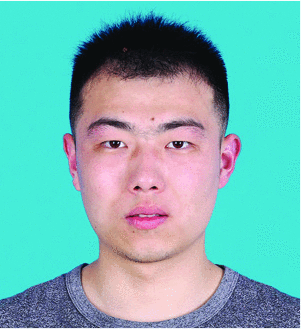 Daocheng Fu合作论文数29
 Xuemeng Yang合作论文数Tianjin University29
 Min Dou合作论文数21
 Jianbiao Mei (梅剑标)合作论文数College of Control Science and Engineering, Zhejiang University;Shanghai Artificial Intelligence Laboratory19
 Yikang Li合作论文数Shanghai Innovation Institute18
 Tao Chen (陈涛)合作论文数School of Information Science and Technology, Fudan University17
 Jiakang Yuan (袁家康)合作论文数School of Information Science and Technology, Fudan University16
 Xiangchao Yan合作论文数15Xinyu Cai合作论文数14
 Yong Liu (刘勇)合作论文数Institute of Cyber-Systems and Control, College of Control Science and Engineering, Zhejiang University;Advanced Perception on Robotics and Intelligent Learning Lab, Zhejiang University14
 Xin Li (李鑫)合作论文数Shanghai Artificial Intelligence Laboratory12
 Conghui He (何聪辉)合作论文数Shanghai AI Laboratory12Renqiu Xia合作论文数10
 Wenhai Wang (王文海)合作论文数Multimedia Laboratory, The Chinese University of Hong Kong10
 Junchi Yan (严骏驰)合作论文数Department of Computer Science and Engineering, Shanghai Jiao Tong University;ReThinkLab, Shanghai Jiao Tong University10
 Bin Wang (王斌)合作论文数Shanghai AI Laboratory9Shenglong Ye合作论文数8Hongbin Zhou合作论文数8
 Zhe Chen (陈喆)合作论文数Department of Computer Science and Technology, Nanjing University;Shanghai AI Laboratory8
 Jifeng Dai (代季峰)合作论文数Department of Electronic Engineering, Tsinghua University8
 Liang He (贺樑)合作论文数School of Computer Science and Technology, East China Normal University;Institute of AI Education, Shanghai, East China Normal University8
 Lei Ji合作论文数Natural Language Computing Group, Microsoft Research Asia8
 Tao Ma (马涛)合作论文数School of Life Sciences, The Chinese University of Hong Kong;Multimedia Laboratory, The Chinese University of Hong Kong8
 Tong Lu (路通)合作论文数National Key Laboratory for Novel Software Technology, Department of Computer Science and Technology, Nanjing University7
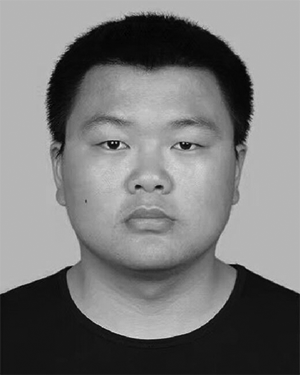 Guohang Yan合作论文数Shenzhen University7
 Wenqi Shao (邵文琪)合作论文数Shanghai AI Lab7
 Chao Xu (许超)合作论文数School of Intelligence Science and Technology, Peking University7
 Dahua Lin (林達華)合作论文数Department of Information Engineering, The Chinese University of Hong Kong;Shanghai Artificial Intelligence Laboratory7Erfei Cui合作论文数6
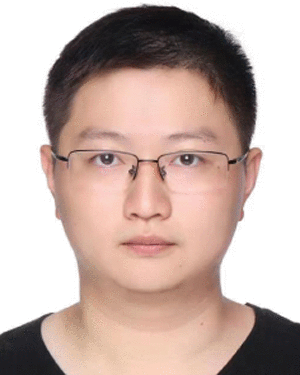 Hancheng Ye合作论文数6
 Song Mao合作论文数6
 Weiyun Wang合作论文数6Xizhou Zhu合作论文数Shanghai AI Laboratory;Tsinghua University6
 Junjun He (何军军)合作论文数Shanghai AI Laboratory6
 Nan Duan (段楠)合作论文数JD Future Academy, JD.COM;Vision and Multimodal Lab, JD.COM6Jianfei Guo合作论文数5
 Yukai Ma合作论文数Advanced Perception on Robotics and Intelligent Learning Lab, Institute of Cyber-Systems and Control, Zhejiang University;College of Control Science and Engineering, Zhejiang University5
 Limin Wang (王利民)合作论文数Multimedia Computing Group, State Key Laboratory for Novel Software Technology, Department of Computer Science and Technology, Nanjing University5
 Lewei Lu合作论文数SenseTime Research5
 Zhendong Niu (牛振东)合作论文数School of Computer Science and Technology, Beijing Institute of Technology5
 Yeqi Bai合作论文数ByteDanc5
 Kaipeng Zhang (张凯鹏)合作论文数Shanghai AI Laboratory5
 Hongsheng Li (李鴻升)合作论文数Department of Electronic Engineering, The Chinese University of Hong Kong;Multimedia Laboratory, The Chinese University of Hong Kong5
 Yi Wang (王毅)合作论文数Shanghai AI Laboratory5Lixin Gu合作论文数4




